

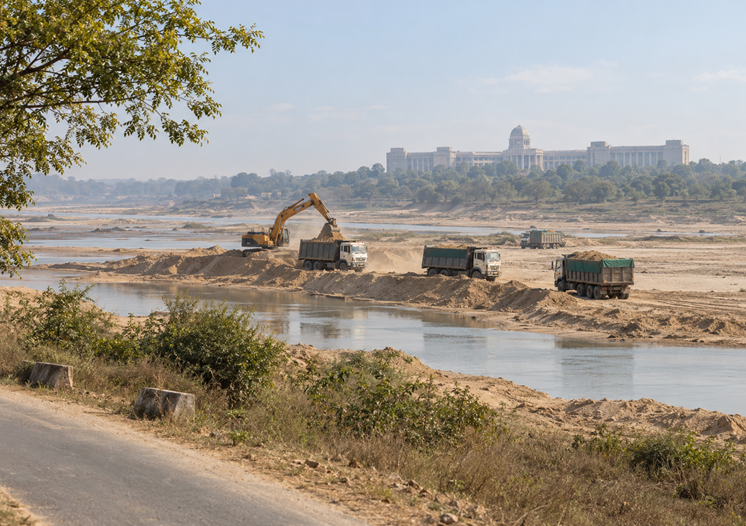



MoEF&CC has told the NGT that SEIAA Uttar Pradesh is the nodal authority for alleged environmental clearance violations in a Jhansi sand mining case involving Village Moti Katra.
NEW DELHI (India CSR): The Ministry of Environment, Forest and Climate Change (MoEF&CC) has informed the National Green Tribunal (NGT) that the State Environment Impact Assessment Authority (SEIAA), Uttar Pradesh, is the nodal authority to address alleged violations of environmental clearance conditions in a sand-mining matter from Jhansi district. The Ministry made the submission in its reply affidavit filed in Original Application No. 327 of 2026, Veer Singh vs Ministry of Environment, Forest and Climate Change and Others, before the NGT’s Principal Bench in New Delhi. The affidavit was verified at Lucknow on September 2, 2026 by Dinesh Runiwal, Scientist ‘F’, MoEF&CC Regional Office, Lucknow.
Case Concerns Sand Mining Lease in Moti Katra Village
According to the MoEF&CC affidavit, the original application alleges illegal sand mining and storage by project proponent Sanjeev Gupta, who was granted a sand-mining lease in Gata No. 1419, Phase-I, Village Moti Katra, Tehsil Garautha, District Jhansi, Uttar Pradesh. The application alleges that the mining and storage activities have resulted in dust pollution in and around the village area, environmental degradation, adverse effects on public health, and traffic-related issues near the highway. It further alleges that excessive and illegal sand mining has caused environmental damage and posed risks to villagers’ lives.

The Ministry stated these were allegations raised in the original application. It said that, except where specifically admitted, the contents of the application were denied to the extent they were inconsistent with the Ministry’s submissions in the affidavit.
***
Environmental Clearance Was Issued by Uttar Pradesh Authority
The affidavit states that the environmental clearance for the concerned project was granted by the SEIAA, Uttar Pradesh, on March 14, 2024. The allegations in the case relate to purported violation of conditions attached to that environmental clearance. MoEF&CC referred to the Environmental Impact Assessment Notification, 2006, issued through notification S.O. 1533(E) dated September 14, 2006. The notification mandates prior environmental clearance for projects and activities listed in its Schedule.
The affidavit says that prior environmental clearance is required for new projects listed in the Schedule, expansion and modernisation of existing scheduled projects or activities, and changes in product mix at existing manufacturing units covered under the Schedule.
EIA Framework Divides Projects Into Two Categories
As stated in the Ministry’s affidavit, projects are divided into Category ‘A’ and Category ‘B’ based on their potential environmental impact, including their likely impact on human health, natural resources and man-made resources. Category ‘A’ projects, including specified expansions, modernisation and product-mix changes, require prior environmental clearance from the Central Government through MoEF&CC. Such decisions are based on recommendations of the Expert Appraisal Committee constituted by the Central Government.
Category ‘B’ projects, however, require prior environmental clearance from the State or Union Territory Environment Impact Assessment Authority. The authority takes its decision on the recommendations of the State-level or Union Territory-level Expert Appraisal Committee.
***
SEIAA Has Powers to Act on EC Condition Violations
The Ministry referred to notifications S.O. 637(E) and S.O. 638(E), both dated February 28, 2014. According to the affidavit, the Central Government delegated powers under Section 5 of the Environment (Protection) Act, 1986, to the State and Union Territory Environment Impact Assessment Authorities in matters involving environmental clearances issued by them. The affidavit states that the delegated powers allow the authorities to issue show-cause notices to project proponents in cases involving alleged non-compliance or violation of environmental clearance conditions.
It further states that SEIAAs are authorised to issue directions to project proponents, including directions for suspension or revocation of environmental clearances where the circumstances require such action.
***
Regional Office Monitors Compliance With Clearance Conditions
MoEF&CC stated that environmental clearances granted by SEIAAs are monitored by the concerned regional offices of the Ministry. According to the affidavit, this monitoring is primarily aimed at checking compliance with the conditions attached to the environmental clearance issued by the respective SEIAA. In the present case, the Ministry has said the SEIAA, Uttar Pradesh, is the authority responsible for addressing the alleged violations or non-compliance relating to the environmental clearance issued at the state level.
The Ministry’s position is based on the fact that the environmental clearance referred to in the matter was issued by SEIAA, Uttar Pradesh, and that action on alleged violations of such clearance conditions lies with the authority that issued it.
***
MoEF&CC Letter Seeks Immediate Appropriate Action
After receiving notice in the NGT matter, MoEF&CC issued a letter to SEIAA, Uttar Pradesh, on September 1, 2026. The letter was issued by the Ministry’s I.A. Compliance and Monitoring Division under File No. IA-L-11011/101/2026-IA-I. In the letter, MoEF&CC noted that the environmental clearance for the project involved in the court matter had been granted by SEIAA, Uttar Pradesh. It stated that the Ministry had delegated authority to the respective SEIAAs to take action in cases of non-compliance or violation by industries concerning environmental clearances issued by them.
The Ministry requested SEIAA, Uttar Pradesh, to take “immediate appropriate action” in the matter and file an affidavit, while keeping MoEF&CC informed.
***
Regional Office Asked to Submit Inspection Report to SEIAA
A copy of the Ministry’s September 1 letter was also sent to the Deputy Director General of Forests (Central), MoEF&CC Regional Office, Lucknow. The communication states that the copy was sent for timely submission of an inspection report to SEIAA, Uttar Pradesh. The reply affidavit does not record the findings of any inspection, any action taken by SEIAA, Uttar Pradesh, or a decision on the allegations made in the original application. It places before the Tribunal the Ministry’s position on the division of responsibilities under the environmental-clearance framework.
MoEF&CC has requested the NGT to take its reply affidavit on record and pass such orders or directions as it considers appropriate in the facts and circumstances of the case. The Ministry has also sought liberty to make additional submissions during the proceedings if required.
Source: Reply affidavit filed by MoEF&CC in Original Application No. 327 of 2026, Veer Singh vs Ministry of Environment, Forest and Climate Change and Others, before the National Green Tribunal, Principal Bench, New Delhi; verified September 2, 2026.
© Copyright Disclaimer: All rights reserved. No part of this report may be reproduced, republished, distributed or transmitted in any form without prior written permission from India CSR®


