

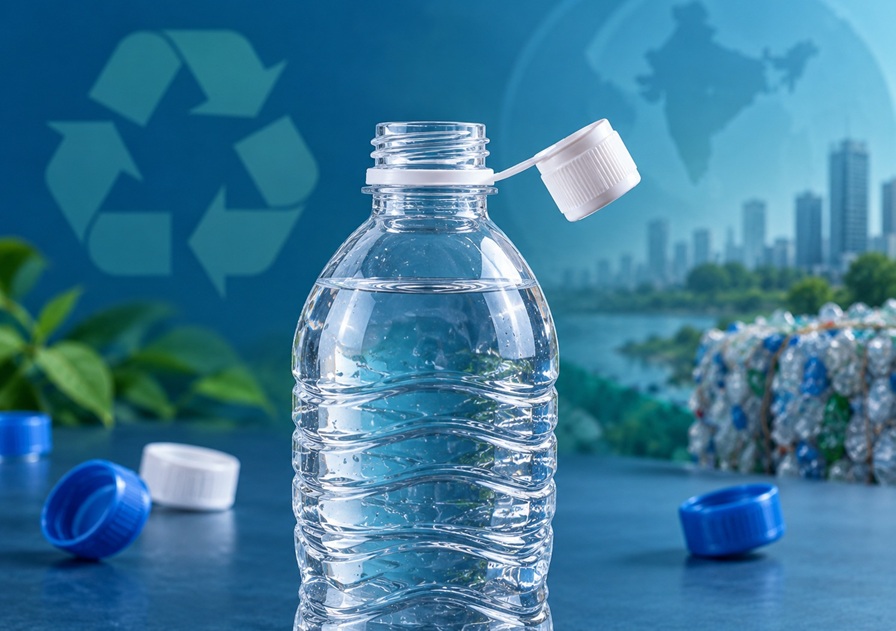


Tethered caps are closures designed to remain attached to bottles after opening, reducing the chance of a cap being separately discarded or lost in the waste stream.
NEW DELHI (India CSR): Hindustan Unilever Limited (HUL) has asked the National Green Tribunal (NGT) to dismiss an application against it in a case seeking directions to make tethered caps mandatory for plastic beverage bottles in India. In its reply filed in Original Application No. 137 of 2026, Aakash Ranison vs Central Pollution Control Board (CPCB) & Ors., HUL has argued that Indian law does not currently require tethered caps and that the relief sought by the applicant is essentially a policy and rule-making matter for the Central Government.
The company, which is Respondent No. 2 in the case, has also sought to be removed from the array of parties. Its reply was filed pursuant to the NGT’s February 20, 2026 order requiring respondents to submit their responses. The proceeding raises a wider question for India’s plastic-waste policy: whether design changes such as caps that remain attached to bottles should be made mandatory through regulation, or whether the existing Extended Producer Responsibility (EPR) system under the Plastic Waste Management Rules should remain the primary mechanism for managing plastic packaging waste.
HUL Challenges NGT Jurisdiction
HUL’s principal objection is that the application does not meet the legal threshold for the NGT to exercise jurisdiction under Section 14 of the National Green Tribunal Act, 2010. The company contends that the Tribunal can hear a matter only where there is a substantial environmental question arising from the implementation of a law listed in Schedule I of the Act. According to HUL, the application does not identify any specific breach of an environmental statute by the company or by any other respondent. Instead, it seeks a prospective direction for introducing a product-design requirement for tethered caps. HUL has described this as a matter of policy and delegated legislation rather than an alleged violation of an existing legal obligation.
The company has cited Supreme Court rulings, including Auroville Foundation v. Navroz Kersasp Mody & Ors., to contend that not every environmental grievance automatically amounts to a “substantial question relating to environment” for the purpose of NGT jurisdiction. HUL says a petitioner must specifically establish a violation of a statutory provision covered under Schedule I.
***
No Specific Allegation Against HUL
HUL has further submitted that the application does not disclose a distinct cause of action against the company. It said it has been joined with 16 other respondents of varied business profiles without any specific allegation concerning a particular HUL product, packaging format, EPR compliance shortfall, breach of consent conditions, inspection finding or environmental incident. The company argues that simply naming a respondent in a case does not establish the necessary link between that respondent’s conduct and the environmental harm alleged. It has therefore termed the application, as far as HUL is concerned, vague and legally unsustainable.
HUL’s filing states that its core business is not primarily the manufacture or marketing of packaged drinking water, carbonated beverages or still beverages that are central to the applicant’s demand for tethered-cap packaging. However, it has stated that wherever its products use plastic packaging covered by the Plastic Waste Management Rules, it is registered on the CPCB’s centralised EPR portal as a Brand Owner and importer.
The reply identifies HUL’s Brand Owner EPR Registration No. as BO-14-000-03-AAACH1004N24 and its importer EPR Registration No. as IM-31-000-01-AAACH1004N23. It has claimed compliance with applicable EPR targets for Category I rigid plastic packaging and other relevant categories for the applicable financial years.
***
MoEFCC Called Necessary Party
A major procedural argument raised by HUL concerns the absence of the Ministry of Environment, Forest and Climate Change (MoEFCC) from the case. The company has said the MoEFCC is a necessary party because the authority to frame, amend or notify rules and packaging standards under the Environment (Protection) Act, 1986 rests with the Central Government. HUL has argued that CPCB does not itself hold rule-making powers under the Environment (Protection) Act. While CPCB plays an advisory and recommendatory role in pollution-control matters, the power to introduce or amend a packaging-design standard lies with the Central Government through the MoEFCC, the company said.
The filing states that a direction to CPCB to introduce tethered caps, or a direction to amend the Plastic Waste Management Rules, cannot be effectively decided without the MoEFCC being made a party and given an opportunity to be heard. HUL has described the non-joinder of the ministry as a material defect affecting the maintainability of the case in its current form.
***
Existing EPR Framework Cited
At the centre of HUL’s defence is the existing EPR system under the Plastic Waste Management Rules, 2016, as amended. The company says plastic bottles and caps already fall under “Category I: Rigid Plastic Packaging” in Schedule II of the Rules, and are therefore subject to EPR obligations applicable to Producers, Importers and Brand Owners. Under this framework, obligated entities are required to ensure collection, recycling and environmentally sound processing of plastic packaging introduced into the market. The company has argued that the Rules deliberately follow an outcome-based approach instead of prescribing component-level design specifications for packaging.
HUL’s submission is that the absence of a separate, cap-specific requirement does not mean there is a regulatory vacuum. It says the current Rules already cover the plastic waste stream concerned by the application and impose EPR-linked responsibilities on companies. The reply also says the “Polluter Pays Principle” is operationalised through the EPR regime, under which producers, importers and brand owners bear responsibility for managing plastic packaging waste. It notes that environmental compensation may be payable under Schedule II of the Plastic Waste Management Rules in the event of non-compliance.
***
Tethered-Cap Policy Question
Tethered caps are closures designed to remain attached to bottles after opening, reducing the chance of a cap being separately discarded or lost in the waste stream. The applicant has sought directions relating to a mandatory tethered-cap requirement for plastic beverage bottles. HUL, however, has argued that ordering such a requirement would amount to asking the NGT to create a new product-design standard where no such binding standard currently exists in India. The company has submitted that courts and tribunals cannot direct the legislature or executive to enact or amend rules in a particular way. The reply refers to the Supreme Court’s observations in State of Himachal Pradesh & Ors. v. Yogendera Mohan Sengupta & Anr. and Narmada Bachao Andolan v. Union of India & Ors. on judicial limits in matters of public policy and executive rule-making.
HUL’s position is that decisions on whether India should adopt a new packaging-design requirement should be made through an appropriate regulatory process involving the competent authorities, technical experts, industry stakeholders and environmental considerations.
***
Evidence and Technical Assessment
The company has also questioned the evidentiary basis of the application. It has said the applicant did not place on record a study, survey, audit report or other technical material supporting claims concerning plastic-waste generation, PET bottle consumption, cap weight, or the relative presence of bottle caps in litter. The reply says that the environmental value of a specific packaging-design change cannot be assumed without examining Indian collection systems, recycling economics, material substitution, consumer use patterns and life-cycle impacts.
According to HUL, whether tethered caps would deliver a net environmental benefit under Indian conditions is a technical question requiring expert assessment. The company has relied on judicial principles that complex environmental and scientific matters should be examined by competent expert bodies rather than decided solely on the basis of general assertions.
***
EU Experience Questioned
The application reportedly relies on the European Union’s Single-Use Plastics framework as an international reference point. HUL has challenged the comparison, arguing that the EU’s tethered-cap requirement was preceded by a multi-year consultation and technical standardisation process. The company has said India does not currently have a comparable regulatory process or a supporting technical assessment before it. It has also argued that the European experience should not automatically be treated as proof that mandatory tethered caps are the most effective solution for India.
HUL has raised a material-use concern, stating that tethered-cap designs can require more plastic per unit than conventional detachable caps. A blanket requirement, it says, could potentially increase the amount of plastic placed in the market unless the environmental trade-offs are assessed through credible evidence. This argument places the debate beyond litter reduction alone. It raises questions about whether reduced cap leakage into the environment could be offset by increased material use, packaging redesign requirements, recycling implications and changes across the supply chain.
***
Industry Transition Costs
HUL has said that a mandatory transition to tethered-cap packaging could require substantial technical and financial changes across the packaging value chain. These could include redesigning bottle and closure geometry, modifying moulds, retooling filling lines, revalidating product integrity and consumer-safety performance, and making supply-chain adjustments.
The company has said the application does not place a technical or financial feasibility assessment on record, either for the sector as a whole or for individual respondents. At the same time, HUL has stated that it is willing, as a matter of general corporate policy, to participate in any lawful stakeholder consultation, technical study or regulatory process initiated by the MoEFCC or CPCB on plastic packaging design standards and sustainability.
That submission leaves room for the policy issue to be examined through an evidence-based process, even as HUL contests the present case and opposes a judicially imposed design mandate.
***
What HUL Has Asked NGT
In its prayer before the Tribunal, HUL has requested that the original application be dismissed insofar as it relates to the company. It has also asked the NGT to discharge it from the array of parties and decline the applicant’s prayers for coercive, penal or interim relief against HUL. The company has reserved the right to file a further paragraph-wise reply and submit additional documents if required during the proceedings.
The NGT’s eventual approach will be significant for companies, regulators, waste-management agencies and consumers. The case brings into focus the limits of EPR-based compliance, the role of product design in preventing litter, and the institutional route through which India may consider new plastic packaging standards. The reply represents HUL’s legal submissions and claims before the NGT. The Tribunal has not, on the basis of this filing alone, made any finding on the merits of the applicant’s demand or HUL’s objections.
Source: Reply filed by Hindustan Unilever Limited, Respondent No. 2, in O.A. No. 137 of 2026, Aakash Ranison vs CPCB & Ors., before the National Green Tribunal, Principal Bench, New Delhi, dated September 1, 2026.
© Copyright Disclaimer: All rights reserved. No part of this report may be reproduced, republished, distributed or transmitted in any form without prior written permission from India CSR®
Also Read in Hindi
प्लास्टिक बोतलों पर टेथर्ड कैप अनिवार्य करने की मांग वाले NGT मामले में HUL ने मांगी राहत – इंडिया सीएसआर



