


Data teams do not lose hours because a detector badge turned red. They lose hours because a report that is numerically correct still reads like a template: even paragraph lengths, identical hedge words, and transitions that could belong to any dashboard writeup in the company. When that draft hits a reviewer, the fight becomes theatrical. People argue about AI percentages instead of whether the confidence interval still means what the analyst intended. An Ai humanizer only earns a slot if it changes sentence movement without moving the numbers.
That is why I compare rewrite approaches the way I compare chart libraries. The acceptance test is rhythm plus fidelity, not a homepage strip of green logos. I care about the second fight: can a senior reader trust the paragraph after a two-minute scan of every figure reference?

The Decision Scene Inside a Reporting Week
Picture a Friday packet: three anomaly notes, one customer narrative, and a methods appendix pulled from a notebook. Half of it started as AI scaffolding because the analyst was drowning in pulls. The risk is not “sounding smart.” The risk is shipping prose that makes a correct table feel untrustworthy because the voice is too even.
In that scene, thesaurus tools fail in a predictable way. They replace “significant” with “notable” and leave the cadence untouched. Manual line edits fix a few openings and miss the middle of the paragraph. What I want is a structural pass that I can budget, then a human pass on every figure reference.
Scorecard: Rhythm, Fidelity, and Cost per Packet
I score options on three axes. Rhythm means uneven sentence length and fewer cloned transitions. Fidelity means numbers, variable names, and citations survive. Cost means I can predict monthly spend from packet volume without pretending unlimited polish is free.
| Option | Rhythm fix | Fidelity risk | Cost shape |
| Manual polish only | Strong when time exists | Lowest if the author stays awake | Analyst hours, not software |
| Synonym paraphraser | Weak on structure | Medium: soft nouns creep in | Cheap runs, expensive rework |
| Structural humanizer desk | Stronger sentence rebuild | Needs a number lock checklist | Subscription buckets by volume |
For reporting weeks, I rarely choose synonym tools as the main path. They create the illusion of progress while leaving the template music intact. Manual-only is ideal and often impossible by Thursday night. That leaves a structural desk as a middle path, provided the team still owns the final read.
Where a Structural Desk Fits the Packet
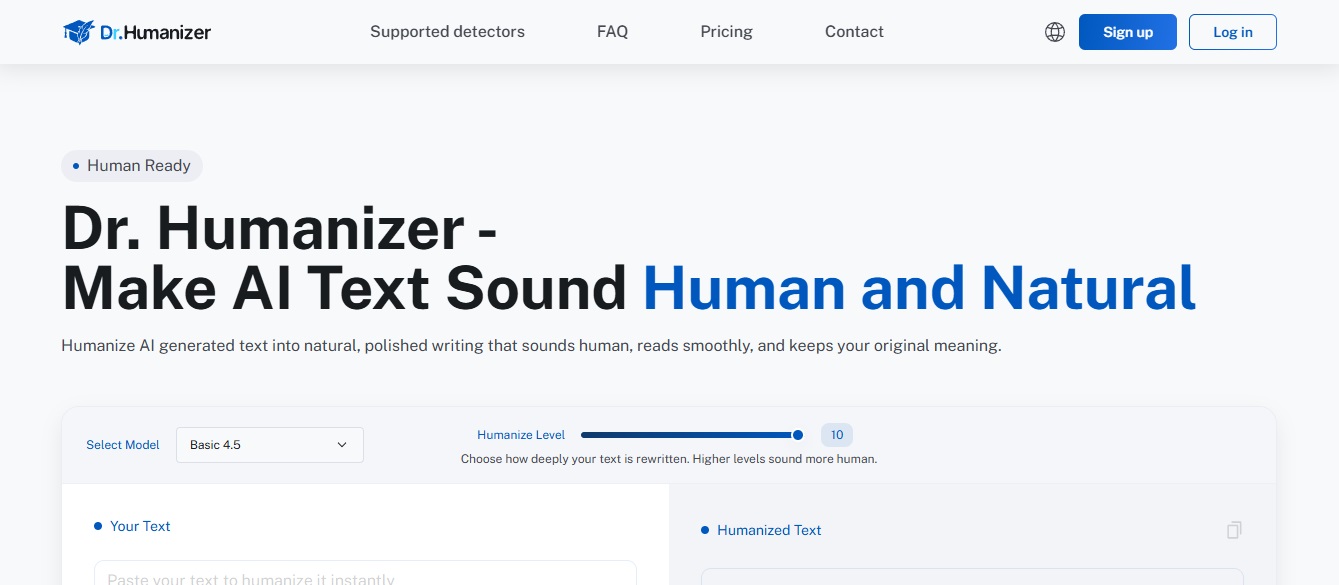
Dr. Humanizer markets deep structural rewriting trained on a large bank of human-written text, with an emphasis on keeping meaning while rebuilding flow. The workspace exposes Select Model and Humanize Level, then returns multiple rewrites so you can compare instead of gambling on one spin. For analyst prose, that compare step is the product.
I paste one section at a time—usually the narrative around a chart, not the raw table. I lock numbers in a side note first. Then I run a mid Humanize Level and read for two failure signals: a softened metric, or a new causal claim the data never supported. If either appears, the version is dead no matter how natural it sounds. Dr. Humanizer is only useful here when the team already knows what must not move.
How I Lock Numbers Before Any Rewrite
I copy every percentage, absolute count, date, and named segment into a plain checklist beside the draft. After rewrite, I tick the list line by line. This takes two minutes and prevents the most expensive class of error: a beautiful paragraph that quietly changed 12.4% into “about twelve percent.” If a version fails the checklist, I do not negotiate. I discard it and try another lane or a lighter Humanize Level.
Model Lanes Without Turning This Into a Brochure
Basic, Pro, and Standard are described as different rewriting approaches with different detection performance. Analysts should treat that as a routing choice. If a client forces a strict scanner, Standard is the lane to test first. If the pain is clumsy grammar while the argument is already solid, a meaning-preserving lane matters more than the loudest bypass claim. I still verify on our own samples. Published averages are not your packet.
Plan Math for Recurring Report Volume
This is the one place I look hard at pricing, because reporting is recurring. Monthly Lite at $9 covers 20,000 words with a 600-word input cap—fine for short anomaly notes, awkward for a long appendix. Plus at $15 and Max at $19 both allow up to 2,000 words per input, with 50,000 and 400,000 monthly words respectively. I route by packet size, not by which plan is labeled popular.
- Short weekly notes under a few hundred words: Lite can be enough if you stay inside the per-input cap.
- Multi-section Friday packets: Plus is usually the sane floor because 2,000-word inputs match real sections.
- Agency-style volume across many clients: Max is a volume decision, not a quality upgrade by itself.
Unused words do not roll over at cycle end, so I size the plan to the busy month, not the quiet one. Cancel-anytime billing helps if the reporting calendar collapses. None of that replaces the fidelity checklist.
Side-by-Side Judgment on a Dirty Metrics Paragraph
I keep a dirty metrics paragraph on purpose: correct numbers, AI-smooth transitions, and one hedge that must survive. Manual polish usually wins on fidelity and loses on speed. Synonym tools often nick the hedge. A structural pass through drhumanizer tends to break the template rhythm faster, which is the point, but only if I reject any version that moves a figure.
In my testing, the useful output is not “more human” as a vibe. The useful output is a paragraph a senior analyst will sign after a two-minute scan of every numeral. If the rewrite forces a longer audit than the original, it failed the scorecard even if a detector looks friendlier.
Failure Signals I Treat as Automatic Rejects
- Any change to a reported percentage, count, or date.
- A new cause-effect sentence that the notebook did not support.
- Citation or variable-name drift.
- Over-smoothing that erases a needed uncertainty hedge.
Pick the Plan That Matches Report Volume
Choose the structural desk when your real problem is template rhythm in otherwise honest analysis. Pair it with a number lock and a human final pass. Choose manual-only when the packet is small and the author still has attention. Avoid synonym-first workflows when the cadence is the defect. Dr. Humanizer belongs in the first bucket only when the fidelity checklist is non-negotiable.
This comparison is for analysts, analytics editors, and research ops leads who already own the findings. It is the wrong purchase if someone wants software to invent the insight. The scoreboard that matters is still the chart and the sentence that explains it—not a theater of detector logos.