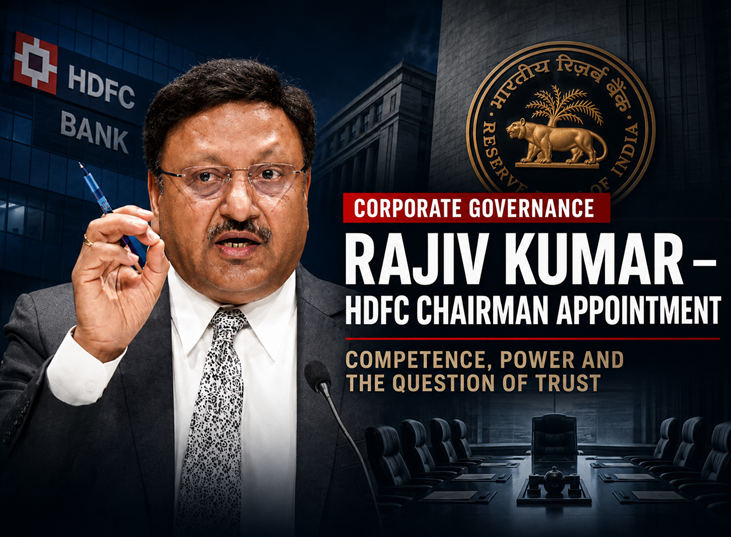



Rajiv Kumar’s appointment at HDFC Bank raises key questions on transparency, governance, RBI approval, shareholder trust and proximity to power.
For HDFC Bank, Rajiv Kumar’s appointment is not merely a boardroom decision; it is a test of transparency. The bank has disclosed the formal route: its Governance, Nomination and Remuneration Committee recommended his name, and the Board of Directors approved the appointment. Legally, this is the correct process. Yet the larger public question remains unanswered: who first brought his name to the table? Did the bank approach him? Did he express interest? Was an external search process followed? Was there any informal comfort from powerful circles? There is no public evidence that the Government formally proposed his name, and there is no evidence that Rajiv Kumar approached the bank himself. But in a systemically important bank, silence is not always neutral. Sometimes, silence becomes the space where doubt grows.
Process Needs Clarity
HDFC Bank does not need to disclose every private boardroom discussion, but it must explain the governance logic behind the choice. A chairman’s appointment in India’s largest private sector bank cannot be treated like a routine human resource matter. If the name came through an internal succession process, the criteria should be made clear. If search advisers were involved, the bank should indicate the broad process. If multiple candidates were considered, shareholders deserve to know why Rajiv Kumar was considered the best fit. Transparency does not mean violating confidentiality; it means showing that the decision was merit-based, independent and aligned with shareholder interest. Without such clarity, the appointment risks being read as a power-sensitive placement rather than a purely governance-driven decision.
Power Proximity Question
Rajiv Kumar’s long public career makes the appointment both strong and sensitive. He was Finance Secretary, Secretary in the Department of Financial Services and later Chief Election Commissioner of India. These roles placed him close to financial policy, banking regulation, public sector reform and constitutional administration. A former public official joining a bank board is not automatically a conflict of interest. In fact, such people often bring valuable regulatory and governance experience. But the concern becomes sharper when the individual has served in positions deeply connected with the financial system and state power. The real issue is not legal disqualification; HDFC Bank has confirmed that he is not debarred by SEBI or any other authority. The issue is perception. Does his appointment strengthen independence, or does it raise questions about proximity to power?

HDFC Bank does not need to disclose every private boardroom discussion, but it must explain the governance logic behind the choice.
Bank’s Urgent Challenge
HDFC Bank is passing through a demanding post-merger phase after the merger with HDFC Ltd. The bank must manage margin pressure, deposit competition, funding costs, loan growth moderation, leadership transition and investor expectations. It also needs to rebuild full market confidence after one of the most significant mergers in Indian banking history. In this context, Rajiv Kumar’s appointment may be viewed as urgent at the governance level, not the operational level. HDFC Bank already has professional management to run daily business. What it needs at the chairman level is regulatory confidence, institutional discipline and strategic patience. Rajiv Kumar’s experience in public sector bank clean-up, recapitalisation, consolidation and financial stability gives him a profile that fits these needs. His presence may reassure regulators and investors that the Board understands risk, credit discipline and systemic responsibility.
This is why the appointment must be explained carefully. If HDFC Bank needed Rajiv Kumar because of his regulatory understanding, crisis-era banking reform experience and ability to strengthen board oversight, the bank should say so clearly. The case for his appointment becomes stronger when linked to the bank’s real challenges: post-merger integration, margin protection, deposit mobilisation, credit discipline, investor confidence and regulatory trust. Without that explanation, the appointment may appear power-sensitive; with it, the appointment can be presented as a governance response to a complex banking moment.
Also Read: