

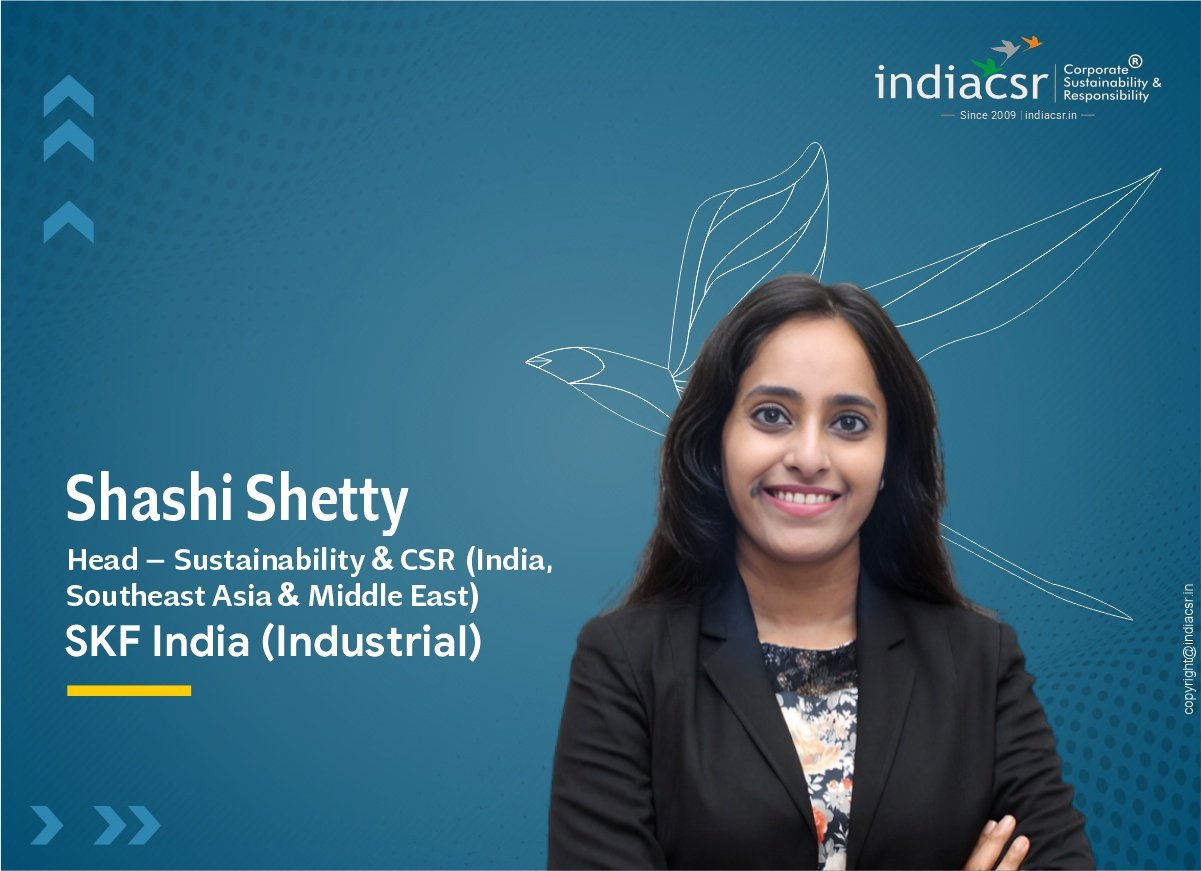



SKF India Industrial’s CSR leader Shashi Shetty explains how UDAAN goes beyond financial aid through mentorship, soft skills, career counselling and industry exposure.

India is moving rapidly towards becoming a global economic powerhouse. Yet, access to quality higher education remains uneven, especially for meritorious students from rural, low-income, and marginalized communities. Many talented girls and people with disabilities are forced to give up their dreams due to financial barriers, lack of exposure, and limited support systems.
SKF India Industrial is addressing this challenge through its UDAAN Scholarship Program. The initiative supports underprivileged girls and specially-abled students by providing financial assistance, mentorship, soft skills training, career counselling, and industry exposure.
In an exclusive interaction with Rusen Kumar of India CSR, Shashi Shetty, Head Sustainability & CSR, India, Southeast Asia & Middle East, SKF India Industrial, explains how UDAAN is not just a scholarship program but a long-term investment in India’s human capital and manufacturing future.
Edited excerpts of an interview:
Q. As India positions itself as a global economic powerhouse, access to quality higher education remains uneven. How do you see corporate India’s role in bridging this opportunity gap?
India stands at a pivotal moment in its economic journey, yet the gap in accessing quality higher education remains a significant hurdle. We have a massive demographic dividend, but it stays underutilized when meritorious students, particularly girls and persons with disabilities, are forced to abandon their dreams due to financial constraints.
At SKF India Industrial, we believe corporate India cannot simply be a consumer of talent; we must be its cultivators. While the government is making strides, the private sector possesses the agility and resources to intervene where the need is most acute. For the manufacturing sector, this is a strategic imperative. When a girl from a remote village in Marathwada becomes an engineer, it isn’t just a family success story. It is a fundamental contribution to the national industrial ecosystem.
We view CSR not as a charitable handout but as a purposeful investment in the human capital of our nation. Bridging this opportunity gap is essential for building a resilient, future-ready India.
Q. What inspired SKF India Industrial to conceptualize the Udaan Scholarship Program, and what need were you aiming to address at the time?
The UDAAN Scholarship Program was shaped by our close engagement with communities around our manufacturing plants in Pune, Bengaluru, and Haridwar. This helped us recognize the need to support students in regions like Marathwada, where access to continued education can create lasting impact not just of the students, but their families and future generations.
We saw brilliant girls with scores exceeding 80 percent in their secondary exams being pulled out of school because their families, earning less than ₹2.5 lakh annually, could not afford the costs of college, hostels, or even transport. At that moment, our leadership asked a single, defining question: what is the cost of not acting? We realized that an entire generation of potential doctors and engineers was being lost to circumstance.
Launched in 2017 with an initial cohort of 40 girls, the name UDAAN was chosen to signify flight. Our mission was never just about covering tuition fees. It was about providing the wings necessary for that untapped potential to soar above limiting circumstances.
Q. From an SKF Industrial leadership perspective, how does investing in underprivileged and specially-abled talent specifically strengthen the resilience of the Indian manufacturing ecosystem?
From a leadership standpoint, a narrow talent pipeline creates a brittle manufacturing ecosystem. We believe diversity includes a broad range of socioeconomic and geographic perspectives, along with different ability statuses. Students from rural backgrounds often possess a ground-level resilience and practical insight that cannot be taught in a classroom. Similarly, our scholars with disabilities bring incredible problem-solving instincts and perseverance to the table.
As India scales its manufacturing through initiatives like Make in India and PLI schemes, global competitiveness will ultimately be decided by the depth of our human capital. UDAAN allows us to widen the talent funnel and access the full spectrum of Indian talent. By investing in these often-overlooked individuals, we are building a robust pipeline of future engineers and quality professionals from untapped geographies, ensuring our industry remains resilient and inclusive in the long term.
Q. How do you structure the “soft skills” and “mentorship” components to ensure a student from a rural background feels at home in a high-pressure MNC environment?
While financial aid removes the barrier to entry, our soft skills and mentorship components are designed to remove the barrier to belonging. For a student from a rural background, transitioning into a high-pressure MNC environment can be overwhelming. We structure our curriculum to cover communication, digital literacy, and workplace etiquette, but our approach is to affirm their cultural identity rather than erase it.
A critical part of this initiative is our mentorship program, ‘YES’ (Youth Empowerment at SKF), which enables employability & entrepreneurship among youth from marginalized communities through vocational training. SKF professionals are paired with individual students to offer guidance. These relationships are not transactional. They require our managers and engineers to have genuine curiosity about the student’s world.
We also provide a safety net through periodic check-ins and peer networks to ensure no student feels they are navigating this transition alone. By focusing on personality development and mental health, we ensure our scholars feel at home in corporate spaces, allowing their technical talents to truly shine.
Q. Many scholarships stop at financial aid. How does Udaan go beyond funding to enable long-term success?
Many scholarship programs end with a cheque, but UDAAN is built on a holistic development model. Of course, the financial support is comprehensive, covering tuition, books, assistive devices for PWD scholars, and even mess charges, with values reaching up to ₹1.0 lakh per year.
However, we go further by integrating psychometric assessments and career counseling, which are vital for first-generation learners who lack professional networks. We also prioritize health and wellness, ensuring mental health support is readily available. Industry exposure is another major pillar, where students visit our manufacturing facilities to see real-world applications of their studies.
Our selection process is rigorous, involving home visits and interviews, because we are looking for long-term partners in success. The goal is for every graduate to walk away not just with a degree, but with the confidence, professional readiness, and network required to sustain a successful career.
Q. How do mentorship, soft skills training, and industry exposure influence the confidence and career trajectories of these students?
The most visible impact of UDAAN is the psychological transformation of the students. We often see a hesitant, soft-spoken student in their first year evolve into an authoritative, self-advocating professional by their final year. This shift is often triggered by direct industry exposure. When a girl from a rural district walks into our Pune facility and a senior engineer tells her that her skills belong there, it completely rewires her sense of what is possible.
These students are now entering fields like medicine, CA, and corporate management, often becoming the primary earners for their families. This creates a powerful ripple effect, as our alumni return to their communities as role models. This transformation is equally impactful for our own employees who serve as mentors, as it challenges their assumptions about where talent comes from. We are investing in a cycle of inspiration that extends far beyond the original scholarship.
Q. What have been some defining moments or stories from the program that reinforced its long-term value?
There are moments in this program that stay with you and reinforce our resolve. I remember a story from our MD’s visit where a father, a humble farmer, wept upon receiving his daughter’s scholarship letter. It was the first time someone had formally recognized that his daughter was worth such a significant investment. We also see this value in our Divyaang scholars, some of whom had dropped out of the education system simply because they could not afford hearing aids or mobility devices. Seeing them re-enter and excel with UDAAN support is incredibly moving.
These stories are not just anecdotes. They are the living proof of our concept. When a girl becomes the first engineer in her entire village, she becomes a beacon for every other child in that community. These individual stories of human impact across families and villages are what validate the program’s long-term value for us.
Q. From an organisational standpoint, how do you assess whether the program is creating meaningful and measurable impact?
We assess UDAAN with the same rigor we apply to our manufacturing quality standards. Our impact measurement is multi-layered, looking first at financial access and retention rates. We have supporting over 680 scholarships recipients across five states. Beyond the numbers, we track holistic development through psychometric scores and confidence indices over time. Long-term outcomes are the ultimate metric, so we monitor graduate employment rates and the change in income levels compared to the family’s original baseline. This year, we will continue to support the initiative, reflecting our commitment to scaling based on these results. We also employ third-party monitoring and mandatory impact assessments under CSR governance to ensure objectivity. By maintaining case-level records and rigorous reporting from our partners, we can confidently say that UDAAN is creating a measurable, generational shift in the communities we serve.
Q. What challenges have you encountered while implementing the program in rural or economically disadvantaged regions?
Implementing a program in deep rural or economically disadvantaged regions requires an honest and empathetic approach. One of the primary challenges is the opportunity cost for families. We often have to convince parents that keeping a daughter in education for four or five years is more valuable than her immediate contribution to farm labor or household income. There are also cultural barriers regarding mobility and hostel life. We address these through intensive community visits, home verifications, and family orientation programs that clearly communicate our safety frameworks.
For our PWD scholars, we deal with the added layer of social stigma and the need to build deep trust before they feel comfortable disclosing their needs. Each challenge we encounter actually makes the program design more robust. We view these hurdles not as roadblocks but as opportunities to refine our empathy and ensure our intervention is truly effective.
Q. Looking at the next five years, what is the roadmap for Udaan? Are there plans to expand into new geographies or perhaps integrate new vocational categories?
Our guiding principle for the future is that scale must follow proof. Over the next five years, we plan to deepen our penetration in our existing regions of Maharashtra and Karnataka. A major focus will be increasing our PWD inclusion. While 50 scholars per year is a great start, we don’t see that as a ceiling. We are also looking to create an end-to-end talent corridor, from primary education through to employment pathways. We want to enhance industry integration further through structured internships within the SKF ecosystem. Finally, we are building an active alumni network to serve as a support system for new scholars. Our core conviction remains that India’s manufacturing future will be built by people who were once told they didn’t belong. We consider it a privilege to prove that conviction right.
Copyright@India CSR®



