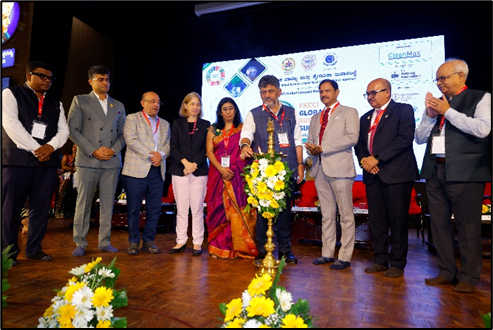



Held July 23, 2026 in Bengaluru, FKCCI’s third and first global CSR summit (“Sustainability at Scale”), with UN Global Compact Network India.
Leaders urged companies to prioritise government schools as CSR funding gaps remain
BENGALURU (India CSR® ): The FKCCI Global CSR and Sustainability Summit 2026 brought together government representatives, corporate leaders, international institutions, academics and social-sector organisations to discuss how Corporate Social Responsibility and Environmental, Social and Governance practices can deliver inclusive development at scale. The third edition of the summit, organised by the Federation of Karnataka Chambers of Commerce and Industry, was held under the theme “Sustainability at Scale” and marked its expansion into a global platform.
The summit highlighted a significant gap between Karnataka’s contribution to the national economy and the CSR funding received by the state. Research presented by the FKCCI Research Centre showed that Karnataka contributes nearly 9% of India’s GDP but receives around 6.5% of national CSR expenditure. The difference of approximately 2.4 percentage points indicates the need for greater CSR investment and more balanced distribution across districts and development sectors.
Karnataka Chief Minister D.K. Shivakumar, while inaugurating the summit, called upon companies to accord the highest priority to primary education under their CSR programmes. He urged businesses to adopt existing government schools, particularly in rural and peri-urban areas, and upgrade their infrastructure to standards comparable with central and CBSE schools. The Chief Minister said CSR should be regarded as a strategic investment in sustainable development rather than merely as charity or statutory expenditure.
The summit report said Karnataka records more than Rs. 10,000 crore in CSR funding annually. However, inadequate district-level disclosure makes it difficult to determine precisely where a substantial portion of these funds is being implemented. Karnataka recorded 2,328 CSR project entries during the reporting period, while the ten largest contributing companies accounted for nearly 27% of the total expenditure. Several aspirational districts, particularly in the Kalyana Karnataka region, remained under-represented.
The programme featured discussions on artificial intelligence for underserved communities, preventive healthcare, quality education, future-ready skilling and sustainable urban development. Leadership dialogues also examined women’s participation in science, technology, industry and education. Speakers underlined the need to connect CSR spending with measurable outcomes, stronger community participation and long-term institutional capacity.
Read More: Karnataka Chief Minister Urges Enterprises to direct CSR Spending Towards Primary Education
Uma Reddy, President of the Federation of Karnataka Chambers of Commerce and Industry (FKCCI), described the Global CSR and Sustainability Summit 2026 as an important platform for advancing responsible business practices. She said ESG considerations had moved from the margins to the mainstream, while CSR had evolved from traditional philanthropy into a strategic instrument for nation-building. She also expressed FKCCI’s commitment to supporting the Karnataka Government’s proposal for corporate adoption and infrastructure development of government schools.
Keerthan Kumar M., Chairman of the CSR Committee at FKCCI, highlighted the steady evolution of the summit from a Karnataka-focused initiative into a national and subsequently global platform. He said the summit was designed to bring businesses, policymakers, academic institutions, NGOs and sustainability practitioners together to exchange knowledge and build partnerships. He also highlighted FKCCI’s proposed ESG certification programme for MSMEs and its skilling initiatives, which have reportedly reached more than 50,000 students.
Professor Abhishek Ranjan, Advisor to the FKCCI CSR Committee, played a key role in shaping the knowledge and research agenda of the Global CSR and Sustainability Summit 2026. Presenting findings from the FKCCI Research Centre, he highlighted that Karnataka contributes nearly 9% of India’s GDP but receives only around 6.5% of the country’s CSR expenditure, indicating an estimated gap of 2.4 percentage points. He also drew attention to inadequate district-level reporting, concentration of expenditure in a limited number of sectors and comparatively low CSR investment in aspirational districts. Professor Ranjan called for a coordinated roadmap involving the Karnataka Government, companies, industry chambers, NGOs and civil society organisations to improve CSR allocation, transparency and measurable impact across the state.
FKCCI Vice President B.P. Shashidhar and Senior Vice President T. Sairam Prasad also participated in the summit proceedings. Prasad delivered the vote of thanks during the inaugural session and acknowledged the contributions of the Government of Karnataka, UN Global Compact Network India, international representatives, speakers, jury members, sponsors, partners, delegates, exhibitors and the FKCCI Secretariat. The leadership team reaffirmed FKCCI’s commitment to promoting accountable, measurable and inclusive CSR and sustainability practices.
Ratnesh, Executive Director of UN Global Compact Network India, called for ESG oversight to move from sustainability departments into corporate boardrooms. He also encouraged companies to help MSME suppliers adopt ESG practices, use disclosure frameworks as strategic management tools and establish shared learning platforms to replicate successful interventions.
The summit concluded with the Global CSR and Sustainability Excellence Awards 2026. A 20-member independent jury evaluated 127 applications submitted by companies, NGOs, MSMEs and educational institutions. Altogether, 45 organisations were recognised across 11 categories covering education, healthcare, women’s empowerment, climate action, waste management, water, rural development, livelihoods, sanitation and energy management.
Inaugural Session
• CM D.K. Shivakumar directed corporates to prioritize adopting rural government schools with CSR funds.
• Karnataka gets ~9% of India’s GDP but only ~6.5% of national CSR spend.
• CM released the MSME ESG Readiness Report.
• UN Resident Coordinator (video) linked India’s growth to global SDGs and Viksit Bharat 2047.
• Consul General of Israel, Orli Weitzman, spoke on water, agri-tech, and climate innovation.
Panels
AI for social good, preventive healthcare, education/skilling, and sustainable cities — with Google, Infosys, NIIF, Colgate-Palmolive, Mercedes-Benz R&D India, Promptier.ai, Samhita Social Ventures, Bangalore City University, ISBR Business School, Christ University, Suntec Business Solutions, Practical Action, and Maaathram Foundation.
Leadership Dialogues (Women Leaders)
Manasi Tata (Toyota Kirloskar), Aishwarya D.K.S. Hegde (National Education Foundation), Anandi Iyer (Fraunhofer India), Dr. Prabha Malikarjun (MP, Davanagere).
Awards
45 winners across 11 categories from 127 submissions, judged by a 20-member jury chaired by Prof. P.D. Jose (IIM Bangalore).
Sponsors and Partners
CleanMax (Platinum), Satsang Foundation (Diamond), Surya Institute, Sairam Institutions, Kindkart, and MSIL (Silver).
Knowledge Partner
India CSR®
Copyright Disclaimer: All rights reserved. No part of this report may be reproduced, republished or distributed without prior written permission from India CSR®.
Download Full Report
FKCCI CSR Summit Report 2026.pdf