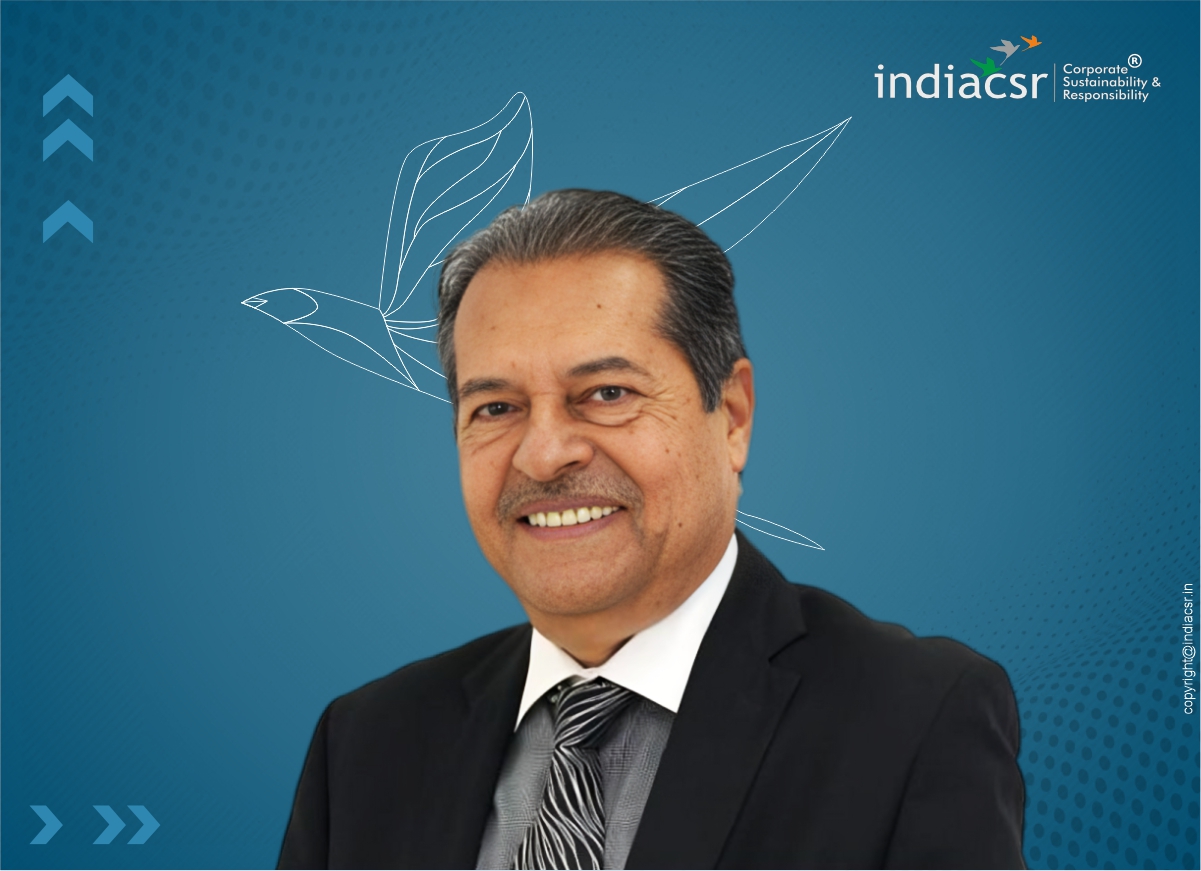


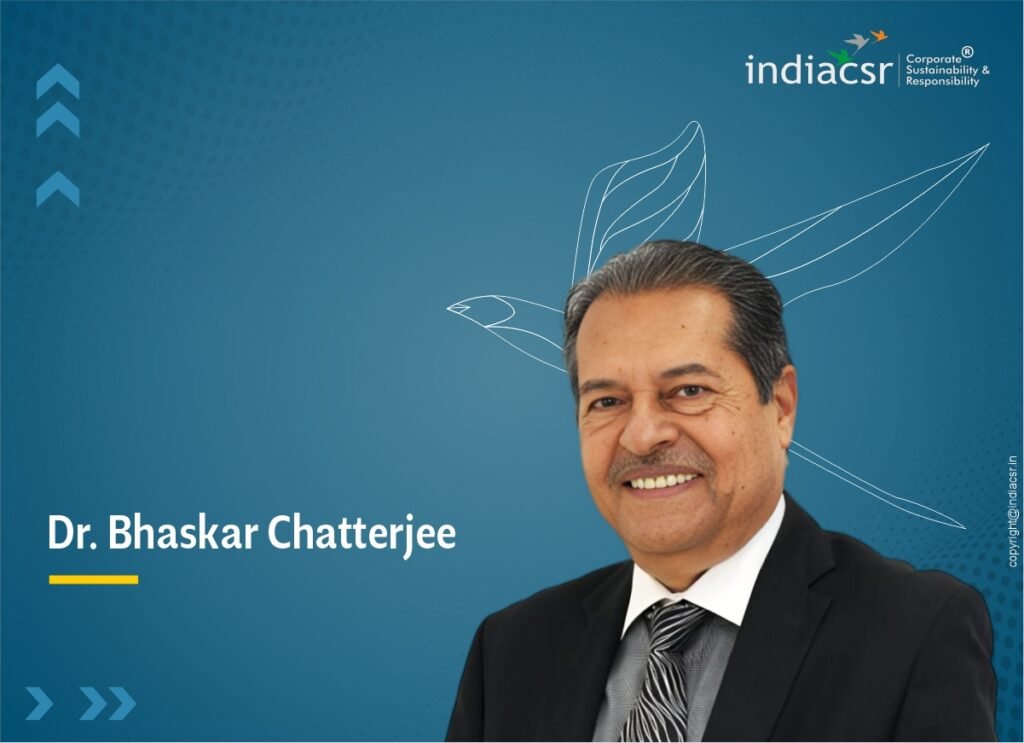
Dr. Bhaskar Chatterjee, widely known as the Father of CSR in India, played a central role in shaping India’s mandatory CSR framework. His contribution includes the 2010 CSR Guidelines for Public Sector Enterprises, Section 135 of the Companies Act, 2013, and the Chatterjee Model of CSR, which links corporate responsibility with national development, sustainability, ESG, and the SDGs.
Co-Author Suhana Agrawal
This article examines the historic contribution of Dr. Bhaskar Chatterjee to the evolution of Corporate Social Responsibility and sustainability governance in India. Widely recognised as the “Father of CSR in India,” Dr. Chatterjee played a decisive role in shaping the country’s CSR architecture through his work on the 2010 CSR Guidelines for Public Sector Enterprises and the inclusion of Section 135 in the Companies Act, 2013. His efforts helped make India the first country in the world to legally mandate CSR spending by eligible companies. The article also explores the Chatterjee Model of CSR, which positions corporate responsibility as a contribution to the national development agenda rather than merely a tool of corporate reputation or competitive advantage. It further highlights his role in connecting CSR with sustainability, ESG, transparency, accountability, and the United Nations Sustainable Development Goals. Through legislative vision, institutional leadership, academic engagement, and policy innovation, Dr. Chatterjee has created a lasting framework that continues to guide responsible business practice in India.
1. Introduction: The Man Who Gave India a CSR Law
In the history of modern corporate governance in India, few individuals have left as decisive an imprint as Dr. Bhaskar Chatterjee. A distinguished member of the Indian Administrative Service (IAS) since 1975, Dr. Chatterjee’s career has traversed the highest echelons of the Indian state, from the Planning Commission to the Department of Public Enterprises, before culminating in his role as the primary architect of India’s legally mandated CSR framework.
To speak of CSR in India today is, in a fundamental sense, to speak of the work of Dr. Bhaskar Chatterjee. He is widely and formally acclaimed as the ‘Father of CSR in India,’ a title that reflects not merely honorary recognition, but the substantive and irreversible legislative legacy he has left behind. Under his stewardship, India became the first country in the world to mandate corporate social responsibility expenditure through statute, a landmark that continues to define India’s approach to responsible business.
Here, we will discuss Dr. Chatterjee’s contributions across five key areas:
- his early career and policy context;
- the 2010 CSR Guidelines for Public Sector Enterprises;
- his central role in the enactment of Section 135 of the Companies Act 2013;
- the theoretical ‘Chatterjee Model’ of CSR; and
- his sustained contributions to sustainability, ESG, and the SDG agenda.
***
2. Formative Career and Policy Context
Dr. Bhaskar Chatterjee joined the Indian Administrative Service in 1975, embarking on a career that would span over three decades of distinguished public service. His postings and responsibilities across various levels of government gave him an intimate understanding of India’s developmental challenges, including poverty, inequality, rural underdevelopment, and the limited reach of the welfare state. This grounding in the lived realities of governance shaped his later conviction that corporate resources must be channelled systematically toward national social priorities.
Between 2008 and 2009, Dr. Chatterjee served as Principal Adviser in the Planning Commission, where he engaged deeply with the macro-economic architecture of the Indian economy. He was, notably, part of the core team responsible for shaping India’s policy response to the global financial crisis of 2009, an experience that reinforced his understanding of the interdependence between economic systems, corporate behaviour, and social outcomes.
His appointment as Secretary in the Department of Public Enterprises, Government of India, from November 2009 to September 2011, proved to be the crucible within which his most consequential contribution would be forged. It was in this role that he undertook the first comprehensive effort to institutionalise CSR within the Indian public sector.
3. The CSR Guidelines for Public Sector Enterprises (2010)
3.1 Background and Context
Before 2010, CSR practice in India was largely voluntary, fragmented, and driven by the philanthropic instincts of individual corporations or their promoters. There was no uniform framework, no governmental mandate, and no accountability mechanism. Public Sector Enterprises (PSEs), which commanded enormous financial resources and operated at the intersection of state power and market activity, were equally without direction on how to deploy their resources toward social objectives.
Dr. Chatterjee recognised this structural gap and worked to fill it with a comprehensive set of guidelines that would bring the PSE sector into a framework of structured, accountable, and policy-aligned CSR.
3.2 Framing and Significance of the 2010 Guidelines
In April 2010, Dr. Chatterjee was instrumental in framing and issuing the CSR Guidelines for Public Sector Enterprises, a landmark document in the history of business regulation in India. These guidelines were significant on multiple fronts.
First, they established a normative framework for what CSR ought to mean in the Indian context: not a mere act of charity or public relations management, but a structured contribution to national development priorities. Second, they introduced the concept of a dedicated CSR budget within PSEs, mandating that corporations set aside a proportion of their net profits for social and environmental activities. Third, they required PSEs to identify specific areas of focus such as education, health, rural development, and environmental sustainability, and align their CSR activities with these domains.
Perhaps most critically, the 2010 guidelines established principles of transparency and accountability. Companies were required to report on their CSR expenditures and outcomes, and to integrate these disclosures into their annual reports. This represented the beginning of a shift from informal philanthropy to structured corporate social investment.
The 2010 guidelines were, in retrospect, a rehearsal and a prototype. They demonstrated that CSR could be governed through state policy, that accountability could be built into corporate spending, and that enterprises could be directed toward the national agenda without sacrificing their fundamental commercial character.
***
4. Section 135 of the Companies Act 2013: Making CSR Mandatory
4.1 The Legislative Innovation
The most transformative contribution of Dr. Bhaskar Chatterjee to CSR in India, and arguably to global corporate governance, was his central role in the drafting and inclusion of Section 135 in the Companies Act 2013. With this provision, India became the first country in the world to make corporate social responsibility expenditure legally mandatory. This was not simply a domestic policy achievement; it represented a new paradigm in the relationship between the state, the corporation, and society.
4.2 The Architecture of Section 135
Section 135 of the Companies Act 2013 applies to companies meeting specified financial thresholds: a net worth of Rs 500 crore or more, a turnover of Rs 1,000 crore or more, or a net profit of Rs 5 crore or more during the preceding financial year. Such companies are required to spend at least 2 per cent of their average net profits from the preceding three years on CSR activities.
Crucially, the provision does not merely mandate spending; it mandates structured, reported, and accountable spending. Companies are required to constitute a CSR Committee at the Board level, develop a CSR policy, identify eligible CSR activities in accordance with Schedule VII of the Act, and disclose their CSR expenditure and activities in their annual report. Dr. Chatterjee also played a critical role in framing the rules and Schedule VII that gave the law operational meaning.
4.3 Elevating CSR to a Board-Level Exercise
One of the most consequential structural features introduced through Dr. Chatterjee’s framework was the elevation of CSR to a matter of Board-level accountability. By mandating a dedicated CSR Committee composed of Board members, the law signalled unambiguously that CSR was not a peripheral activity to be managed by the public relations or community affairs department, but a strategic corporate function that demanded the attention and oversight of the highest decision-making body in the firm.
Embedding CSR within corporate governance in this way was ahead of its time. It prefigured the contemporary ESG discourse, which similarly insists that environmental, social, and governance commitments must be embedded at the level of corporate strategy and Board accountability rather than delegated to lower operational tiers.
4.4 Impact and Scale
The impact of Section 135 has been substantial. It unlocked a significant stream of mandatory corporate funding for social and developmental purposes. Indian companies covered by the law collectively contribute enormous sums annually, and these figures have grown year on year since the law’s enactment, channelled toward education, healthcare, rural development, clean water, gender equality, and environmental sustainability.
India CSR Day, inaugurated in 2026 to mark 12 years of the CSR legislation, acknowledges April 1, 2014, the day Section 135 came into force, as a defining date in the nation’s developmental history. Dr. Chatterjee co-hosted this inaugural observance, a fitting recognition of the man whose labours made the law possible.
***
5. The Chatterjee Model of CSR
5.1 A Departure from Western Frameworks
Dr. Chatterjee’s intellectual contribution to CSR extends beyond legislation into theory. He is the progenitor of what scholars and practitioners have come to call the ‘Chatterjee Model’ of Corporate Social Responsibility, a distinctive framework that has been published in peer-reviewed academic literature, including the Journal of Sustainable Business (Springer Nature).
The Chatterjee Model represents a significant departure from the dominant Western frameworks of CSR. The Porter Model of strategic CSR, the Elkington Triple Bottom Line framework, and the Prahalad Base-of-the-Pyramid model all, in different ways, conceive of CSR as a business opportunity or a mechanism of competitive advantage. They frame corporate social responsibility primarily in relation to the corporation’s own interests: reputation, stakeholder goodwill, market differentiation, or access to underserved markets.
5.2 CSR as a Contribution to the National Agenda
The Chatterjee Model fundamentally reorients this perspective. Its core proposition is that in emerging economies, CSR should be designed and implemented as a contribution to the national development agenda. Rather than asking what CSR can do for the corporation, it asks what the corporation can do for the nation.
Dr. Chatterjee’s reasoning is rooted in the socio-economic realities of countries like India. Emerging economies face acute developmental deficits, including mass poverty, low levels of human capital, inadequate public infrastructure, and persistent inequalities across class, caste, gender, and region. The state, despite its best efforts, cannot adequately address these challenges alone. Corporations, which generate significant private surplus and operate across the economic geography of the nation, are uniquely positioned to supplement state capacity if their CSR activities are oriented toward national priorities.
The model thus proposes a tripartite partnership between the government (Sarkar), civil society organisations (Sanstha), and corporate actors as representatives of civil society (Samaj), as the ideal vehicle for impactful CSR in a developing-country setting.
5.3 Accountability and Transparency as Core Principles
A critical dimension of the Chatterjee Model is its insistence on accountability and transparency. Dr. Chatterjee consistently argued that CSR funds must not be dissipated in ad hoc or poorly monitored activities. Effective CSR, in his framework, requires robust partnerships with credible civil society organisations, rigorous monitoring of outcomes, and public disclosure of both expenditures and results. This insistence on accountability, which found direct expression in the reporting requirements of Section 135, distinguishes the Chatterjee Model from softer, more voluntarist approaches to corporate responsibility.
***
6. Sustainability, ESG, and the SDG Framework
6.1 Linking CSR to the Sustainable Development Goals
Dr. Chatterjee’s intellectual engagement with sustainability extends well beyond the narrower domain of CSR. He has been a consistent and influential voice for aligning corporate responsibility with the United Nations Sustainable Development Goals (SDGs). His contributions in this regard have helped to reframe CSR in India not merely as a matter of domestic corporate law, but as an instrument of global developmental commitment.
As a Council Member for India at the United Nations Global Compact, Dr. Chatterjee coordinates the integration of SDG commitments into corporate practice in India. He has worked with business schools and institutes that espouse the Principles for Responsible Management Education (PRME), seeking to embed sustainability into the formation of future business leaders from the earliest stages of their education.
6.2 Sustainable Futures: The Social Agenda
Dr. Chatterjee has also made a significant contribution to the sustainability discourse through his authorship of the book Sustainable Futures: Imperatives for Managing the Social Agenda. In this work, he articulates a vision of development that is simultaneously sustainable, humanistic, and inclusive. The book argues that governments, corporations, and civil society organisations must synergise their efforts in order to construct a genuinely new paradigm of development, one that moves beyond GDP-centred growth to embrace human flourishing in all its dimensions.
This argument anticipates and aligns with the growing global consensus, expressed through the ESG (Environmental, Social, and Governance) framework, that long-term corporate value cannot be divorced from environmental sustainability, social equity, and transparent governance. Dr. Chatterjee’s work thus bridges the legislative world of CSR compliance and the strategic world of sustainability management.
6.3 Standards Development and Institutional Leadership
Dr. Chatterjee has also contributed to the governance of CSR through his chairmanship of the National Sectional Committee on the Development of Standards at the Bureau of Indian Standards. In this capacity, he has worked to establish formal standards for CSR implementation, qualifications for extra-financial auditors, and anti-corruption frameworks, providing the technical infrastructure that allows the broader CSR ecosystem to function with rigour and consistency.
Additionally, as Adviser to the Federation of Indian Chambers of Commerce and Industry (FICCI) on CSR and Sustainability, and later as CEO of the Anil Agarwal Foundation, one of India’s prominent corporate foundations, he has translated policy vision into operational reality, demonstrating the practical feasibility of impact-driven corporate social investment.
***
7. Institutional Roles and Legacy Building
7.1 Director General and CEO, Indian Institute of Corporate Affairs
Among Dr. Chatterjee’s most consequential institutional roles was his tenure as Director General and CEO of the Indian Institute of Corporate Affairs (IICA) from 2013 to 2016. As head of the premier institution for corporate governance in India, Dr. Chatterjee spearheaded the National Foundation for Corporate Social Responsibility (NFCSR), which became the principal national platform for CSR research, dissemination, and capacity building.
Under his leadership, IICA became a hub for the intellectual and operational advancement of CSR in India, training corporate practitioners, engaging civil society organisations, disseminating research, and building the institutional ecosystem necessary to realise the ambitions of Section 135 in practice.
7.2 Academic Engagement and CIMP Appointment
Dr. Chatterjee’s commitment to the intergenerational transmission of knowledge is evident in his continuing academic engagements. He has spoken and lectured on CSR and sustainability at a vast number of national and international fora, and has authored extensive scholarship on social development, corporate responsibility, and human resources.
In 2026, he joined the Chandragupt Institute of Management Patna (CIMP) as Professor of Practice and Chief Advisor of the CSR and ESG Studies Foundation, an appointment that signals his ongoing commitment to building institutional capacity for responsible business education in India. His association with CIMP is expected to accelerate research, policy dialogue, and education on CSR and ESG in the country.
7.3 Recognition and Honours
Dr. Chatterjee’s contributions have been formally recognised at the highest levels. He was awarded the Lifetime Achievement Award at the India CSR Award ceremony in 2016, and again in 2018, for his outstanding contributions to the CSR space and for innovation in the practice of corporate responsibility. These recognitions reflect not merely professional accomplishment but a transformative personal mission: to make corporate resources work for India’s developmental imperatives.
***
8. Critical Assessment and Contemporary Relevance
Any assessment of Dr. Chatterjee’s contributions must also engage with the complexities and limitations of the framework he helped create. Critics of India’s mandatory CSR law have raised questions about the quality of CSR spending, including whether the 2 per cent mandate is fulfilled in spirit or merely in formal compliance; whether CSR activities are genuinely responsive to community needs or driven by corporate preference; and whether the reporting mechanisms are robust enough to ensure accountability without excessive bureaucratic burden.
Dr. Chatterjee himself has consistently acknowledged these limitations and has advocated for stronger partnerships with credible civil society organisations, better measurement of social outcomes, and deeper integration of CSR with the SDG framework. His evolving engagement with the ESG discourse reflects a recognition that the initial legislative achievement, however historic, is only the beginning of a longer journey toward genuinely responsible corporate practice.
The contemporary relevance of his work is perhaps most visible in the convergence between the CSR framework he built and the ESG framework now gaining traction in Indian regulatory practice. The Securities and Exchange Board of India’s Business Responsibility and Sustainability Reporting (BRSR) framework, introduced in 2021, and the National Guidelines on Responsible Business Conduct (NGRBC) both draw on the same foundational conviction that animates the Chatterjee Model: that corporate enterprises bear responsibilities to society and the environment that must be governed, reported, and held accountable.
***
9. Conclusion
Dr. Bhaskar Chatterjee occupies a place of singular importance in the history of corporate governance in India. His contribution is not the contribution of an activist or an advocate, but of a statesman who translated a moral vision of corporate responsibility into durable legal architecture, institutional infrastructure, and theoretical frameworks that have shaped practice at scale.
Through the CSR Guidelines for Public Sector Enterprises in 2010, the drafting of Section 135 of the Companies Act 2013, the formulation of the Chatterjee Model, and his sustained engagement with sustainability, the SDGs, and ESG governance, he has built a legacy that extends far beyond any single institution or policy initiative. India’s status as the first country in the world to mandate CSR by law, a status that has attracted global attention and study, is in substantial part his achievement.
In a period of growing global urgency around climate change, inequality, and the governance of large corporations, the central question that has driven Dr. Chatterjee’s career, namely how corporate power can be made to serve the common good, has never been more relevant. His life’s work stands as a sustained, serious, and consequential answer to that question in the Indian context.
Key References and Sources
- Chatterjee, B. (2017). CSR should contribute to the national agenda in emerging economies: The Chatterjee Model. Journal of Sustainable Business, Springer Nature.
- Chatterjee, B. Sustainable Futures: Imperatives for Managing the Social Agenda. IILM / IICA Publications.
- Ministry of Corporate Affairs, Government of India. (2013). Companies Act, 2013: Section 135 and Schedule VII. New Delhi: MCA.
- Department of Public Enterprises, Government of India. (2010). Guidelines on Corporate Social Responsibility for Central Public Sector Enterprises. New Delhi: DPE.
- India CSR Network. (2016, 2018). Lifetime Achievement Award Presentations. New Delhi: India CSR.
- Bureau of Indian Standards. (2022). Profile of Dr. Bhaskar Chatterjee, Chairman, MSD 10. BIS: New Delhi.
- Sustainable Advancements. (2024). Dr. Bhaskar Chatterjee: Profile. Retrieved from www.sustainableadvancements.com.
- India CSR. (2026). India to Observe India CSR Day on April 1: Marking 12 Years of CSR Legislation.
(Co-author: Suhana Agrawal)
Copyright@IndiaCSR