




In October 2025, we committed to supporting the career journeys of 2,000 girls through the Daughter’s Day Futures Fund.
Not through a campaign brief or a board resolution. I picked up the number, called seven NGO partners across the country, and said: we are funding these girls, one by one, until every one of them has a career roadmap, a counsellor, and a job. We called it the Daughter’s Day Futures Fund. It felt, at the time, like the most direct form of CSR I could imagine. No intermediaries, no dilution, no vague impact language. Every contribution was linked to a clearly defined beneficiary and a measurable outcome.

By April 2026, all 2,000 girls had been funded. Every cohort that ran to completion did so with a zero percent dropout rate. In 2025 alone, corporate partners stood behind complete cohorts of these girls, tracked individually, with full completion. On paper, this was working exactly as designed.
Then a message arrived on WhatsApp. A wedding card, gold bordered, with a photograph of a girl I had spent an afternoon with three and a half months earlier during ground selection in Bhuj. I remembered helping her with a pair of quadratic equations. I remembered arguing with her about a cricket match. She had made the cut for the Fund. Her family had not waited for the Fund to make the cut for her.
Nobody filed a complaint. Nobody could have stopped it in time even if they had. And that is the part that forced a reckoning I had been avoiding: we had built a fund that could rescue a girl once she was inside our pipeline, but we had built nothing that reached the thousands of girls who were never going to make it into that pipeline at all, because the decision about their future gets made long before any NGO, counsellor, or fund shows up at their door.
The instinct, and why it was wrong
The instinct in CSR, mine included, is to fund the version of the problem you can see and measure. A girl. A cohort. A completion rate. It is legible, it is reportable, and it photographs well in an annual impact deck. I do not think that instinct is dishonest. I think it is incomplete.
What the Fund’s own success revealed was a ceiling built into its design. Every girl we saved was a girl someone had already flagged, already assessed, already brought to us by a partner with the reach to find her in time. The girls we lost were the ones sitting one village over, where no one had yet arrived, where no counsellor was scheduled to visit, where the decision about her marriage would be made at a kitchen table we would never see until it was already done.
You cannot fund your way past a systemic gap by funding individuals faster. You have to fund the system that decides, at scale, whether a girl is ever found in time.
Why this stopped being a CSR question
Here is the number that changed how I think about this. India is expected to remain one of the world’s youngest and most populous nations for decades to come, and the median age of that population is still in its twenties. Whatever this decade does with its daughters, the country lives with the result for the next forty years, not the next annual report cycle.
That is a different category of problem than a single fund cycle, and increasingly, it is also a documentation question. CSR spend is under more scrutiny than it was even three years ago. Boards and compliance teams are asking not just what impact a rupee produced, but whether that impact is tracked to a unit, reportable against a defined standard, and defensible five years later regardless of which fund, cohort, or partner relationship was active at the time it was spent.
That is the question the Fund’s design could not answer on its own, not because the model of reaching a girl through a trusted partner is wrong, it plainly works, but because a fund built around 2,000 named adoptions ends when the adoptions end. The question I kept returning to was whether the same rigour could be built into something that outlasts any single fund cycle.
What we rebuilt
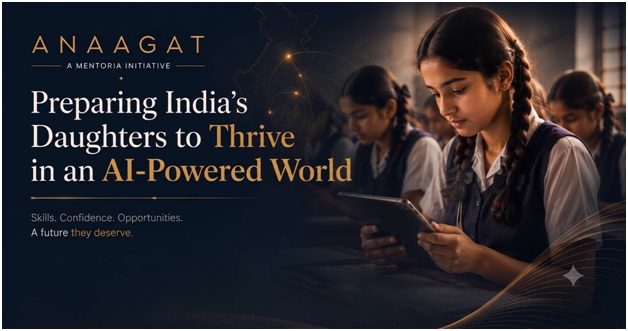
Anaagat keeps the part of the Fund that worked: direct, trackable, high completion career guidance for the girl herself, delivered through a psychometric assessment, one to one counselling, and Arya, our AI career agent, staying with her until she is employed. But it adds two pieces the Fund never had, because the Fund was never designed to reach past the girls already inside its pipeline.
The first is teachers. A single government school teacher already stands in front of fifty children every year, year after year. Train that teacher once as an AI curriculum mentor, and the reach compounds every year she stays in service, without needing a new partner relationship or a new cohort of donors for every new set of girls. This is not outreach. It is a multiplier built into infrastructure that already exists in every district in the country.
The second is permanence: AI learning labs built inside trusted partner institutions so that the intervention continues long after a funding cycle ends. A rescued girl is a result. A functioning learning ecosystem is a lasting capability.
The country needs both, but only one of them survives past the fund that paid for it.
Neither of these existed in the Fund. Both exist because the Fund’s design could not answer the question the girl in Bhuj forced us to ask: what happens to the girl nobody personally adopted, and what happens to the ten thousand girls behind her that no single fund, however well intentioned, was ever going to reach one adoption at a time.
The stakes, stated plainly
I do not think most companies doing CSR are being cynical. I think most of us default to funding the visible unit of the problem, the school, the scholarship, the cohort, because it is the version we can put a number against by the end of the quarter. That number is real. It is also not the same as fixing the thing that produced the problem in the first place.
The test I now apply to every decision at Mentoria, CSR or otherwise, is simple: does this fund a girl, or does this fund the system that decides how many girls like her get found in time. The first is generous. The second is the only version that scales past any single founder’s attention, any single fund’s donor cycle, or any single partner’s reach.
Mentoria has guided more than 3.75 lakh students since 2015. That scale did not come from funding individuals faster. It came from building a model that runs whether or not anyone is watching a particular case in real time. What India’s next decade needs is not a shortage of committed partners, there are many doing serious work in this space today, but infrastructure built to the deployment and reporting standard that CSR compliance will keep raising the bar on. Anaagat represents our belief that India’s next decade of CSR must move beyond funding individual outcomes to building systems that create opportunity at scale. Because lasting impact is not measured by how many lives we touch once, but by how many futures we transform consistently.


