

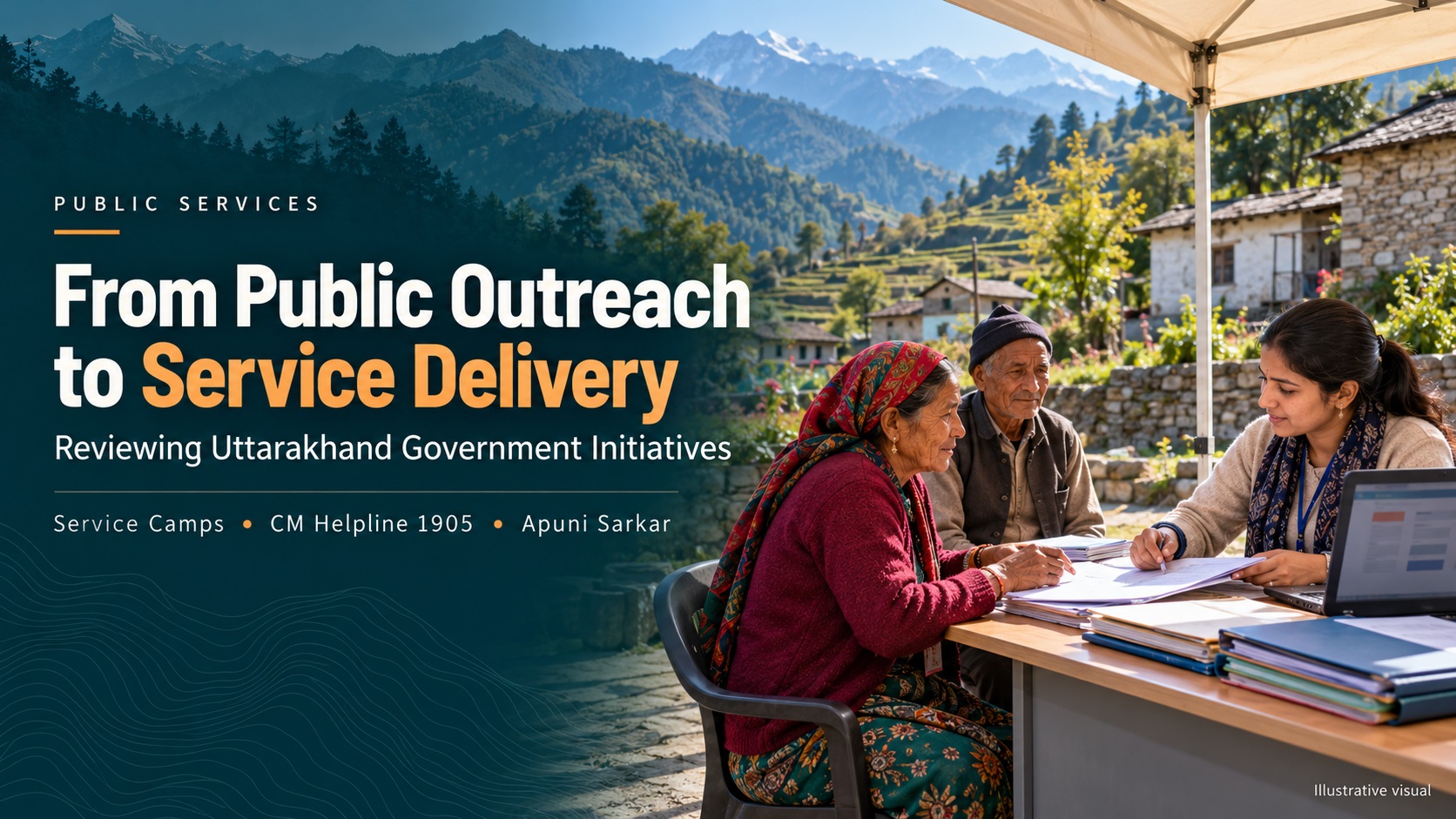


Public outreach becomes meaningful only when it results in a completed service, a resolved complaint or a benefit reaching an eligible citizen. This distinction is particularly important in Uttarakhand, where mountainous terrain, scattered settlements and long travel distances can make routine interaction with government departments difficult.
Several Dhami government initiatives have attempted to reduce this gap by combining local service camps with digital grievance and application-tracking systems. The most visible examples include Jan Jan Ki Sarkar, Jan Jan Ke Dwar, CM Helpline 1905 and the Apuni Sarkar platform.
Together, these mechanisms represent a shift from office-centred administration towards a model in which services are delivered through physical outreach and digital access. Their long-term credibility, however, will depend on whether participation and complaint numbers translate into measurable outcomes.
Taking Government Departments Closer to Citizens
The Jan Jan Ki Sarkar, Jan Jan Ke Dwar campaign was designed to take government departments and public services closer to people through local multipurpose camps.
These government service camps can help residents access information about welfare schemes, submit applications, obtain certificates and raise concerns related to pensions, roads, healthcare, revenue records, electricity, employment and other public services.
The model is especially relevant for senior citizens, people with disabilities and residents of remote villages. A task that requires multiple visits to a block or district office can involve considerable travel time, expense and loss of daily income.
According to an official update from Uttarakhand’s Department of Information and Public Relations, 681 camps were organised during a 45-day phase of the campaign. The government reported direct participation from 5,33,452 citizens and the prompt resolution of approximately 33,000 public grievances.
These figures demonstrate the scale of the outreach. They also create an opportunity to evaluate the campaign beyond attendance.
Measuring Delivery Beyond Camp Participation
A large number of participants indicates public reach, but it does not automatically establish that every application or complaint reached a final resolution.
For a clearer assessment of Uttarakhand public services, future reporting should distinguish between:
- Citizens attending a camp
- Applications submitted
- Certificates or benefits delivered
- Complaints resolved at the camp
- Complaints transferred to another department
- Cases pending after 15, 30 or 60 days
- Complaints reopened by citizens
- Cases closed without the citizen accepting the resolution
This distinction would make the programme’s performance easier to understand. It would also help identify whether certain services are being delivered consistently across districts or whether residents in remote areas continue to face longer delays.
District-wise reporting would be particularly valuable. The difficulties faced by a resident of Dehradun may be very different from those experienced in Chamoli, Pithoragarh or Uttarkashi.
Connecting Camps With CM Helpline 1905
A government camp may be the starting point of a complaint, but many issues cannot be resolved immediately. Land disputes, road repairs, departmental payments and infrastructure complaints may require investigation or coordination between several offices.
CM Helpline 1905 provides a digital framework for such follow-up. Citizens can register complaints by calling 1905, using the web portal or accessing the mobile application.
The official portal allows users to track complaints through their registered mobile number or email address, view forwarding and action details, check settlement reports, submit reminders and provide feedback after resolution. It also provides for higher-level review and reopening of a complaint where required.
This makes CM Helpline 1905 an important part of Uttarakhand grievance redressal. If complaints received during local camps are linked with the helpline, citizens can continue tracking their cases after the camp has ended.
The system would become more accountable if every unresolved camp complaint automatically received a reference number and appeared in the citizen’s digital grievance record.
Apuni Sarkar and Digital Service Access
Physical camps remain important, but they cannot be organised continuously in every location. Digital platforms are therefore necessary for routine service delivery.
The Apuni Sarkar portal allows citizens to access public services online, check application status, download certificates and verify issued documents.
A connected system could allow an application submitted at a camp to appear automatically on Apuni Sarkar. The applicant could then check its progress without repeatedly contacting local officials.
This combination of assisted physical access and digital tracking is particularly useful in Uttarakhand. Residents who are comfortable with online services can apply directly, while those who need assistance can receive support at local camps or Common Service Centres.
Building Accountability Into Public Outreach
Chief Minister Pushkar Singh Dhami has positioned doorstep governance as part of a broader public-service delivery approach. The strongest evidence of its success will come from transparent and independently understandable performance data.
A public dashboard for Dhami government initiatives could show:
- Camps organised in each district
- Department-wise applications received
- Services delivered on the same day
- Complaints forwarded for further action
- Average grievance-resolution time
- Cases pending beyond the prescribed timeline
- Citizen feedback and reopened complaints
- Frequently reported service gaps
- Action taken against repeated departmental delays
The dashboard should also clarify what “resolved” means. A complaint should not be considered settled merely because it was forwarded or a standard response was issued. Closure should ideally reflect completion of the required action or acceptance of the response by the complainant.
What Should Come Next?
The existing model provides a useful foundation: local camps improve access, CM Helpline 1905 creates a trackable grievance route and Apuni Sarkar enables digital service delivery.
The next phase should focus on integrating these systems. Every application or grievance -whether received at a camp, over the telephone or through a portal – should be connected to a common tracking framework.
Regular publication of district-level outcomes would help the government identify administrative bottlenecks and allocate staff where delays are highest. It would also allow citizens to judge public-service performance using evidence rather than announcements alone.
From Outreach to Measurable Governance
Jan Jan Ki Sarkar, Jan Jan Ke Dwar has demonstrated that there is significant demand for government services closer to local communities. The reported participation across hundreds of camps shows the potential of doorstep administration in a geographically challenging state.
The more important test is what happens after a citizen leaves the camp. An accountable system must ensure that applications are tracked, complaints remain visible until final action and residents receive clear updates.
By connecting government service camps with CM Helpline 1905, Apuni Sarkar and a public performance dashboard, Uttarakhand can turn large-scale outreach into a measurable service-delivery system. That would offer a stronger and more credible assessment of governance than participation figures or promotional claims alone.



