


• India CSR Awards 2026
  • India CSR Leadership Summit
  • Guest Posts
Tuesday, July 14, 2026
India CSR
  • Home
  • Corporate Social Responsibility
    • Art & Culture
    • CSR Leaders
    • Child Rights
    • Culture
    • Education
    • Gender Equality
    • Around the World
    • Skill Development
    • Safety
    • Covid-19
    • Safe Food For All
  • Sustainability
    • Sustainability Dialogues
    • Sustainability Knowledge Series
    • Plastics
    • Sustainable Development Goals
    • ESG
    • Circular Economy
    • BRSR
  • Corporate Governance
    • Diversity & Inclusion
  • Interviews
  • SDGs
    • No Poverty
    • Zero Hunger
    • Good Health & Well-Being
    • Quality Education
    • Gender Equality
    • Clean Water & Sanitation – SDG 6
    • Affordable & Clean Energy
    • Decent Work & Economic Growth
    • Industry, Innovation & Infrastructure
    • Reduced Inequalities
    • Sustainable Cities & Communities
    • Responsible Consumption & Production
    • Climate Action
    • Life Below Water
    • Life on Land
    • Peace, Justice & Strong Institutions
    • Partnerships for the Goals
  • Articles
  • Events
  • हिंदी
  • More
    • Business
    • Finance
    • Environment
    • Economy
    • Health
    • Around the World
    • Social Sector Leaders
    • Social Entrepreneurship
    • Trending News
      • Important Days
        • Festivals
      • Great People
      • Product Review
      • International
      • Sports
      • Entertainment
    • Case Studies
    • Philanthropy
    • Biography
    • Technology
    • Lifestyle
    • Sports
    • Gaming
    • Knowledge
    • Home Improvement
    • Words Power
    • Chief Ministers
No Result
View All Result
  • Home
  • Corporate Social Responsibility
    • Art & Culture
    • CSR Leaders
    • Child Rights
    • Culture
    • Education
    • Gender Equality
    • Around the World
    • Skill Development
    • Safety
    • Covid-19
    • Safe Food For All
  • Sustainability
    • Sustainability Dialogues
    • Sustainability Knowledge Series
    • Plastics
    • Sustainable Development Goals
    • ESG
    • Circular Economy
    • BRSR
  • Corporate Governance
    • Diversity & Inclusion
  • Interviews
  • SDGs
    • No Poverty
    • Zero Hunger
    • Good Health & Well-Being
    • Quality Education
    • Gender Equality
    • Clean Water & Sanitation – SDG 6
    • Affordable & Clean Energy
    • Decent Work & Economic Growth
    • Industry, Innovation & Infrastructure
    • Reduced Inequalities
    • Sustainable Cities & Communities
    • Responsible Consumption & Production
    • Climate Action
    • Life Below Water
    • Life on Land
    • Peace, Justice & Strong Institutions
    • Partnerships for the Goals
  • Articles
  • Events
  • हिंदी
  • More
    • Business
    • Finance
    • Environment
    • Economy
    • Health
    • Around the World
    • Social Sector Leaders
    • Social Entrepreneurship
    • Trending News
      • Important Days
        • Festivals
      • Great People
      • Product Review
      • International
      • Sports
      • Entertainment
    • Case Studies
    • Philanthropy
    • Biography
    • Technology
    • Lifestyle
    • Sports
    • Gaming
    • Knowledge
    • Home Improvement
    • Words Power
    • Chief Ministers
No Result
View All Result
India CSR
No Result
View All Result
Home Sustainability

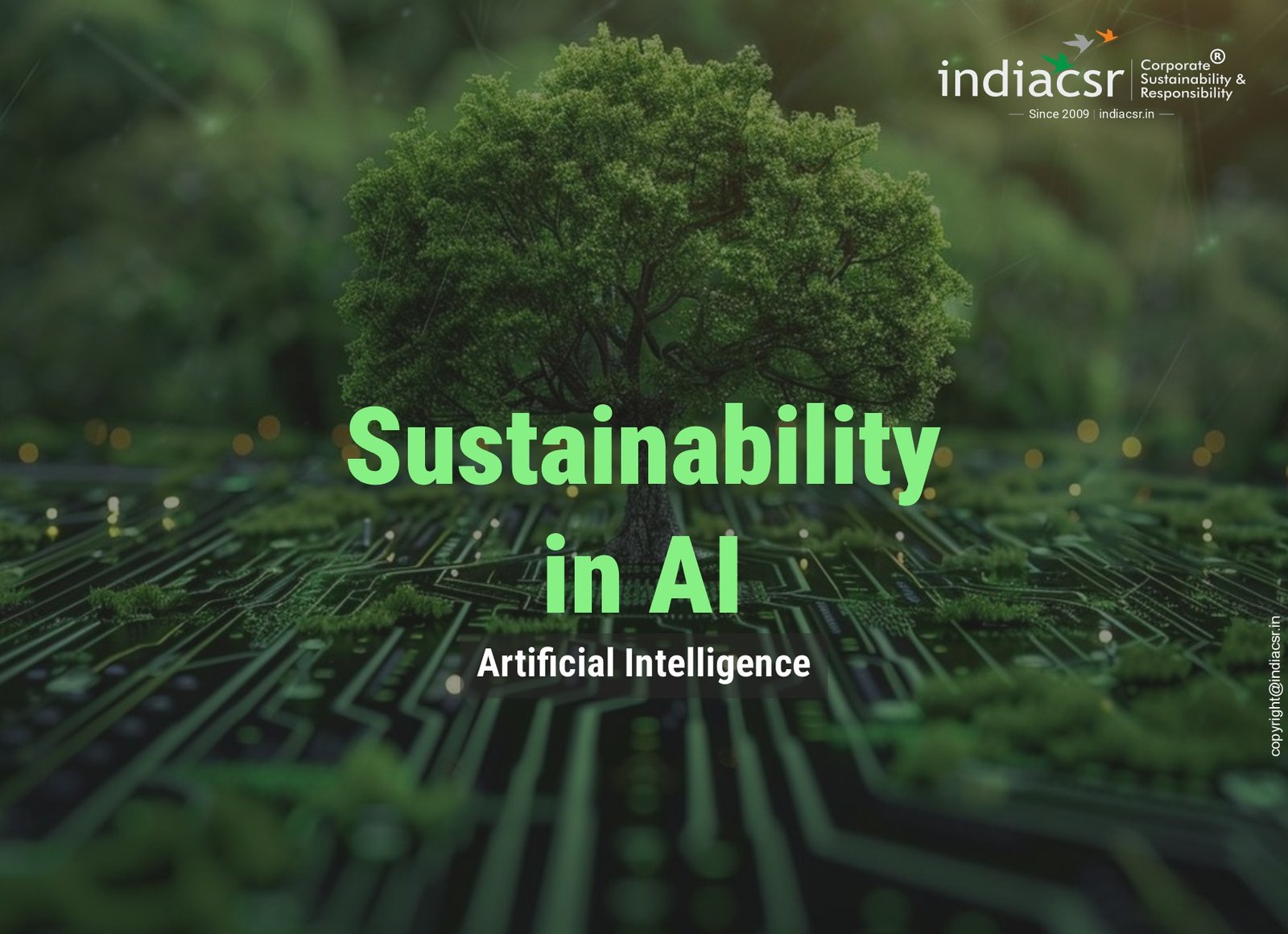
Sustainability in AI: Building an Intelligent and Responsible Future

Beyond energy savings, sustainable AI means fairness, transparency, and accountability. Learn why responsible design and ethical algorithms matter for humanity’s future.

India CSR by India CSR
November 6, 2025
in Sustainability
Reading Time: 6 mins read
India CSR
Share Share Share Share
WhatsApp icon
WhatsApp — Join Us
Instant updates & community
Google News icon
Google News — Follow Us
Get our articles in Google News feed

Explore how sustainable AI merges technology with ethics and ecology to create an intelligent, responsible, and energy-efficient future.

Artificial Intelligence (AI) is transforming how humans live, work, and interact with the world. From automating industries to diagnosing diseases, AI is the foundation of a new digital civilization. Yet, as its power grows, so does its environmental and ethical footprint. Sustainable AI is not just about innovation—it’s about ensuring that the technology we build today does not compromise the planet of tomorrow. It blends intelligence with responsibility, efficiency with ethics, and growth with green thinking.

Sustainability in AI is about designing a future where intelligence serves humanity and the planet together. It’s about asking not only what AI can do but also how it does it—and for whom. The goal is to create systems that are efficient yet empathetic, intelligent yet inclusive, powerful yet planet-friendly. Every line of code, every data model, and every algorithm must now be written with awareness of its ecological and ethical impact.

Understanding Sustainability in AI

Sustainability in AI refers to the creation, deployment, and use of artificial intelligence systems that are environmentally efficient, socially equitable, and economically viable. It considers the entire lifecycle of AI—from model design and data collection to energy use, deployment, and long-term impact.

In simple terms, sustainable AI seeks to minimize the carbon footprint of data centers, ensure fairness and inclusivity in algorithms, and promote responsible use of data and computing resources. It is both a technological goal and a moral responsibility.

The Environmental Cost of AI

Behind the sophistication of AI models lies a massive infrastructure of servers, storage, and energy. Training large AI models, such as deep neural networks, requires enormous computational power. Studies have shown that training a single large language model can emit as much carbon as five cars over their lifetimes. These emissions come mainly from the electricity used to power data centers and cool the servers.

As the demand for AI grows, so does its energy appetite. Data centers already consume more than 2% of the world’s total electricity, and the figure is projected to increase rapidly. Without conscious efforts to make AI energy-efficient, the environmental cost could outweigh its benefits.

Green Computing: A Path Toward Efficiency

One of the most practical ways to achieve sustainability in AI is through green computing—the use of energy-efficient hardware, algorithms, and architectures. Cloud providers such as Google, Microsoft, and Amazon are investing heavily in renewable-powered data centers. They are using solar, wind, and hydro energy to reduce the carbon footprint of AI operations.

AI researchers are also developing techniques like model pruning, quantization, and knowledge distillation to reduce computational load without compromising accuracy. Smaller, optimized models not only use less power but also make AI more accessible to organizations with limited resources. Edge computing—processing data closer to the source instead of large centralized centers—is another sustainable alternative that reduces data transfer energy costs.

The Role of Ethics in Sustainable AI

Sustainability goes beyond energy efficiency. It also includes ethical responsibility—ensuring that AI systems are fair, transparent, and accountable. Biased algorithms can lead to social harm, economic exclusion, and discrimination. Therefore, creating sustainable AI means developing systems that respect human rights and promote inclusivity.

Ethical frameworks, such as the EU’s “Trustworthy AI” guidelines or the IEEE’s standards on ethical AI, emphasize fairness, explainability, and accountability. Companies are now appointing AI ethics officers and forming review boards to ensure that sustainability includes social responsibility as well.

AI for Environmental Sustainability

Interestingly, AI can also help the planet heal. When used wisely, AI becomes a tool for environmental sustainability. Machine learning algorithms are now used to forecast weather, predict forest fires, optimize energy grids, and monitor wildlife. For example, satellite data analyzed by AI helps detect illegal deforestation, track ocean pollution, and measure the impact of climate change on biodiversity.

In agriculture, AI-driven precision farming systems optimize water use, fertilizer distribution, and crop yields, reducing environmental stress. Similarly, in transportation, AI helps design smart routes and manage electric vehicle charging, cutting emissions significantly.

In this sense, sustainability in AI is a two-way relationship—making AI sustainable and using AI to make sustainability possible.

Social and Economic Dimensions

AI’s sustainability is not only about the environment but also about human and social well-being. Sustainable AI promotes job creation, digital inclusion, and equitable access to technology. It ensures that automation does not replace human dignity but enhances human capability.

Educational initiatives play a crucial role here. People need to be trained to understand, monitor, and work with AI systems responsibly. Developing countries, especially, must be empowered to adopt AI sustainably—bridging digital divides rather than widening them.

Economically, sustainable AI encourages companies to invest in responsible innovation. Governments and global organizations are introducing green tax incentives, sustainability reporting standards, and ethical AI certifications to motivate industries to integrate sustainable practices into their AI strategies.

Measuring AI Sustainability

Quantifying sustainability in AI is a growing field. Organizations are developing sustainability indicators for AI systems, measuring parameters like:

  • Carbon intensity of model training and deployment
  • Energy consumption per inference or transaction
  • Water usage in cooling systems
  • Fairness metrics and bias reduction performance
  • Lifecycle assessment of AI hardware and infrastructure

These metrics help companies and researchers track progress and set transparent sustainability goals. Many leading firms now publish annual sustainability reports, highlighting their AI’s energy use and carbon reduction strategies.

The Role of Governments and Policymakers

Governments play a vital role in ensuring that sustainability becomes a standard, not an option. Public policies can encourage sustainable AI through funding for green R&D, tax credits for renewable-powered data centers, and mandatory sustainability disclosures.

The United Nations and World Economic Forum have already emphasized AI’s potential in achieving the Sustainable Development Goals (SDGs). Countries like Singapore, the UK, and India are drafting frameworks that promote ethical and sustainable AI ecosystems. The alignment of national digital policies with sustainability targets will be crucial for balancing innovation with environmental responsibility.

Challenges on the Road Ahead

Despite growing awareness, several challenges remain. High-performance AI hardware still consumes vast energy, and renewable energy adoption in data centers is uneven across regions. Moreover, there’s a lack of universal standards for measuring AI sustainability. Smaller companies often lack resources to invest in sustainable infrastructure or expertise in ethical governance.

There’s also a cultural challenge—balancing the race for innovation with long-term responsibility. Many organizations prioritize short-term gains over sustainable development, leading to unregulated AI expansion.

To overcome these challenges, global collaboration among governments, corporations, academia, and civil society is essential. Shared knowledge, open data, and global ethical standards can accelerate progress toward sustainable AI.

As technology evolves, so must our sense of responsibility. Sustainable AI is not just the future of artificial intelligence—it is the conscience of it.


Also Read: Trustworthy AI: Building Technology You Can Rely On I India CSR

Tags: AI and SDGsAI Energy EfficiencyAI EthicsClimate TechEthical Artificial IntelligenceGreen ComputingRenewable Data CentersResponsible InnovationSustainable AISustainable Technology
India CSR Image 1 India CSR Image 2

CSR, Sustainability, and ESG success stories hindustan zinc
ADVERTISEMENT
India CSR

India CSR

India CSR® is the largest media on CSR and sustainability offering diverse content across multisectoral issues on business responsibility. It covers Sustainable Development, Corporate Social Responsibility (CSR), Sustainability, and related issues in India. Founded in 2009, the organisation aspires to become a globally admired media that offers valuable information to its readers through responsible reporting.

Related Posts

ESG. Image: India CSR
ESG

Why ESG Thinking Must Begin Within Educational Institutions

6 days ago
SOMANY Ceramics
Sustainability

SOMANY Ceramics Strengthens Renewable Energy Commitment with Solar Alliance

1 week ago
Tata Motors, Welspun Renewable Energy Partner to Develop 86 MW Wind-Solar Hybrid Project
Sustainability

Tata Motors, Welspun Renewable Energy Partner to Develop 86 MW Wind-Solar Hybrid Project

1 week ago
OPPO 2025 Sustainability Report
Sustainability

OPPO 2025 Sustainability Report Highlights Major Advances in Green Practices and Inclusive Innovation

2 weeks ago
Honda Targets Product-Use Emissions as Core Part of 2050 Carbon Neutrality Plan
Sustainability

Honda Targets Product-Use Emissions as Core Part of 2050 Carbon Neutrality Plan

2 weeks ago
Sustainability Courses Rise as Green Talent
Sustainability

Sustainability Courses Rise as Green Talent Sees 46.6% Higher Hiring Rates

3 weeks ago
Load More
CSR Raigarh Summit 2026
ADVERTISEMENT
bba
ADVERTISEMENT
FKCCI
ADVERTISEMENT

Interviews

Dr. Vikas Garg, Chairman, Ebix Group
Interviews

CSR: Compliance Gives You a Floor, But Purpose Gives You a Legacy: Dr. Vikas Garg, Chairman, Ebix Group

by India CSR
June 29, 2026

Ebix Group aligns CSR with technology, financial inclusion and digital literacy.

Read moreDetails
Harkirat Kaur, CEO, Hartek Foundation

Building Resilient Communities Through Sustainable Development: Harkirat Kaur, CEO, Hartek Foundation

June 22, 2026
Indu Mehta, Chief Sustainability Officer (CSO) at Bhilwara Energy Limited @IndiaCSR

ESG in India Has Moved Beyond Storytelling: Bhilwara Energy’s Indu Mehta on Sustainability as an Operating Discipline

May 30, 2026
Sourabh Lohtia, Chief Marketing & Communications Officer, PNB MetLife

Targeted Skilling Can Build Confident Futures for Underprivileged Women: Sourabh Lohtia, PNB MetLife

May 29, 2026
Load More
Ad 1 Ad 2 Ad 3 Ad 4 Ad 5 Ad 6
ADVERTISEMENT

CSR UPDATES

Piramal Finance Impacts 113 Million Lives Through CSR in FY2026

VRL Logistics Spent Rs 4.41 Crore on CSR in FY26, Exceeded Obligation

CSR: DS Group Begins Pallu Protection Drive for Women Farmers in Uttar Pradesh

GGRC, Tata Chemicals Introduce PINS Project to Boost Irrigation in Gujarat

CSR: Bandhan Bank, Rohit Shetty Unite for ‘Cyber Cop’ Cyber Safety Campaign

Digital Transformation: Pune Zilla Parishad Partners with BMC Software India & Thinksharp Foundation to Launch Smart Classrooms

STEM Learning STEM Learning STEM Learning
ADVERTISEMENT
Facebook Twitter Youtube LinkedIn Instagram
India CSR Logo

India CSR is the largest tech-led platform for information on CSR and sustainability in India offering diverse content across multisectoral issues. It covers Sustainable Development, Corporate Social Responsibility (CSR), Sustainability, and related issues in India. Founded in 2009, the organisation aspires to become a globally admired media that offers valuable information to its readers through responsible reporting. To enjoy the premium services, we invite you to partner with us.

Follow us on social media:

Subscribe to Our Newsletter

Don't miss out on the latest updates in corporate social responsibility. Subscribe to our newsletter at indiacsr.in and be part of the positive change.
Please enable JavaScript in your browser to complete this form.
Loading

  • About India CSR
  • Team
  • India CSR Awards 2026
  • India CSR Leadership Summit
  • Partnership
  • Guest Posts
  • Services
  • ESG Professional Network
  • Content Writing Services
  • Business Information
  • Contact
  • Privacy Policy
  • Terms of Use
  • Donate

Copyright © 2026 - India CSR | All Rights Reserved

No Result
View All Result
  • Home
  • Corporate Social Responsibility
    • Art & Culture
    • CSR Leaders
    • Child Rights
    • Culture
    • Education
    • Gender Equality
    • Around the World
    • Skill Development
    • Safety
    • Covid-19
    • Safe Food For All
  • Sustainability
    • Sustainability Dialogues
    • Sustainability Knowledge Series
    • Plastics
    • Sustainable Development Goals
    • ESG
    • Circular Economy
    • BRSR
  • Corporate Governance
    • Diversity & Inclusion
  • Interviews
  • SDGs
    • No Poverty
    • Zero Hunger
    • Good Health & Well-Being
    • Quality Education
    • Gender Equality
    • Clean Water & Sanitation – SDG 6
    • Affordable & Clean Energy
    • Decent Work & Economic Growth
    • Industry, Innovation & Infrastructure
    • Reduced Inequalities
    • Sustainable Cities & Communities
    • Responsible Consumption & Production
    • Climate Action
    • Life Below Water
    • Life on Land
    • Peace, Justice & Strong Institutions
    • Partnerships for the Goals
  • Articles
  • Events
  • हिंदी
  • More
    • Business
    • Finance
    • Environment
    • Economy
    • Health
    • Around the World
    • Social Sector Leaders
    • Social Entrepreneurship
    • Trending News
      • Important Days
      • Great People
      • Product Review
      • International
      • Sports
      • Entertainment
    • Case Studies
    • Philanthropy
    • Biography
    • Technology
    • Lifestyle
    • Sports
    • Gaming
    • Knowledge
    • Home Improvement
    • Words Power
    • Chief Ministers

Copyright © 2026 - India CSR | All Rights Reserved

This website uses cookies. By continuing to use this website you are giving consent to cookies being used. Visit our Privacy and Cookie Policy.

