

• India CSR Awards 2025
  • India CSR Leadership Summit
  • Guest Posts
Saturday, June 27, 2026
India CSR
  • Home
  • Corporate Social Responsibility
    • Art & Culture
    • CSR Leaders
    • Child Rights
    • Culture
    • Education
    • Gender Equality
    • Around the World
    • Skill Development
    • Safety
    • Covid-19
    • Safe Food For All
  • Sustainability
    • Sustainability Dialogues
    • Sustainability Knowledge Series
    • Plastics
    • Sustainable Development Goals
    • ESG
    • Circular Economy
    • BRSR
  • Corporate Governance
    • Diversity & Inclusion
  • Interviews
  • SDGs
    • No Poverty
    • Zero Hunger
    • Good Health & Well-Being
    • Quality Education
    • Gender Equality
    • Clean Water & Sanitation – SDG 6
    • Affordable & Clean Energy
    • Decent Work & Economic Growth
    • Industry, Innovation & Infrastructure
    • Reduced Inequalities
    • Sustainable Cities & Communities
    • Responsible Consumption & Production
    • Climate Action
    • Life Below Water
    • Life on Land
    • Peace, Justice & Strong Institutions
    • Partnerships for the Goals
  • Articles
  • Events
  • हिंदी
  • More
    • Business
    • Finance
    • Environment
    • Economy
    • Health
    • Around the World
    • Social Sector Leaders
    • Social Entrepreneurship
    • Trending News
      • Important Days
        • Festivals
      • Great People
      • Product Review
      • International
      • Sports
      • Entertainment
    • Case Studies
    • Philanthropy
    • Biography
    • Technology
    • Lifestyle
    • Sports
    • Gaming
    • Knowledge
    • Home Improvement
    • Words Power
    • Chief Ministers
No Result
View All Result
  • Home
  • Corporate Social Responsibility
    • Art & Culture
    • CSR Leaders
    • Child Rights
    • Culture
    • Education
    • Gender Equality
    • Around the World
    • Skill Development
    • Safety
    • Covid-19
    • Safe Food For All
  • Sustainability
    • Sustainability Dialogues
    • Sustainability Knowledge Series
    • Plastics
    • Sustainable Development Goals
    • ESG
    • Circular Economy
    • BRSR
  • Corporate Governance
    • Diversity & Inclusion
  • Interviews
  • SDGs
    • No Poverty
    • Zero Hunger
    • Good Health & Well-Being
    • Quality Education
    • Gender Equality
    • Clean Water & Sanitation – SDG 6
    • Affordable & Clean Energy
    • Decent Work & Economic Growth
    • Industry, Innovation & Infrastructure
    • Reduced Inequalities
    • Sustainable Cities & Communities
    • Responsible Consumption & Production
    • Climate Action
    • Life Below Water
    • Life on Land
    • Peace, Justice & Strong Institutions
    • Partnerships for the Goals
  • Articles
  • Events
  • हिंदी
  • More
    • Business
    • Finance
    • Environment
    • Economy
    • Health
    • Around the World
    • Social Sector Leaders
    • Social Entrepreneurship
    • Trending News
      • Important Days
        • Festivals
      • Great People
      • Product Review
      • International
      • Sports
      • Entertainment
    • Case Studies
    • Philanthropy
    • Biography
    • Technology
    • Lifestyle
    • Sports
    • Gaming
    • Knowledge
    • Home Improvement
    • Words Power
    • Chief Ministers
No Result
View All Result
India CSR
No Result
View All Result
Home Business

Rewriting Hope: India’s CAR-T Revolution, From Fortis’ Front Lines

India CSR by India CSR
May 15, 2026
in Business
Reading Time: 5 mins read
India CSR
Share Share Share Share
WhatsApp icon
WhatsApp — Join Us
Instant updates & community
Google News icon
Google News — Follow Us
Get our articles in Google News feed

For patients with relapsed blood cancers, the conversation used to shift from cure to control. Multiple rounds of chemotherapy, targeted therapy, even bone marrow transplants, and still the disease returned.

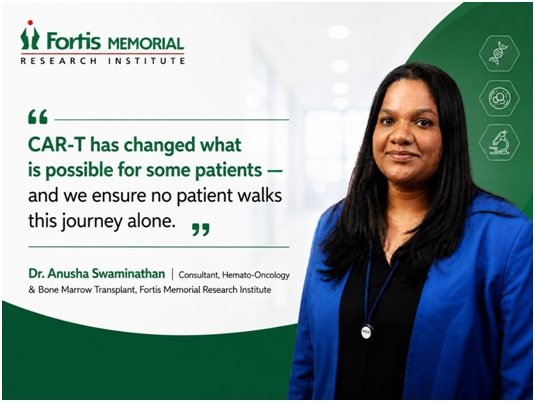
Dr. Anusha Swaminathan, Consultant Hemato-Oncology and Bone Marrow Transplant at Fortis Memorial Research Institute Gurugram, has watched that reality change.

She spoke to us about CAR-T therapy — a treatment that re-engineers a patient’s own immune cells to fight cancer — and what India’s entry into this space means for patients who previously had nowhere left to turn.

What is CAR-T Therapy and how is it different from other drugs?

Early CAR-T experience revealed that patients with aggressive B-cell cancers — many having exhausted chemotherapy, targeted therapy, and transplant — were achieving deep remissions rarely seen with conventional treatment. Unlike standard drugs, CAR-T is a “living therapy” that genetically trains a patient’s own immune cells to recognize and destroy cancer, representing a fundamental shift in how relapsed blood cancers are approached.

However, CAR-T is not a universal cure. Outcomes depend on disease biology, patient selection, referral timing, supportive care, and close monitoring. The deeper realization was not just that CAR-T could produce dramatic responses, but that it changed the treatment philosophy itself — offering genuine hope to heavily pretreated patients who previously had very few options, while underscoring that it remains a highly specialized therapy that demands experienced teams and responsible, careful delivery.

How do you explain CAR-T to a patient or family — and what does a successful response look like in the days and weeks after infusion?

When I explain CAR-T to patients and families, I usually say that this is a treatment where we use the patient’s own immune cells and retrain them to recognize and fight the cancer more effectively. Instead of giving repeated chemotherapy alone, we are trying to empower the immune system itself to attack the lymphoma or leukemia.

I also explain that CAR-T is not an “instant cure” the moment the cells are infused. The first few weeks are a very closely monitored phase. After infusion, the CAR-T cells begin expanding inside the body and interacting with the cancer cells. During this period, many patients can develop fever, low blood pressure, fatigue, or temporary neurological symptoms because the immune system is becoming highly activated. Families are often surprised that fever after CAR-T can sometimes be a sign that the treatment is actively working, although it still needs careful medical supervision and a coordinated medical team with expertise in this.

I usually tell families that CAR-T is a “long game.” We do not judge success only in the first few days after infusion. Instead, we look at important milestones over time. The first major milestone is the initial 30 days, where we monitor for early complications and assess whether the therapy is beginning to control the disease. The second milestone is around 100 days, when we evaluate recovery, infections, immune reconstitution, and disease response more clearly. The third milestone is the one-year mark, where we begin to understand the durability of remission and overall quality of life.

Ultimately, long-term success means not only remaining disease-free, but also living with fewer infections, fewer hospitalizations, and a good quality of life. That is the outcome we are all working toward together.

For a patient who has relapsed after two or more lines of treatment, what could you offer them five years ago versus what you can offer them now? And how has having an indigenous option changed that equation specifically?

Five years ago, patients with relapsed/refractory blood cancers — particularly aggressive B-cell malignancies — had limited options after multiple relapses: further chemotherapy, select targeted therapies, or transplantation where feasible, all carrying significant toxicity. CAR-T therapy has meaningfully changed that landscape, offering heavily pretreated patients the possibility of deep, durable remissions and shifting the clinical conversation from “Have we exhausted options?” to “Is this patient a candidate for cellular therapy?”

Equally significant, especially in India, has been the rise of indigenous CAR-T programs. Previously, access was largely out of reach due to the financial and logistical barriers of seeking treatment abroad. Homegrown programs are changing that equation — improving accessibility and allowing patients to be treated closer to their families and care teams. Much work remains, but indigenous CAR-T development represents a major step forward for cancer care in India.

What is the one thing you want a patient or their family to understand about what this therapy can genuinely achieve?

One of the most important things I want patients and families to understand is that CAR-T therapy has changed what is possible for some patients with relapsed or refractory blood cancers. We are now seeing patients who previously had very limited options achieve meaningful remissions and return to normal life activities. For a subset of patients, this therapy can offer the possibility of long-term disease control and, potentially, cure.

At the same time, it is important to approach CAR-T with both hope and realism. It is not a guaranteed cure for every patient, and it is not an “easy” treatment. It should always be undertaken after honest conversations about an individual patient’s potential benefits, risks, expected recovery journey, and long-term goals. Outcomes also depend on factors such as disease biology, disease burden, timing of referral, and overall patient fitness.

What I encourage families to focus on is that CAR-T is a genuine ray of hope and has opened a door that simply did not exist for many patients a few years ago. Most importantly, patients should know that they are not fighting this journey alone. Successful CAR-T therapy is built on teamwork — between patients, families, physicians, nurses, and the wider transplant and cellular therapy team.

How do you see the Indian entrants into the CAR-T market in terms of their results and safety?

Indian CAR-T entrants, particularly indigenous CD19 CAR-T programs, have shown that high-quality cellular therapy can be developed and delivered within India. The early results from Indian CAR-T programs have been promising and appear encouraging when compared with global experience, although longer-term follow-up is still needed. Equally important, the safety profile has been reassuring in experienced centres, with many toxicities being manageable when recognised early and treated by trained teams.

What excites me most is not just that Indian CAR-T works, but that it is making this therapy more accessible. It is allowing selected patients to receive advanced cellular therapy closer to home, at a fraction of the earlier global cost. That is a major step forward — and I hope this must continue to grow with strong science, transparent data, and experienced clinical programs.

Note: CAR-T therapy is an advanced and evolving treatment approach that can offer meaningful benefit for selected patients with certain blood cancers. However, like all intensive therapies, it may be associated with significant side effects and requires close monitoring in specialised centres. Treatment outcomes can vary based on disease characteristics, prior treatments, and individual patient factors. Patients are encouraged to discuss the potential benefits, risks, and suitability of CAR-T therapy with their treating physician. This article is intended for educational and awareness purposes only and should not be considered a substitute for professional medical advice.
#
ADVERTISEMENT
FKCCI
ADVERTISEMENT
Ambedkar Chamber
ADVERTISEMENT
ESG Professional Network
ADVERTISEMENT
India CSR Image 1 India CSR Image 2

CSR, Sustainability, and ESG success stories hindustan zinc
ADVERTISEMENT
India CSR

India CSR

India CSR® is the largest media on CSR and sustainability offering diverse content across multisectoral issues on business responsibility. It covers Sustainable Development, Corporate Social Responsibility (CSR), Sustainability, and related issues in India. Founded in 2009, the organisation aspires to become a globally admired media that offers valuable information to its readers through responsible reporting.

Related Posts

Shravan Gupta, MGF Group, and the Expanding AI Market: Opportunities in India and Beyond
Business

Shravan Gupta, MGF Group, and the Expanding AI Market: Opportunities in India and Beyond

5 hours ago
Sri Ramakrishna Hospital Certified as first Comprehensive Chest Pain Center in Tamil Nadu
Business

Sri Ramakrishna Hospital Certified as first Comprehensive Chest Pain Center in Tamil Nadu

5 hours ago
Srinagar Best Hotel to Stay, Luxury Hotel in Srinagar, Best Hospitality in Srinagar
Business

Srinagar Best Hotel to Stay, Luxury Hotel in Srinagar, Best Hospitality in Srinagar

5 hours ago
Karan Bhargava Revives 105-Year Healthcare Legacy with AI Vision
Business

Karan Bhargava Revives 105-Year Healthcare Legacy with AI Vision

5 hours ago
Aurangabad Food Explorer: Unveiling the Culinary Gems of Marathwada
Business

Aurangabad Food Explorer: Unveiling the Culinary Gems of Marathwada

5 hours ago
Ravi Bhatnagar
Business

Reckitt’s Ravi Bhatnagar honoured with Chakra of Change Award by former CJI Dr Justice D.Y. Chandrachud

5 hours ago
Load More
BBA - CSR, Sustainability and ESG, Rungta International Skills University Bhilai
ADVERTISEMENT
FKCCI
ADVERTISEMENT

Interviews

Harkirat Kaur, CEO, Hartek Foundation
Interviews

Building Resilient Communities Through Sustainable Development: Harkirat Kaur, CEO, Hartek Foundation

by India CSR
June 22, 2026

The conversation also explores the evolving role of CSR in India.

Read moreDetails
Indu Mehta, Chief Sustainability Officer (CSO) at Bhilwara Energy Limited @IndiaCSR

ESG in India Has Moved Beyond Storytelling: Bhilwara Energy’s Indu Mehta on Sustainability as an Operating Discipline

May 30, 2026
Sourabh Lohtia, Chief Marketing & Communications Officer, PNB MetLife

Targeted Skilling Can Build Confident Futures for Underprivileged Women: Sourabh Lohtia, PNB MetLife

May 29, 2026
Shashi Shetty: SKF India’s UDAAN Scholarship Helps Rural Girls and Divyaang Students Build Careers

Shashi Shetty: SKF India’s UDAAN Scholarship Helps Rural Girls and Divyaang Students Build Careers

May 28, 2026
Load More
Ad 1 Ad 2 Ad 3 Ad 4 Ad 5 Ad 6
ADVERTISEMENT

CSR UPDATES

CSR: Hindustan Zinc’s Shiksha Sambal Empowered 47,000+ Students Since 2018

Jupiter Life Line Hospitals Reported No Permanent Employee in Recognised Union in FY26

CSR: Over 100 Youth Placed Under SBI Foundation-NIIT Foundation Skilling Programme

Tenon Group Hosts Blood Donation Drive at Gurugram office

CSR: Chola Foundation hands over ALS Ambulance to NDA to enhance Emergency Care

CSR: UPL’s Decade-Long Biodiversity Program Boosts Sarus Crane Count to 1,576 in Gujarat

STEM Learning STEM Learning STEM Learning
ADVERTISEMENT
Facebook Twitter Youtube LinkedIn Instagram
India CSR Logo

India CSR is the largest tech-led platform for information on CSR and sustainability in India offering diverse content across multisectoral issues. It covers Sustainable Development, Corporate Social Responsibility (CSR), Sustainability, and related issues in India. Founded in 2009, the organisation aspires to become a globally admired media that offers valuable information to its readers through responsible reporting. To enjoy the premium services, we invite you to partner with us.

Follow us on social media:

Subscribe to Our Newsletter

Don't miss out on the latest updates in corporate social responsibility. Subscribe to our newsletter at indiacsr.in and be part of the positive change.
Please enable JavaScript in your browser to complete this form.
Loading

  • About India CSR
  • Team
  • India CSR Awards 2026
  • India CSR Leadership Summit
  • Partnership
  • Guest Posts
  • Services
  • ESG Professional Network
  • Content Writing Services
  • Business Information
  • Contact
  • Privacy Policy
  • Terms of Use
  • Donate

Copyright © 2026 - India CSR | All Rights Reserved

No Result
View All Result
  • Home
  • Corporate Social Responsibility
    • Art & Culture
    • CSR Leaders
    • Child Rights
    • Culture
    • Education
    • Gender Equality
    • Around the World
    • Skill Development
    • Safety
    • Covid-19
    • Safe Food For All
  • Sustainability
    • Sustainability Dialogues
    • Sustainability Knowledge Series
    • Plastics
    • Sustainable Development Goals
    • ESG
    • Circular Economy
    • BRSR
  • Corporate Governance
    • Diversity & Inclusion
  • Interviews
  • SDGs
    • No Poverty
    • Zero Hunger
    • Good Health & Well-Being
    • Quality Education
    • Gender Equality
    • Clean Water & Sanitation – SDG 6
    • Affordable & Clean Energy
    • Decent Work & Economic Growth
    • Industry, Innovation & Infrastructure
    • Reduced Inequalities
    • Sustainable Cities & Communities
    • Responsible Consumption & Production
    • Climate Action
    • Life Below Water
    • Life on Land
    • Peace, Justice & Strong Institutions
    • Partnerships for the Goals
  • Articles
  • Events
  • हिंदी
  • More
    • Business
    • Finance
    • Environment
    • Economy
    • Health
    • Around the World
    • Social Sector Leaders
    • Social Entrepreneurship
    • Trending News
      • Important Days
      • Great People
      • Product Review
      • International
      • Sports
      • Entertainment
    • Case Studies
    • Philanthropy
    • Biography
    • Technology
    • Lifestyle
    • Sports
    • Gaming
    • Knowledge
    • Home Improvement
    • Words Power
    • Chief Ministers

Copyright © 2026 - India CSR | All Rights Reserved

This website uses cookies. By continuing to use this website you are giving consent to cookies being used. Visit our Privacy and Cookie Policy.


