

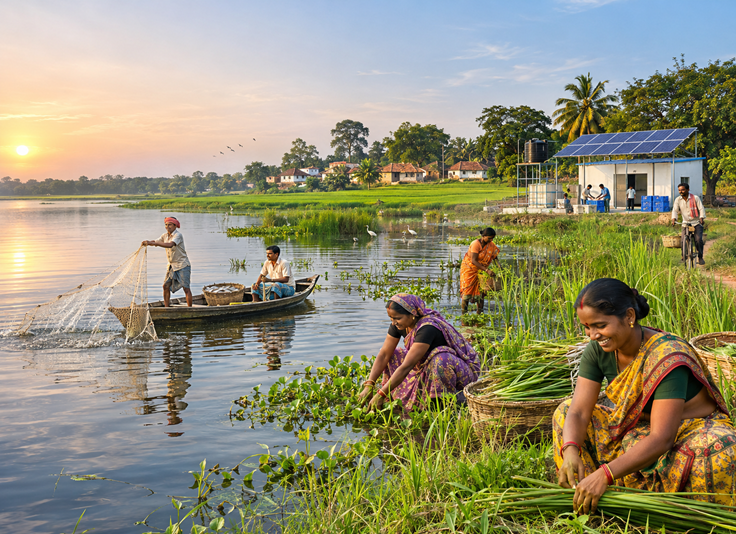



Women are expected to be amongst the largest beneficiaries. Bihar, Odhisha, Telangana, Karnataka and Tamil Nadu have the maximum room to grow
NEW DELHI (India CSR): India’s village ponds, tanks, lakes and reservoirs could sustainably double inland fish production from 15 to 30 million tonnes over the next ten years, creating 1.8 crore new jobs and adding about $40 billion to the economy, finds a new report by Jaljeevika in collaboration with Change Engine, India’s Aquatic Economy: The Untapped Potential of Inland Water Bodies. The report looks at the current status of inland fisheries in India, their productivity, the potential of resources such as ponds, tanks, wetlands and reservoirs, and what it will take to turn that potential into jobs and incomes for rural families.
That potential lies in a yield gap. India is already the world’s second-largest fish producer, and inland waters, which account for roughly half of the $45 billion that aquaculture and fisheries add to the economy, supply 75% of its 19.78 million tonnes. Yet they yield just 1.86 tonnes per hectare, against the government’s target of 5, a mark Andhra Pradesh has already crossed. Five states, Bihar, Odisha, Telangana, Karnataka and Tamil Nadu, hold nearly half of India’s inland water area but produce only a fifth of its fish.

Raising them to 2.5 tonnes per hectare, half the national target, could deliver more than half the growth needed to double output.
Shubham Bansal, Co-founder, Change Engine, said, “Most programmes to raise rural incomes have focused on agriculture and livestock, while the waters in our own villages have been left to underperform. Unlike sea fishing, fish farming needs no big boats or heavy investment. It is work ordinary families can do in their own ponds, and doubling what these waters produce means jobs where people live, not in the cities they migrate to.”
Some of the key findings of the report include:
- Fish is India’s fastest-growing farm sector. Fisheries has grown at 8.74% over the past decade, nearly twice as fast as agriculture (4.45%), and inland waters now supply 75% of India’s fish, up from 63% in 2014.
- Five states hold nearly half of India’s inland water area but produce only a fifth of its inland fish. Bihar, Odisha, Telangana, Karnataka and Tamil Nadu yield between 0.39 and 0.97 tonnes per hectare. Raising them to 2.5 could deliver more than half the growth needed to reach 30 million tonnes by 2034-35.
- The jobs follow the fish. About 2.3 crore people already practise inland fish farming, 44% of them women, with households earning ₹60,000 to ₹1.2 lakh a year, mostly as a second income. Every 10% rise in inland production brings an 8.2% rise in jobs, double the 4% in agriculture.
- Field results show the gains reach marginal families. In Bihar, 2,622 small farmers saw fish income rise from ₹30,000 to ₹1 lakh a year (233%). In Odisha, 92,000 women in over 9,000 self-help groups each earned about ₹10,600 more by farming fish in unused village tanks. Pilots in Jharkhand and Telangana raised household incomes by 45% and 25%.
Neelkanth Mishra, Founder, Jaljeevika, said, “Field pilots have shown the model works; the task now is scale. That means public-private-community partnerships across production clusters, real-time digital advisories, local seed nurseries and rural credit working together. Get that right and inland waters become engines of rural GDP and climate-resilient livelihoods.”

To help inland fisheries grow fairly, Jaljeevika and Change Engine propose the following recommendations to state governments as well as funders in the report:
- Launch state Aquatic Livelihoods Missions that bring fisheries, rural development, panchayat, revenue and water resources departments together, with each water body as the unit of planning. The Centre has spent Rs. 39,272 crore on fisheries since 2015, but the support is spread across departments.
- Build hatcheries and cold chains near high-potential clusters. The report estimates ₹7000 crore is needed for hatcheries and nurseries. With bank loans and owner contributions, this would cost the government about Rs. 3,600 crores over ten years through existing schemes, PMMSY and FIDF. Cold storage, collection centres and processing units must follow.
- Give communities secure rights to water: States should let gram panchayats lease village ponds and tanks, and give first claim to local women self-help groups, fisher groups, cooperatives and FFPOs. Leases should be longer than five years, with a rent-free first year and capped rent. Open auctions should be the last resort.
- Build a cadre of local extension agents: Trained local workers should give farmers regular hands-on help on preparing ponds, choosing and stocking fish, feed, water quality, disease prevention and harvesting.
- Fund inland fisheries as part of a livelihood portfolio, and invest in research on what works for incomes, jobs and nutrition.



