




83% pharma companies adopt Zero Liquid Discharge systems; renewable energy share rises to 25%: ICRA ESG
Approximately 83% of pharmaceutical companies in India have adopted Zero Liquid Discharge (ZLD) systems, while the sector’s renewable energy share has increased to 25% in FY2025 from 17% in FY2023, according to ICRA ESG Ratings’ latest report on the sustainability landscape of India’s pharmaceutical sector. The report highlights the evolving sustainability landscape of India’s pharmaceutical sector as it balances global competitiveness with increasing ESG expectations.

One of the more encouraging findings is the sector’s progress on water. Freshwater intensity has declined steadily, and approximately 83% of companies have adopted Zero Liquid Discharge (ZLD) systems, a notably high penetration rate. Recycling rates are also improving, especially among integrated players, though hazardous waste management remains a persistent challenge for API-heavy operations.
The Indian pharmaceutical industry, a key global supplier of generic medicines and vaccines, is characterised by diverse operating models spanning API manufacturers, formulation players, and integrated companies. Given the inherent differences in processes, ESG risks and performance vary significantly across segments, necessitating a differentiated analytical approach.
ICRA ESG Research analysed a sample of pharmaceutical companies drawn from the top 1,000 listed entities by market capitalisation, covering over 50 companies with consistent and reliable data availability. The assessment evaluated performance across key ESG parameters, including energy and emissions, water management, waste circularity, governance practices, and value chain sustainability over FY2023–FY2025.
The analysis indicates the average share of renewable energy in the sector climbed from roughly 17% in FY2023 to 25% in FY2025, driven largely by group captive and open-access procurement models. While this has helped bring down emission intensity, overall energy intensity per unit of revenue has shown an upward trend mainly due to pricing pressures and shifting product mixes.
Sheetal Sharad, Chief Ratings Officer at ICRA ESG Ratings, said, “Improving renewable energy adoption, enhanced water efficiency, and stronger circularity practices indicate that the sector is progressing in the right direction. While this momentum is encouraging, further strengthening is required to sustain long-term resilience.”
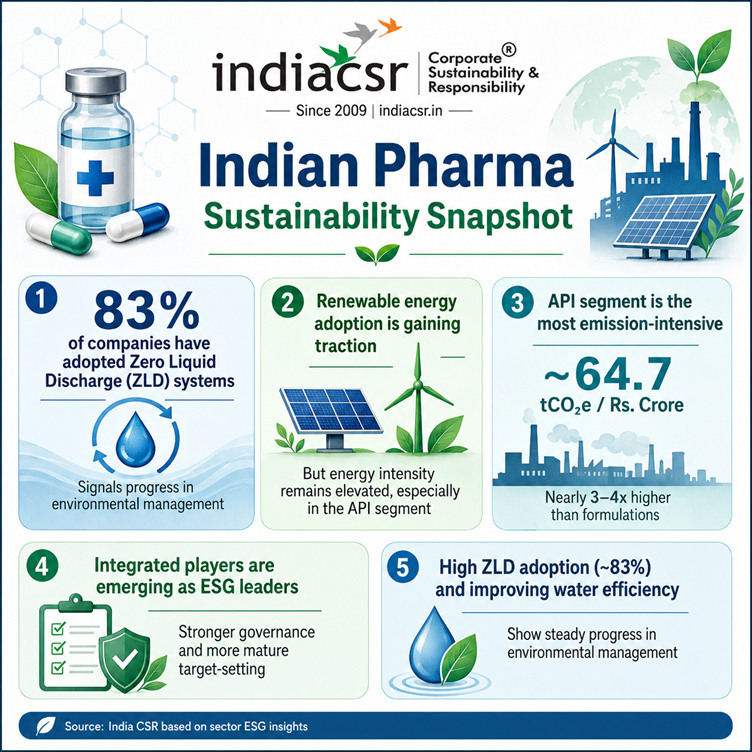
Not all pharmaceutical segments face the same sustainability pressures. API manufacturers carry the heaviest environmental burden, with high energy consumption, water use, and hazardous waste generation stemming from complex, multi-step chemical synthesis. Formulation players sit at the other end of the spectrum, with lower emission and waste intensity. Integrated companies strike the best balance, benefiting from scale, operational efficiency, and more mature ESG frameworks.
Waste management remains a critical ESG concern, given the structurally high hazardous waste share (~67% in APIs) and constraints on recycling, underscoring the need for stronger circularity and advanced treatment systems.
Sustainability governance is gaining increasing traction, with around 35% of companies having dedicated ESG committees, while 59% have established formal emission reduction targets. That’s meaningful progress, but it also means a significant portion of the sector still lacks structured – accountability.
With frameworks like the EU’s CSRD and the UK NHS’s net-zero procurement requirements raising the bar globally, Indian pharmaceutical exporters face growing pressure to decarbonise faster, improve supply chain transparency, and build more robust governance structures.
Ms. Sheetal Sharad added: “API manufacturers continue to face structural challenges related to energy intensity and hazardous waste, and governance frameworks across the sector remain at an evolving stage. At the same time, global customers are increasingly positioning ESG as a core procurement criterion rather than a compliance exercise. In this context, continued focus on decarbonization, improved Scope 3 visibility, and the strengthening of governance frameworks will be critical for Indian pharmaceutical companies to enhance competitiveness and sustain export growth over the long term.”
Key Trends from ICRA ESG Pharma Sustainability Report
| Trend | Key Data |
|---|---|
| Renewable Energy Rising | RE share increased from 17% in FY2023 to 25% in FY2025. |
| API Segment High Emission | API emission intensity stood at 64.72 tCO₂e/Rs. crore in FY2025. |
| Water Efficiency Improving | Freshwater intensity declined from 336.8 m³/Rs. crore to 293.1 m³/Rs. crore. |
| High ZLD Adoption | ZLD adoption reached about 83%, with integrated players leading at 89%. |
| Hazardous Waste Concern | API hazardous waste share remained high at around 67%. |
| Integrated Players Lead | Integrated players showed stronger ESG governance and target-setting maturity. |
| Scope 3 Disclosure Gap | About 57% of API and integrated players disclose Scope 3, versus 9% of formulation firms. |
| Global ESG Pressure | EU CSRD and UK NHS rules are pushing pharma exporters toward stronger ESG disclosure. |
Download the report
(India CSR)



