

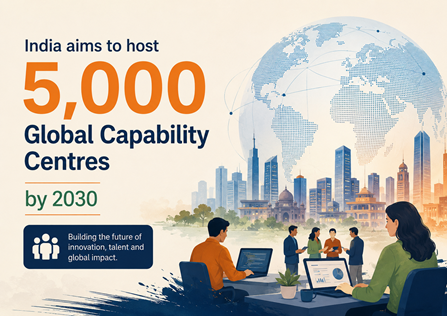



India is stepping into a new era of global innovation, where ideas, technology and talent converge to shape the future of business. Its growing GCC ambition reflects a larger vision—to become the place where the world’s most important solutions are imagined, built and led.
In a significant boost to India’s position as a global innovation powerhouse, Union Finance Minister Nirmala Sitharaman has declared the country’s ambition to build an ecosystem supporting around 5,000 Global Capability Centres (GCCs) by 2030 as both “realistic and achievable.” Speaking at the CII National GCC Business Summit 2026 in New Delhi on July 9, 2026, she painted a picture of a sector that’s not just growing, but transforming India’s role in the world economy from a back-office destination to a strategic nerve centre for multinational corporations.

Where India Stands Today
India has already emerged as the undisputed leader in the GCC space. The country currently hosts more than 2,100 GCCs, employing over 2.3 million professionals and generating nearly $100 billion in annual revenues. This ecosystem represents perhaps the world’s largest organised knowledge export, with India home to more than half of all global GCCs.
More than 500 Forbes Global 2000 companies have set up operations here, and in many sectors, multinationals are now more likely to establish their next capability centre in India than anywhere else. The growth pace is accelerating dramatically: from one new GCC every week in 2024 to nearly one every day on average now.
US firms dominate, accounting for nearly two-thirds of the centres, but companies from Germany, the UAE, Denmark, and others are expanding rapidly. Sectors like IT/ITeS, BFSI (banking, financial services, and insurance), engineering R&D, healthcare, and retail/FMCG are leading the charge. Bengaluru remains the crown jewel, but the story is spreading.
The Economic Impact: Beyond the Numbers
GCCs are far more than cost-saving outposts anymore. They’ve evolved into hubs for AI, engineering research and development (ER&D), cybersecurity, digital platforms, product architecture, financial innovation, and enterprise-wide transformation. Over half of newly established GCCs are AI-first, and more than 1,200 centres now embed AI and machine learning capabilities, supported by 250+ dedicated AI Centres of Excellence and a talent pool of around 250,000 AI professionals.
Economically, the impact is profound. In FY25, GCCs contributed about $68 billion in direct gross value added (GVA), roughly 1.6-2% of India’s GDP. Projections suggest this could rise to $155-199 billion by FY30, potentially unlocking $470-600 billion in broader economic value. Direct employment could reach 4-5 million, with a total footprint (including indirect jobs in real estate, supply chains, and services) of 20-25 million by 2030.
GCCs already drive nearly 40% of commercial real estate demand in major cities, reshaping urban landscapes and boosting local economies.
Why 5,000 by 2030 Feels Achievable
Sitharaman highlighted massive untapped potential: around two-thirds of Fortune Global 2000 companies have yet to establish a GCC in India. With the current momentum and supportive policies, scaling up is realistic. Deloitte and other experts have echoed similar optimism, forecasting thousands of new setups in the coming years driven by AI, digital transformation, and global protectionism trends.
Government initiatives are playing a key role. The Union Budget 2026-27 introduced measures like a unified safe harbour regime for IT and ITeS, higher thresholds, faster advance pricing agreements, and incentives to reduce tax uncertainties. State policies in places like Uttar Pradesh, Karnataka, Telangana, and others offer land subsidies, stamp duty waivers, and more.
The Next Frontier: Geographic Diversity and Tier-2/Tier-3 Cities
The first 2,000 GCCs were concentrated in metros like Bengaluru, Hyderabad, Gurugram, Pune, Chennai, and Mumbai. The next wave will be far more diverse. Sitharaman named emerging hubs such as Varanasi, Chandigarh, Visakhapatnam, Tiruchirappalli, and Mysuru as future centres for AI, engineering design, and product development.
Tier-2 and Tier-3 cities are already gaining traction, offering talent pools, lower costs, and improving infrastructure. This decentralisation could create balanced regional growth and reduce pressure on major metros.
Challenges and the Road Ahead
While the outlook is bright, challenges remain. Some GCCs (especially post-2020 setups) are hitting plateaus and need a strategic reset toward higher-value innovation and enterprise ownership. Talent retention, infrastructure in smaller cities, and global geopolitical shifts will require ongoing attention.
Sitharaman outlined a five-pronged strategy: moving up the value chain with IP creation and frontier research; deepening ties with universities and startups; geographic expansion; policy enablement; and fostering global leadership roles from India.
A Milestone on a Larger Journey
India’s GCC story is more than numbers—it’s about confidence, capability, and contribution. From humble back offices two decades ago to strategic global hubs today, these centres are helping multinationals innovate faster while powering India’s knowledge economy.
As Sitharaman noted, hitting 5,000 GCCs by 2030 is not the end goal but a milestone. The larger vision is for India to be where the world’s next-generation ideas, patents, products, and platforms are conceived, engineered, and led.
With strong fundamentals—talent, infrastructure, policy support, and an entrepreneurial spirit—India is well-positioned to turn this ambition into reality. The GCC boom isn’t just good news for businesses; it’s a game-changer for millions of professionals and the broader Indian economy. The coming years promise to be transformative.
(India CSR)



