




The report estimates India’s print-book market at Rs. 95,816 crore, digital publishing at Rs. 7,048 crore and scholarly journals at Rs. 5,150 crore.
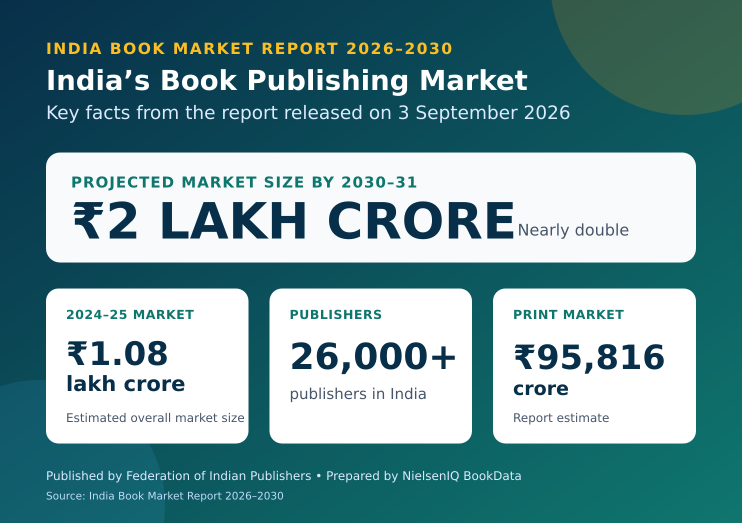
NEW DELHI (India CSR): India’s book publishing market is projected to reach Rs. 2 lakh crore by 2030–31, nearly doubling from an estimated Rs. 1.08 lakh crore in 2024–25, according to the India Book Market Report 2026–2030. The report was launched in New Delhi on September 3 by the Federation of Indian Publishers (FIP) in partnership with NielsenIQ BookData.
The report presents an assessment of India’s print, digital, educational and scholarly publishing segments. It attributes the projected expansion to growth in education and research, the rise of Indian-language content, digital adoption and a large reader and learner base. It also examines the effect of artificial intelligence, copyright, creator rights and policy frameworks on the future of publishing.
Market Growth Outlook
The report estimates India’s print-book market at Rs. 95,816 crore, digital publishing at Rs. 7,048 crore and scholarly journals at Rs. 5,150 crore. It places the overall book-publishing market at about Rs. 1.08 lakh crore in 2024–25. The projected Rs. 2 lakh crore market size by 2030–31 would imply an increase of nearly Rs. 92,000 crore over six years and annual growth of close to 11 percent.
According to the report, India has more than 26,000 publishers, while the print-publishing market is growing at a nearly 11 percent compound annual growth rate. The report also estimates that print publishing generated an economy-wide output footprint of Rs. 1,46,598 crore in 2025–26, with an estimated multiplier of about 3.7. Employment in printing and book publishing was estimated at 3,75,534 in 2025.
Education Drives Demand
Education remains a central driver of the sector, supported by India’s schools, universities and competitive-examination ecosystem. The report identifies further growth opportunities in children’s books, professional learning, Indian-language publishing, research and intellectual-property development. It does not view digital publishing as a replacement for print. Instead, the report sees technology supporting book discovery, assessment, accessibility and distribution, while connecting print books with e-books, audiobooks, translations and accessible editions. A single title can create value through multiple formats, learning tools, licensing and international rights, it notes.
The report also identifies potential for India to export publishing technology, editorial services, educational products and intellectual property alongside printed books.
Data-Led Decisions
Vikrant Mathur, Executive Director, NielsenIQ BookData, India & GCC, said the report was developed to provide a clearer understanding of the scale, structure and evolution of India’s publishing sector. “By combining market data with industry expertise, it offers practical insights into the trends, opportunities and challenges shaping the industry. We hope it serves as a valuable resource for businesses, policymakers and other stakeholders as they plan for the future,” Mathur said.
Pranav Gupta, Vice President, Federation of Indian Publishers, said publishing is central to India’s intellectual, educational and cultural progress. He said the sector’s future should be informed by reliable data, rigorous research and a shared understanding of its opportunities and challenges.
The report has ISBN 9788195575046 and was prepared by NielsenIQ BookData for FIP.
Global Publishing Potential
Sanjay Kumar, former Secretary of Education, Government of India, said India is the world’s third-largest publishing industry after China and the United States, and has the potential to become the largest. He described publishing as a key component of the knowledge economy and called for India to seek a larger role as a global printing hub in line with the Make in India initiative.
Yuvraj Malik, Director of the National Book Trust, India, said the sector is at an important inflection point. He cited India’s reader and learner base, linguistic diversity and expanding technological capabilities as factors that could strengthen its position in the global knowledge economy.
The report also received international attention. José Borghino, Secretary General of the International Publishers Association, stressed the importance of reliable publishing data and statistics. Caroline Sutton, CEO of the International Association of Scientific, Technical and Medical Publishers, said India’s educated English-speaking population, rising research output and publishing-services capability create opportunities in academic and scientific publishing.
Rights And Technology
Artificial intelligence is identified as an important factor in the sector’s next phase. The report notes that AI may support editing, production, translation, accessibility and discoverability. At the same time, it highlights questions around accuracy, privacy, human judgement, copyright, licensing and remuneration for creators. The report calls attention to quality, research integrity, stronger rights management, copyright protection and sustainable business models. It indicates that the sector’s future growth will depend not only on market expansion, but also on its ability to protect intellectual property, build trustworthy systems and convert India’s education, language and technology strengths into a sustainable knowledge industry.
Key Facts
| Particular | Details |
|---|---|
| Report | India Book Market Report 2026–2030 |
| Released by | Federation of Indian Publishers |
| Prepared by | NielsenIQ BookData |
| Launch date | September 3, 2026 |
| Launch location | New Delhi |
| Projected market size | ₹2 lakh crore by 2030–31 |
| Estimated market size | ₹1.08 lakh crore in 2024–25 |
| Print market estimate | ₹95,816 crore |
| Digital publishing estimate | ₹7,048 crore |
| Scholarly journals estimate | ₹5,150 crore |
| Publishers in India | More than 26,000 |
| ISBN | 9788195575046 |



