

An ASSOCHAM-ASCELA report estimates India’s annual post-harvest losses at nearly $18.5 billion and calls for better cold-chain integration, utilisation and end-to-end connectivity.
- India’s cold-storage infrastructure comprises 8,815 facilities with a combined capacity of 40.22 million tonnes as of June 2025, providing a strong foundation for the country’s expanding cold-chain ecosystem. With continued participation from private players and growing demand for integrated logistics solutions, the next phase of development will focus on strengthening multi-temperature, multi-product capabilities and seamless end-to-end connectivity across the cold chain.
- The report highlights that annual post-harvest losses in India have been estimated at nearly USD 18.5 billion and points to significant opportunities to expand the use of cold-chain solutions, with currently only around 4 per cent of perishables moving through organised cold-chain networks
- Cold storage capacity is projected to reach 43.7 million tonnes by 2031 at a CAGR of just 2.2 per cent, with the report calling for a shift in focus from building capacity to improving integration, utilisation and end-to-end cold chain connectivity.
NEW DELHI (India CSR) “India produces enough. Now, India must preserve enough,” said Sukanta Kumar Panigrahi, Hon’ble Member of Parliament and Member of the Parliamentary Standing Committee on Agriculture, Animal Husbandry and Food Processing, Government of India, speaking as Chief Guest at the ASSOCHAM Cold Chain and Warehousing Summit, themed “Building Ecosystem for Viksit Bharat,” held today at Hotel Le-Meridian, New Delhi.
“A fruit harvested today has a biological clock. Milk collected from a farmer has a quality clock. Fish landed at the harbour has an even faster clock. If we manage time and temperature well, we preserve value. If we fail, we lose food, income and resources,” he said. “That is why I believe cold chain is not about keeping products cold. It is about keeping value alive. So, a strong cold chain is not merely a logistics asset; it is a stronger income chain for the farmer. Because the ultimate return on investment is not the capacity we build, it is the value we preserve.”
“India Produces Enough, Now India Must Preserve Enough”, Sukanta Kumar Panigrahi, Member of Parliament, at ASSOCHAM Cold Chain and Warehousing Summit
He added, “Let us therefore build a culture that connects farm to market, farmer to consumer, production to processing, and India to the world. Let us move from wastage to value, from fragmented logistics to integrated supply chains, and from cold chain to stronger farmer incomes.”
Delivering the welcome address, Saandip Wadhwa, Chairman, National Council on Logistics and Warehousing, ASSOCHAM, and Group Director, JM Baxi Group, said, “Warehousing and cold chain are no longer simply support infrastructure. They are becoming strategic enablers of economic growth, food security, farmer incomes, exports and industrial competitiveness. India has made significant progress in expanding its physical infrastructure. However, the next phase of growth must focus not merely on creating more capacity, but on creating connectivity.
In the theme address, Sanjay Bajpai, Industry Veteran and Advisor, National Council on Logistics and Warehousing, ASSOCHAM, and Former Executive Director, CONCOR, observed, “Supply chains, as they extend further out of the country, are also becoming increasingly trust chains. These chains of trust depend on standardisation, on preservation of quality, and on resilience to connect with the market. This is where one sees the future of warehousing and cold chain getting increasingly and intimately integrated with the supply chain.”
Delivering the industry address, Mata Prasad, DGM – ABU and GSS, State Bank of India, said, “From SBI’s perspective, cold chain infrastructure represents an important opportunity to connect agriculture infrastructure, food processing and logistics exports. Our approach is to look at the complete agri value chain and provide the right financial solution depending upon the nature of the activity, the borrowers and the cash flow profile. In cold chain, we can finance construction of cold storage, plant and machinery, working capital and other needs.”
Speaking as the Guest of Honor, Dr Devendra Kumar Dhodawat, Former Additional Chief Secretary to the Governor of Kerala and Member, Warehousing Development and Regulatory Authority (WDRA), noted, “India today is among the leading agriculture producers. In 2024-25, the country recorded food grain production of about 358 million tonnes, while horticulture has also emerged as a major driver of agriculture growth, with production reaching about 371 million tonnes.” He added, “As we collectively work towards realising the vision of Viksit Bharat 2047, I sincerely urge the leaders of industry to focus on five key priorities, foremost among them expanding integrated, efficient and sustainable cold chain infrastructure.”
“Unlocking the Next Phase of India’s Cold Chain” Report Flags USD 18.5 Billion Annual Post-Harvest Loss, Calls for Shift from Capacity to Capability
Also speaking as the Guest of Honor, Amrit Lal Meena, Former Chief Secretary, Government of Bihar, and Former Special Secretary (Logistics), DPIIT, Ministry of Commerce, Government of India, said, “It is time that industry associations and state governments plan their industrial townships, warehousing and multimodal logistics parks, including smaller logistics parks, at the junctions of trunk infrastructure, railway lines and highways.” He added, “Industry should take advantage of these developments, and through conferences such as this one, meaningful recommendations should emerge, recommendations that reach the appropriate forums for implementation.”
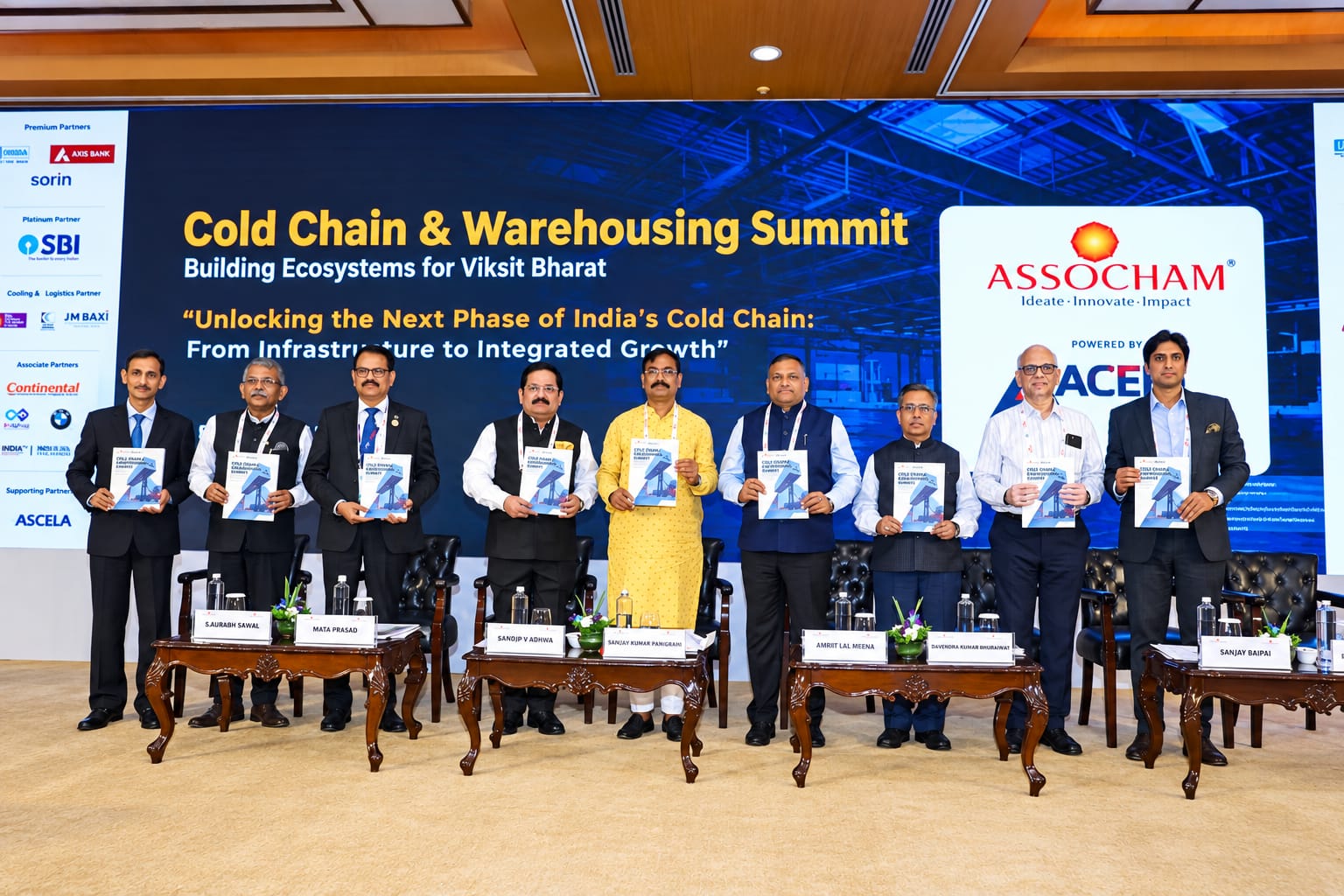
The Inaugural Session also saw the release of the ASSOCHAM-ASCELA Knowledge Report, and a presentation by Nivesh Chaudhary, Co-Founder and Managing Director, ASCELA.
The summit featured three thematic panel discussions throughout the day. The first, on Building Future-Ready Warehousing and Cold Chain Infrastructure: Driving India’s Logistics Growth; the second panel, on Sustainable Cold Chains for Global Markets: Green Warehousing, Smart Refrigeration and Agri-Export Competitiveness; and the third panel, on Advancing Multimodal Logistics: Integrating Supply Chains for Seamless Connectivity.
The summit also featured a special address by Ajit Kumar Panda, Chairman and Managing Director, CONCOR.
The event concluded with a vote of thanks by Saurabh Sanyal, Secretary General, ASSOCHAM, who thanked the Chief Guest, dignitaries, speakers, industry leaders and participants for their contributions to the summit. He highlighted the importance of cold chain, warehousing and multimodal logistics in making Indian supply chains more competitive, resilient and globally integrated, and urged participants to put forward practical, actionable recommendations. The summit reaffirmed ASSOCHAM’s commitment to strengthening the cold chain and warehousing ecosystem by bringing industry, government and other stakeholders together on a common platform.