


Dr. Sheron Mathew explains why India needs earlier rehabilitation, safe transport, local networks and data systems for spinal cord injury care.
By Dr. Sheron Mathew
A fall from a construction site. A two-wheeler accident on a flooded road. A slip from a tree while working on a farm. For someone who sustains a spinal cord injury, the accident may last seconds, but its consequences can last a lifetime. A spinal cord injury turns a person’s world upside down. It often leads to Quadriplegia (tetraplegia) resulting from a higher spinal cord injury in the neck and can affect both the arms and legs, as well as the trunk. or Paraplegia affects the lower part of the body, mainly the legs, while the arms and hands are usually unaffected. Can also cause other serious health challenges, including, problems with bladder and bowel control, and bedsores. Some people may also experience difficulties with blood pressure, breathing, sexual function, or temperature regulation.
But the impact extends far beyond the physical. Many individuals face social isolation, stigma, financial hardship, and the fear of losing their independence.
The weeks and months that follow can determine whether a person returns to work, moves independently, participates in family life, and regains a sense of autonomy. Rehabilitation is central to these outcomes and needs to begin as early as possible in the care journey.

Consider Ramesh, a 28-year-old construction worker and the sole earner for his family. A fall from scaffolding left him with thoracic paraplegia. In an instant, his family lost their income and was thrust into navigating a medical system they were completely unprepared for. Ramesh’s story is far from unique, as spinal cord injuries disproportionately affect people in their most productive years. In India, falls from a height account for roughly 40% of all traumatic injuries, making occupational safety and rural awareness an essential part of prevention.
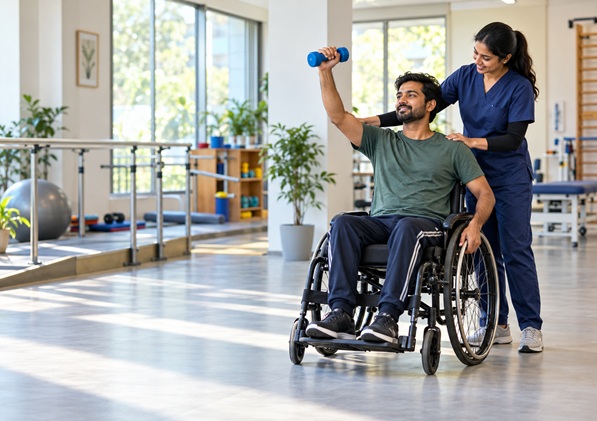
The needs following an injury also differ across age, gender and circumstance. Men account for a substantially higher proportion of reported cases, reflecting differences in occupational and environmental exposure. Women may require additional support around reproductive health and gender-responsive rehabilitation. Children have distinct developmental and long-term rehabilitation needs. Recognising these differences can help shape services that respond to the circumstances of different groups.
Planning those services also requires better data. India currently does not have a national registry for spinal cord injury, making it difficult to establish the full scale and geographical distribution of need. A national registry could provide evidence on incidence, patient profiles and rehabilitation requirements, helping inform health planning, workforce requirements and resource allocation.
The race to save a life begins long before a patient ever reaches a hospital bed. In India, well-meaning but untrained bystanders handle over 80% of emergency rescues, and more than 60% of patients are rushed to emergency rooms in standard cars or auto-rickshaws lacking any spinal immobilization. A single awkward lift on the side of a road can turn a treatable trauma into permanent paralysis. Teaching first responders, transport workers, and local communities how to lift and transport injured people safely creates a vital lifeline at the moment of impact.
Once the initial medical crisis subsides, keeping care continuous becomes the real challenge. Specialist rehabilitation centres have expert teams, but families in rural villages often live hundreds of kilometres away. District-level clinics, local referral networks, community-driven care, and tele-rehabilitation can collapse these distances, bringing world-class expertise right to a patient’s doorstep.
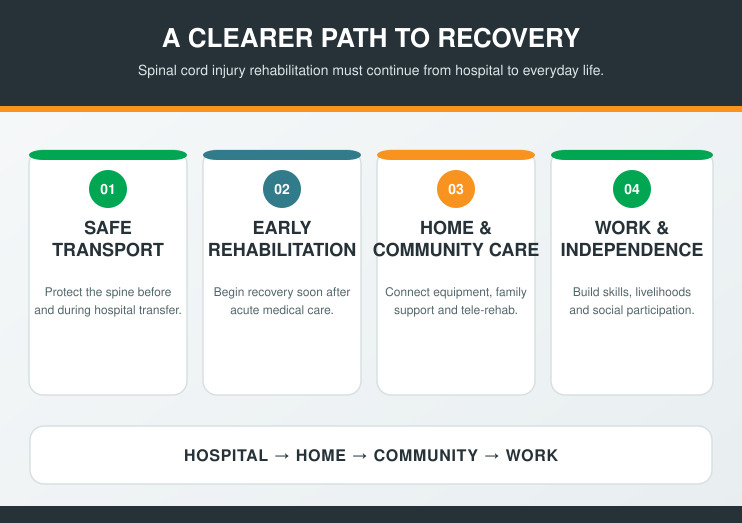
The Spinal Cord Injury Rehabilitation Programme at the Association of People with Disability provides one example of how this continuum can work. Its Cot to Community approach, developed through work in Karnataka since 2001 and expanded into Maharashtra in 2024, combines clinical rehabilitation with wheelchair skills, assistive devices, livelihood and vocational pathways, community strengthening and tele-rehabilitation.
This approach recognises the range of challenges a person may encounter after leaving a rehabilitation facility. Learning wheelchair mobility is one part of rehabilitation. Using those skills at home and in the community can depend on appropriate equipment, family support and the accessibility of the surrounding environment. Returning to work may require vocational assessment, skills development, workplace adaptations or support to identify alternative livelihoods. Each of these factors can influence long-term independence.
India can strengthen spinal cord injury rehabilitation by integrating rehabilitation earlier into the acute care pathway; strengthening links between specialist, district, and community services; tailoring rehabilitation to differences in age, gender, occupation, and geography; and improving data to guide planning and investment.
Ultimately, we must measure recovery by how much life a person gets back, not just by clinical charts or muscle scores. Can they return home with confidence? Can they earn a living or finish their education? Can they move through their village without relying on others? Can they take charge of their own health and future?
After 25 years in spinal cord injury rehabilitation, I have seen how much of a person’s recovery depends on what happens after they leave the healthcare facility. Returning home, navigating the community and finding a way back to work are all part of that journey.
India has a profound opportunity to strengthen every link in this chain of care. By fixing emergency transport, expanding local rehabilitation networks, deploying smart technology to the last mile, and building a national spinal cord injury registry, we can identify gaps, guide resources, and improve care. And build a system that doesn’t just keep people alive, but helps them rebuild their independence and reclaim the full, rich lives they deserve.
Because surviving a spinal cord injury should be the beginning of a new life, not the end of one.
About the Author: Dr. Sheron Mathew (PT), MPT (Neurology), Senior Manager, Spinal Cord Injury Rehabilitation Programme (SCIR), The Association of People with Disability (APD)
Dr. Sheron Mathew, a graduate of Christian Medical College (CMC), Vellore, holds a master’s degree in Physiotherapy – Neurology and has 13 years of experience transforming rehabilitation from a clinical service into a pathway to independence, participation and inclusion. A strong advocate for accessible, high-quality rehabilitation, Dr. Sheron has worked extensively with underserved communities through both community-based and institution-based rehabilitation programmes across Jharkhand, rural Maharashtra, Madhya Pradesh and Delhi. Dr. Sheron is particularly committed to building sustainable disability ecosystems in rural India that enable people with disabilities to live independently, participate fully and access opportunities with dignity.