

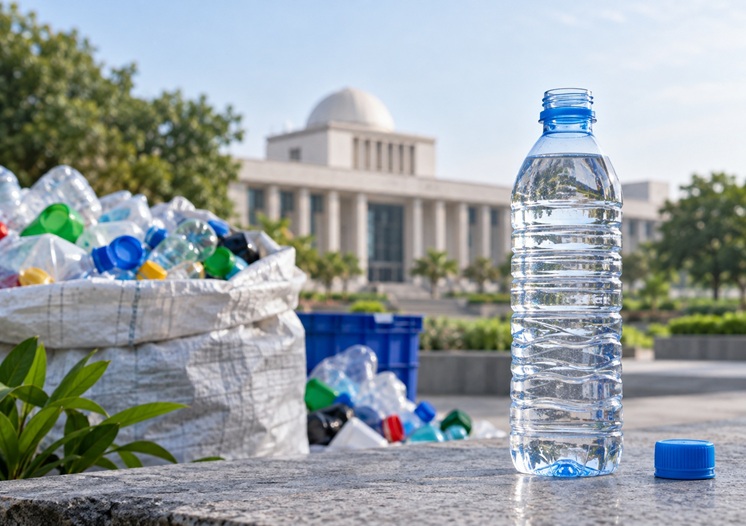


Bisleri has opposed a proposed tethered-cap mandate before the NGT, citing EPR compliance, transition costs, recycling concerns and counterfeit-water risks.
NEW DELHI (India CSR): Bisleri International Private Limited has opposed a proposed mandate for tethered caps on plastic beverage bottles in India, stating before the National Green Tribunal (NGT) that the present Extended Producer Responsibility (EPR) framework already addresses collection and recycling of plastic packaging, including bottle caps. The submission has been made in a reply affidavit filed by Bisleri, respondent no. 6, in Original Application No. 137 of 2026, Aakash Ranison vs Central Pollution Control Board & Ors. The application seeks directions for mandating tethered caps for plastic beverage bottles to prevent plastic pollution and enforce the Plastic Waste Management Rules, 2016.
It is worth mentioning that Hindustan Unilever Limited (HUL) has also asked the National Green Tribunal (NGT) to dismiss an application against it in a case seeking directions to make tethered caps mandatory for plastic beverage bottles in India. In its reply filed in Original Application No. 137 of 2026, Aakash Ranison vs Central Pollution Control Board (CPCB) & Ors., HUL has argued that Indian law does not currently require tethered caps and that the relief sought by the applicant is essentially a policy and rule-making matter for the Central Government.
Tethered caps are closures designed to remain attached to bottles after opening, reducing the chance of a cap being separately discarded or lost in the waste stream.
Company Denies Legal Breach
In its affidavit verified on August 31, 2026, Bisleri said the original application does not contain entity-specific allegations or product-specific data against the company. It submitted that there is currently no legal mandate requiring tethered caps in India and therefore it is not in breach of any prevailing law on this issue. The company stated that it is registered with the Central Pollution Control Board (CPCB) as a brand owner under the Plastic Waste Management framework. It further said the application’s assertions on the scale of PET bottle and cap waste were unsupported by primary or India-specific data.
Bisleri argued that the applicant had not quantified the share of total plastic litter in India attributable specifically to bottle caps or demonstrated the additional environmental benefit that a tethered-cap mandate would provide over existing EPR collection mechanisms.
HUL Seeks Dismissal from NGT Case Seeking Mandatory Tethered Caps on Plastic Beverage Bottles
***
EPR Framework Cited
The affidavit stated that producers, importers and brand owners are required under the EPR regime to ensure the processing of plastic packaging waste through recycling, reuse or end-of-life disposal. Bisleri said its EPR obligation covers collection and recycling of 100% of plastic introduced into the market, including the weight of caps. It said it files annual returns on the CPCB EPR portal and annexed its return for 2024–25, stating that its targets had been achieved.
The company also cited a Lok Sabha reply dated July 18, 2022, in which the Ministry of Environment, Forest and Climate Change said there was more than 90% collection of PET waste in India. The ministry had stated that PET imports were later permitted to address a shortage of feedstock for recycling units, despite the high collection rate. Bisleri further referred to a notification dated March 31, 2026, stating that recycled plastic content had been mandated in addition to the EPR obligations of brand owners. According to the affidavit, PET bottles and HDPE caps are single polymers and are recyclable.

***
Cost and Manufacturing Concerns
The company told the tribunal that switching to tethered caps would require specialised imported machinery, moulds and capping equipment. It said the transition could require replacement of injection moulds and capping lines across company-owned and franchisee plants. Bisleri submitted that India has more than 6,200 packaged drinking water manufacturing plants, of which it said 80% are micro and small enterprises. It argued that the required investment could be difficult for smaller manufacturers and cap suppliers to absorb.
The affidavit also stated that redesigning bottle necks, caps and machinery would involve product testing, research and development, procurement and supply-chain changes. According to the company, these changes could raise production costs and disrupt supply chains during the transition.
***
Plastic Use and Consumer Issues
Bisleri argued that tethered-cap designs may require additional plastic for reinforced hinges or thicker sections needed to maintain the cap’s flexibility and attachment strength. It said a small increase in cap weight, when applied across a large volume of bottles, could add substantial quantities of plastic to the market. The company also raised concerns relating to consumer use, stating that attached caps could obstruct pouring or touch the face while drinking. It said this could affect user experience, particularly for children and elderly consumers.
***
Counterfeit Water Concern
The affidavit additionally raised concerns about refilling and counterfeit packaged water. Bisleri said that a broken seal is an important safety indicator for consumers and claimed that tethered caps could make it easier for counterfeiters to refill bottles and reattach caps in a manner that appears sealed. It submitted that this issue should be considered in the Indian context and said any alleged gaps in plastic-waste management should be addressed through enforcement against entities that do not comply with the existing EPR framework.
Bisleri has requested the NGT to dismiss the original application, submitting that the proposed product-design mandate would impose a disproportionate burden without a demonstrated environmental benefit commensurate with the costs.
Source: Reply affidavit filed by Bisleri International Private Limited, Respondent No. 6, in OA No. 137/2026 before the National Green Tribunal, Principal Bench, New Delhi.
© Copyright Disclaimer: All rights reserved. No part of this report may be reproduced, republished, distributed or transmitted in any form without prior written permission from India CSR®



