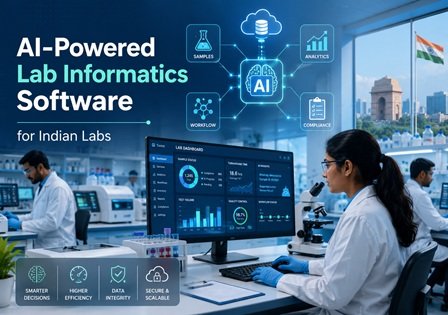


Discover how AI lab informatics software helps Indian labs manage data, automate routine work, and use advanced analytics for better decisions.
Laboratories of today hold an exponential amount of data that centers on patient diagnosis, research, and studies. They no longer stand just as testing facilities, but they are data-driven ecosystems where speed, accuracy, and insight define success. However, to contain such data volumes and analyze them through its complex structures is humanly tough. Laboratory Informatics Software helps handle such a pool of data, streamlines, processes, and analyzes it to improve healthcare and lab decision-making.
With artificial intelligence now embedded into the core functionality of lab data management solutions, labs can expect far more than basic recordkeeping. Modern solutions are designed to meet the growing advancements of labs today. Hence, lab leaders must know what is expected from these systems before planning & investing in them.
From Digital Storage to Intelligent Operations
Older systems focused mainly on capturing and storing information. While that solved one problem, it created others, such as disconnected workflows, delayed reporting, and limited visibility. Modern lab informatics software driven by AI technology shifts the focus from simple documentation to intelligent operations.
AI systems can recognize patterns that can be missed by a human eye, flag anomalies, and suggest optimizations based on historical and real-time data. This means labs no longer have to wait for issues to surface. Instead, they can prevent errors in real-time, control turnaround times, and ensure consistent quality across all processes.
For growing organizations, this intelligence becomes even more valuable. It helps teams stay ahead of operational challenges while maintaining accuracy and compliance.
Automation That Frees Teams to Do More
Manual processes drain time, energy, and morale. From repetitive data entry to routine validations, many lab tasks don’t require human judgment, but they do require precision.
This is where next-generation LIMS solutions bring measurable impact. By automating routine workflows, these systems reduce dependency on manual inputs while maintaining consistency. AI can also prioritize tasks, detect outliers, and recommend corrective actions in real time.
AI systems can handle tasks that are slower and prone to unavoidable human errors. For example, uploading handwritten TRF info into the system can cause transcription errors if the technician misinterprets the handwriting. AI-powered Cloud-based LIMS can save the trouble and speed up this process in bulk.
The result is not just efficiency; it’s a better experience for staff. When teams spend less time on repetitive work, they can focus on analysis, innovation, and quality improvement.
Unified Data, Zero Silos
Data silos are one of the biggest barriers to lab efficiency. When information is scattered across spreadsheets, devices, and disconnected tools, it becomes harder to trust results or act quickly.
Modern lab data management solutions eliminate this fragmentation by centralizing everything into a single, connected environment. Instrument data, quality metrics, compliance logs, and patient records all live in one secure ecosystem.
This unified view, summarized and compared using AI, improves transparency, reduces duplication, and enables faster collaboration across departments.
Cloud and Web-Based Access for Flexible Teams
Flexibility is no longer optional. Labs today operate across locations, time zones, and hybrid teams. That’s why cloud-based systems are becoming the default choice.
A well-designed LIMS System allows users to access critical data securely from anywhere, anytime, and through multiple devices, without being tied to local servers. Updates happen automatically, scaling is seamless, and system reliability improves dramatically.
Meanwhile, a well-architected web-based LIMS enhances usability with intuitive dashboards, role-based views, and mobile-friendly interfaces. This ease of use shortens training time and accelerates adoption across teams. It is also very helpful for employees working outside a lab’s premises, like a phlebotomist, making their communication and collaboration quick.
Analytics That Drive Real Business Value
Data alone doesn’t drive value; insights do.
Advanced Laboratory Data Management Software uses AI-powered analytics to convert raw numbers into actionable intelligence. These systems can:
- Identify workflow inefficiencies
- Forecast test demand surges
- Detect recurring quality issues
- Optimize resource allocation
What would take humans hours or days to analyze, AI can process in minutes. More importantly, it uncovers patterns that the human eye might miss.
This allows labs to operate proactively rather than reactively, improving turnaround times, reducing rework, and delivering better patient experiences.
Built for Growth, Compliance, and Security
Growth brings complexity. More samples, more users, more regulations; everything scales at once. New-age LIMS Software Solutions are built to handle this complexity without slowing down or interrupting operations. These platforms support modular expansion, seamless integrations, and configurable workflows. So, as labs evolve, the software grows with them.
In addition to growth, these platforms support mandated standard operating procedures to enable consistency & quality in the core laboratory processes. As a result, it encourages staff to adapt and follow regulatory requirements and be audit-ready without undergoing rigorous documentation.
With sensitive data at stake, security-enabled laboratory data management software becomes a priority. Role-based access, audit trails, encryption, and AI-driven monitoring ensure that sensitive information remains protected at all times.
Smarter Integrations Across the Lab Ecosystem
No lab system of today works in isolation. Connectivity, interoperability, and uninterrupted collaborations are the key essentials for smooth operations.
Made for seamless interoperability, laboratory informatics software integrates easily with instruments, billing platforms, reporting tools, and enterprise systems. This interoperability eliminates redundant data entry, sharing, and communication to ensure consistency across workflows.
When systems communicate smoothly, productivity increases and errors drop significantly.
A Strategic Investment, Not Just a Tool
Smart laboratories don’t view LIMS solutions as an IT purchase; they see it as a business investment.
Systems updated with changing trends empower organizations to deliver faster results, maintain higher quality standards, and adapt quickly to changing demands. Using intelligent data improves visibility for leadership, making it easier to track performance and plan strategically.
For labs aiming to stay competitive, this level of intelligence is no longer optional.
Final Thoughts
AI-powered platforms are redefining what’s possible in next-gen laboratories. From automation and analytics to secure cloud access and real-time visibility, today’s lab solutions are designed to do more than store information; they turn data into a competitive advantage.
Choosing the right system means looking beyond basic functionality and focusing on long-term value. The best LIMS software solutions don’t just support operations; they actively improve them.
With intelligent design, seamless integration, and predictive capabilities, the future of lab informatics is not just digital; it’s smart, scalable, and strategically driven.
(India CSR)