


• India CSR Awards 2026
  • India CSR Leadership Summit
  • Maharashtra CSR Summit 2027
  • Guest Posts
Wednesday, November 18, 2026
India CSR®
  • Home
  • CSR
    • Art & Culture
    • CSR Leaders
    • Child Rights
    • Culture
    • Education
    • Gender Equality
    • Around the World
    • Skill Development
    • Safety
    • Covid-19
    • Safe Food For All
  • Sustainability
    • Sustainability Dialogues
    • Sustainability Knowledge Series
    • Plastics
    • Sustainable Development Goals
    • ESG
    • Circular Economy
    • BRSR
  • SUMMIT
  • AWARDS
  • Interviews
  • SDGs
    • No Poverty
    • Zero Hunger
    • Good Health & Well-Being
    • Quality Education
    • Gender Equality
    • Clean Water & Sanitation – SDG 6
    • Affordable & Clean Energy
    • Decent Work & Economic Growth
    • Industry, Innovation & Infrastructure
    • Reduced Inequalities
    • Sustainable Cities & Communities
    • Responsible Consumption & Production
    • Climate Action
    • Life Below Water
    • Life on Land
    • Peace, Justice & Strong Institutions
    • Partnerships for the Goals
  • Articles
  • Events
  • हिंदी
  • More
    • Business
    • Finance
    • Corporate Governance
      • Diversity & Inclusion
    • Environment
    • Economy
    • Health
    • Around the World
    • Social Sector Leaders
    • Social Entrepreneurship
    • Trending News
      • Important Days
        • Festivals
      • Great People
      • Product Review
      • International
      • Sports
      • Entertainment
    • Case Studies
    • Philanthropy
    • Biography
    • Technology
    • Lifestyle
    • Sports
    • Gaming
    • Knowledge
    • Home Improvement
    • Words Power
    • Chief Ministers
No Result
View All Result
India CSR®
No Result
View All Result
Home Business

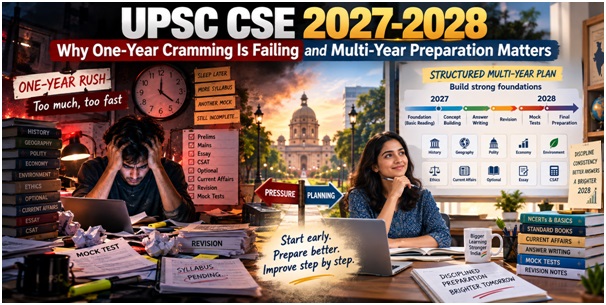
UPSC CSE 2027-2028: Why One-Year Cramming Is Failing and Multi-Year Preparation Matters

India CSR by India CSR
October 24, 2026
Reading Time: 6 mins read
A A
India CSR®
Share Share Share Share
WhatsApp icon
WhatsApp — Join Us
Instant updates & community
Google News icon
Google News — Follow Us
Get our articles in Google News feed
india csr awards
ADVERTISEMENT

UPSC CSE has a wide syllabus and requires preparation for both Prelims and Mains. Aspirants need to study subjects such as history, geography, polity, economy, environment, ethics and current affairs. They also need to prepare an optional subject, Essay and CSAT. Trying to cover all these areas in just one year can make preparation stressful. It can also leave less time for revision, answer writing and mock tests. This is why many aspirants are now looking at a longer and more structured preparation plan. For that a multi-year foundation model gives students two to three years to build their concepts, practise regularly and improve step by step. The focus is not on studying for more years without a plan. It is about using the extra time for better understanding, revision and regular practice. For students targeting UPSC CSE 2027 or 2028, starting early can provide enough time to build a strong foundation before moving towards intensive examination preparation.

Why One-Year Cramming Is Becoming Difficult

UPSC CSE has a wide syllabus that covers Prelims, Mains and the Personality Test.  An aspirant has to prepare General Studies, CSAT, an optional subject, Essay, Ethics and current affairs. If you try to cover all these areas in one year you will leave very little time for revision and regular practice. Prelims also requires more than memorising facts. Aspirants need to understand concepts and apply them while solving questions. Mains requires another set of skills. Students have to write clear, relevant and analytical answers within a limited time. Answer writing cannot improve through reading alone. It needs regular practice and feedback. The same is true for revision and mock tests. If too much time is spent completing the syllabus, students may have less time to practise these important areas.
india csr awards
ADVERTISEMENT

The changing nature of questions also makes a quick preparation approach difficult. Current affairs are often connected with static subjects, and Mains questions can require links between areas such as polity, economy, society and environment. This is why starting early can give aspirants more time to build concepts, practise answer writing, revise multiple times and improve gradually.

The Changing Nature of UPSC CSE

UPSC CSE preparation is no longer limited to memorising facts from standard books. Questions require aspirants to understand concepts and apply them to different situations. This is visible in both Prelims and Mains. Current affairs also play an important role in preparation. An issue in the news may need to be understood through different subjects. For instance, an environmental issue can have links with the economy, governance, science and society.

Mains questions can also connect different areas of the syllabus. An aspirant may need to use knowledge of polity, economy, society and environment while answering a single question. This makes interdisciplinary understanding important. Essay and Ethics require another level of preparation. Students need to develop clear arguments, use relevant examples and present their thoughts in a balanced manner. Because of this changing nature, UPSC preparation needs regular reading, revision, answer writing and analysis. These skills take time to develop and are difficult to build through last-minute preparation alone.

What Is the Multi-Year Foundation Model?

The multi-year foundation model means preparing for UPSC CSE over two to three years in a planned way. Instead of trying to complete the entire syllabus in one year, aspirants divide preparation into clear stages. The first stage focuses on NCERTs, basic concepts and building a regular current affairs reading habit. The second stage covers advanced books, the optional subject, note-making and answer-writing practice. The final stage focuses on revision, PYQ analysis, mock tests and improving weak areas. The aim is to build knowledge and skills gradually. It gives aspirants more time for practice, revision and improvement before the examination.

First year : Build the Foundation

The first year should focus on basic concepts and understanding the UPSC syllabus. Aspirants can study NCERTs, read newspapers regularly and build a clear understanding of subjects such as history, geography, polity and economy. The main aim should be concept clarity.

Second year : Build Core Preparation

The second year can focus on advanced books, the optional subject and useful note-making. Aspirants should start regular Mains answer writing and analyse previous year questions. This stage can help improve content, structure and analytical thinking.

Third year : Revision and Testing

The third year should focus on revision and examination practice. Aspirants can revise their notes, take mock tests and analyse their performance. Regular Prelims practice and Mains answer writing can help improve speed and accuracy. This phase should also focus on weak areas and repeated revision before the examination.

Benefits of Starting Early

Starting UPSC preparation early gives aspirants more time to understand the syllabus and build strong concepts. It reduces the pressure of completing everything in a short period.

Early preparation also allows students to revise important topics multiple times. They can start answer writing sooner and gradually improve their structure, analysis and presentation. A longer preparation period also gives students time to identify and work on their weak areas. They can learn from mistakes through regular practice and self-assessment. Starting early can also make it easier to balance UPSC preparation with college or work. A realistic schedule can help students stay consistent without putting too much pressure on themselves.

Challenges of a Multi-Year Preparation

A multi-year UPSC preparation plan gives more time, but it also comes with some challenges. Staying consistent for two or three years can be difficult. Aspirants may lose motivation if they do not see quick results. Time management can also be a challenge for students who are studying in college or working. They need to balance their regular responsibilities with UPSC preparation. Financial and social pressure can also affect long-term preparation. Some students may feel pressure to clear the exam quickly. There is also a risk of overpreparation. Aspirants may keep collecting books, notes and courses without enough revision or practice. A clear plan, limited resources and regular self-assessment can help avoid these problems.

Who Can Follow This Approach?

The multi-year approach can work well for students who want to start UPSC preparation early. College students can use this time to build basic concepts and develop a regular study habit. Fresh graduates can also follow this approach. They can gradually cover the syllabus, practise answer writing and prepare for Prelims and Mains. Working professionals can use a part-time or weekend schedule. They can study for a few hours each day and use weekends for longer study sessions. This approach can also help beginners who need more time to understand the UPSC syllabus. The main requirement is consistency. Aspirants should set realistic goals and make steady progress instead of trying to complete everything at once.

How to Make a Multi-Year Plan Work

A multi-year plan works when aspirants follow a clear and realistic routine. The plan should have small targets for each month instead of keeping the entire syllabus as one large goal. Aspirants should use limited and standard study resources. Collecting too many books and materials can waste time. Regular revision should be part of the plan from the beginning. Answer writing, PYQ practice and mock tests should be added gradually. Students should also review their performance and work on weak areas. Consistency is more important than studying for long hours on some days and doing nothing on others.

Aspirants can also take guidance from teachers or mentors when they face difficulties. The plan should be flexible enough to change when needed, while keeping the main preparation goals clear. Vajirao & Reddy IAS Institute is a well known IAS coaching institute that also offers a multi-year course for students who want to start early. The course helps them build concepts, develop skills and follow a structured preparation plan.

Conclusion

UPSC CSE preparation is a long process that requires knowledge, practice and regular revision. Trying to complete the entire preparation in one year can create pressure and leave less time for practice. A multi-year foundation approach gives aspirants more time to understand concepts, develop answer-writing skills and revise important topics. It can also help students prepare alongside college or work. However, a longer preparation period does not mean studying without a clear plan. Aspirants need realistic goals, limited resources and regular self-assessment. Starting early with a structured plan can make preparation more steady and manageable. The aim should be to build strong knowledge and skills over time rather than depend on last-minute preparation.

csr education cybernetyx
ADVERTISEMENT
India CSR Image 1 India CSR Image 2

CSR, Sustainability, and ESG success stories hindustan zinc
ADVERTISEMENT
India CSR

India CSR

India CSR® is the largest media on CSR and sustainability offering diverse content across multisectoral issues on business responsibility. It covers Sustainable Development, Corporate Social Responsibility (CSR), Sustainability, and related issues in India. Founded in 2009, the organisation aspires to become a globally admired media that offers valuable information to its readers through responsible reporting.

Related Posts

India CSR®
Business

Top 5 Real Estate Companies in Panama for Foreign Buyers (2026)

8 hours ago
India CSR®
Business

ESG Analyst in India: The Data Skills Behind BRSR Reporting

11 hours ago
India CSR®
Business

Why Whole-Kitchen Airflow Matters When Using a Low-Profile Ductless Range Hood

13 hours ago
India CSR®
Business

SDG 7 in Action: Energy-Efficient Appliances for CSR-Funded Facilities

14 hours ago
India CSR®
Business

Union Minister Nitin Gadkari Honours Winners of Job-Creating Micro-Entrepreneurs at JRD Tata Awards 2026

14 hours ago
India CSR®
Business

From Rs 15 Biscuit Packets to Company Ownership: Chaai Kaapi Gifts ESOPs to Employees This Diwali

17 hours ago
Load More
csr education cybernetyx
ADVERTISEMENT
bba
ADVERTISEMENT

Interviews

Foundation for Excellence (FFE) @India CSR
Interviews

Beyond Graduation: How FFE Is Helping First-Generation Students Build Careers and Change Family Futures

by India CSR
November 13, 2026

In an interaction with India CSR, Ram Kolavennu, CEO, and Dr. Sudha Kidao, Managing Trustee, Foundation for Excellence (FFE), explain...

Read moreDetails
Isha Anand Director - Mixed Use RMZ Corp-India CSR

“ESG is Now a Core Business Strategy”: Isha Anand on Building Future-Ready Real Estate

November 12, 2026
Geetaj Channana, Chief Corporate Communications Officer, vivo India @india csr

“We Will Not Compromise on Credibility”, Says Geetaj Channana on vivo Ignite and India’s Young Innovators

November 3, 2026
Smitha Gopalkrishnan Asia Sustainability Leader & India CSR Leader 3M India-@India CSR

“Water Security Is a Shared Responsibility”: Smitha Gopalkrishnan on 3M India’s Water Stewardship Work

October 23, 2026
Load More
Ad 1 Ad 2 Ad 3 Ad 4 Ad 5 Ad 6
ADVERTISEMENT

CSR UPDATES

Vedanta Power Launches Campaign to Build Awareness on Sustainable Paddy Straw Management

NSRCEL and Kotak Mahindra Bank’s Women Startup Program 6 Supports 90 Women Entrepreneurs Across India

BIPF’s IDEATE 2026 Calls for Community-Led Water Security to Drive Rural Transformation

How CSR Teams Can Build Lasting Employee Wellness

A New Skills Chapter Begins in Gadchiroli: Chief Minister Devendra Fadnavis Inaugurates Lloyds Mission for Global Skills and Entrepreneurship

Rusen Kumar to Address National CSR Conclave on Skills, Education and Future Workforce in Mumbai

STEM Learning STEM Learning STEM Learning
ADVERTISEMENT
Facebook Twitter Youtube LinkedIn Instagram
India CSR Logo

India CSR® is the largest tech-led platform for information on CSR and sustainability in India offering diverse content across multisectoral issues. It covers Sustainable Development, Corporate Social Responsibility (CSR), Sustainability, and related issues in India. Founded in 2009, the organisation aspires to become a globally admired media that offers valuable information to its readers through responsible reporting. To enjoy the premium services, we invite you to partner with us.

Follow us on social media:

Subscribe to Our Newsletter

Don't miss out on the latest updates in corporate social responsibility. Subscribe to our newsletter at indiacsr.in and be part of the positive change.
Please enable JavaScript in your browser to complete this form.
Loading

  • About India CSR®
  • Team
  • India CSR® Awards 2026
  • India CSR® Leadership Summit
  • Maharashtra CSR Summit 2027
  • Partnership
  • Guest Posts
  • Services
  • ESG Professional Network
  • Content Writing Services
  • Business Information
  • Contact
  • Privacy Policy
  • Terms of Use
  • Donate

Copyright © 2026 - India CSR® | All Rights Reserved

No Result
View All Result
  • Home
  • CSR
    • Art & Culture
    • CSR Leaders
    • Child Rights
    • Culture
    • Education
    • Gender Equality
    • Around the World
    • Skill Development
    • Safety
    • Covid-19
    • Safe Food For All
  • Sustainability
    • Sustainability Dialogues
    • Sustainability Knowledge Series
    • Plastics
    • Sustainable Development Goals
    • ESG
    • Circular Economy
    • BRSR
  • SUMMIT
  • AWARDS
  • Interviews
  • SDGs
    • No Poverty
    • Zero Hunger
    • Good Health & Well-Being
    • Quality Education
    • Gender Equality
    • Clean Water & Sanitation – SDG 6
    • Affordable & Clean Energy
    • Decent Work & Economic Growth
    • Industry, Innovation & Infrastructure
    • Reduced Inequalities
    • Sustainable Cities & Communities
    • Responsible Consumption & Production
    • Climate Action
    • Life Below Water
    • Life on Land
    • Peace, Justice & Strong Institutions
    • Partnerships for the Goals
  • Articles
  • Events
  • हिंदी
  • More
    • Business
    • Finance
    • Corporate Governance
      • Diversity & Inclusion
    • Environment
    • Economy
    • Health
    • Around the World
    • Social Sector Leaders
    • Social Entrepreneurship
    • Trending News
      • Important Days
      • Great People
      • Product Review
      • International
      • Sports
      • Entertainment
    • Case Studies
    • Philanthropy
    • Biography
    • Technology
    • Lifestyle
    • Sports
    • Gaming
    • Knowledge
    • Home Improvement
    • Words Power
    • Chief Ministers

Copyright © 2026 - India CSR® | All Rights Reserved

This website uses cookies. By continuing to use this website you are giving consent to cookies being used. Visit our Privacy and Cookie Policy.
