

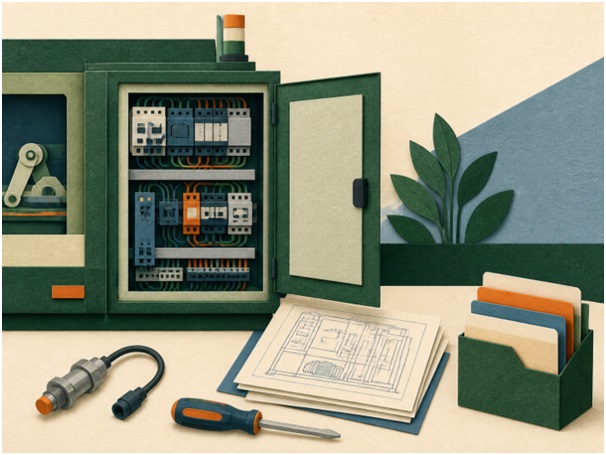



An automation project changes more than the number of manual tasks on a production line. It changes who knows why the machine stopped, who can make it safe, and who has enough information to restore production without waiting for the original engineering team. If that knowledge remains concentrated outside the plant, the investment may improve output while weakening local capability.
A company appointing a system integrator Singapore partner should therefore treat knowledge transfer as a project deliverable. The question is not whether operators receive a presentation at commissioning. It is whether maintenance staff can identify a fault, find the relevant drawing, replace the correct part, verify the repair, and return the equipment to service within their authorized role.

Motionwell Automation describes a full-cycle model that covers mechanical and electrical engineering, PLC and HMI work, machine assembly, testing, operator training, manuals, maintenance schedules, and post-commissioning support. That public scope offers a practical way to discuss responsible automation: the machine and the capability to maintain it should arrive together.
Automation Changes Who Holds Operational Knowledge
In a manual process, much of the operating knowledge sits with experienced workers. They recognize a misfed component by sound, know which adjustment affects alignment, and notice when a fixture begins to wear. Automation does not eliminate that knowledge. It translates some of it into sensors, recipes, tolerances, interlocks, and programmed sequences.
The translation creates a risk. If the reasoning behind those controls is visible only to the machine builder, plant staff may be able to press reset without understanding the condition that caused the stop. Repeated resets can hide wear, defeat traceability, or turn a minor feeder issue into damaged tooling.
Map Knowledge Before the Machine Leaves Singapore
Knowledge transfer should start during design review, not after factory acceptance. Ask who will own mechanical adjustment, electrical diagnosis, PLC backup, vision recipe control, calibration, preventive maintenance, and spare-parts ordering. For each task, decide what the plant team may do independently and what still requires specialist support.
This map also prevents training from becoming too broad. An operator needs different knowledge from a controls engineer. The operator should recognize states, safe interventions, and escalation points. Maintenance personnel need drawings, component references, diagnostic paths, and verification procedures. Giving everyone the same slide deck serves neither group.
Treat Operator Training as a Design Test
Training reveals whether the HMI, access points, and fault messages make sense to the people who will use them. Let a normal shift operator clear a staged misfeed using the delivered screen and procedure. If the trainer has to translate every alarm into an unwritten action, the interface or manual still needs work.
The strongest result is not a confident instructor. It is an operator who can explain what the machine believes, what physical check comes next, and when work must stop for maintenance or engineering support.
Documents Must Match the Delivered Machine
Documentation is often listed as a package item, yet its value depends on exact correspondence with the equipment on the floor. A schematic showing an early sensor model, a spare-parts list without vendor codes, or an HMI manual using obsolete screenshots can slow recovery more than no document at all because it sends technicians down the wrong path.
The medical-device project scope described by Motionwell Automation can include mechanical drawings, electrical schematics, PLC program documentation, operator manuals, maintenance schedules, spare-parts lists, and validation support. A responsible handover connects each item to a real maintenance decision rather than treating the files as evidence that a folder exists.
Give Every Document a Maintenance Job
A useful handover matrix is small enough to use during acceptance. It names the plant task, the document or control needed, and a simple proof that the information matches the final machine.
| Maintenance task | Required handover item | Acceptance proof |
| Locate an electrical fault | As-built schematic and panel labels | Technician traces one staged signal loss |
| Restore control software | PLC/HMI backup and version record | Team identifies the approved restore file |
| Replace a wear component | Spare-parts list and drawing reference | Part number matches installed hardware |
| Verify a vision station | Recipe, lighting, and calibration procedure | Known sample returns the expected result |
| Plan preventive work | Maintenance schedule and access method | Task can be performed safely as written |
The proof column matters because document quality cannot be judged from filenames. One controlled exercise exposes missing revision marks, inaccessible backups, unclear photographs, and tasks that require tools the plant does not own.
Make spare parts a capability decision. A long spare-parts list is not automatically responsible procurement. Criticality, lead time, wear rate, storage condition, and the skill needed for replacement all affect what should be held locally. A low-cost sensor with a long delivery time may deserve a shelf position before an expensive assembly that rarely fails and requires factory alignment.
The discussion should also cover obsolescence. Record the installed model, approved equivalent, firmware or parameter dependencies, and the test required after replacement. That turns purchasing data into a recovery plan.
Maintenance Work Shapes Safety and Job Quality
Responsible business reporting often counts jobs created, training hours, or injuries avoided. Automation adds another dimension: the quality of the work left behind. A well-designed machine can move workers away from repetitive handling while giving technicians clearer diagnostic information and more structured maintenance tasks. A poorly transferred system can replace physical repetition with stressful dependence on opaque alarms.
This matters beyond the production target. When local staff can perform authorized checks and planned maintenance, the plant is less exposed to avoidable travel, emergency freight, and prolonged stoppages while outside help is arranged. Those benefits should not be inflated into guaranteed sustainability gains, but they are legitimate operating questions for a responsible investment review.
Define Safe Authority Before the First Breakdown
Plant staff need a clear boundary between permitted recovery and protected engineering access. Operators may clear a known obstruction after isolation, while changes to safety logic, force limits, inspection tolerances, or electronic records require a different approval path. The boundary should appear in training, access permissions, and written procedures.
Motionwell Automation integrates safeguarding, PLC control, machine vision, robotics, and operator interfaces in custom systems. That combination makes role clarity essential. A technician who can reach a component physically may still lack authorization to alter the logic around it.
Use recurring faults as training evidence. Alarm histories and maintenance records can show whether knowledge transfer is working. Repeated calls for the same recoverable fault may indicate a weak procedure, confusing message, inaccessible tool, or training gap. The responsible response is not to blame the operator; it is to improve the information or design that shapes the decision.
Over time, this creates a better measure than attendance sheets. The plant can see whether local teams resolve defined events safely, whether escalation becomes more precise, and whether lessons are folded back into the handover set.
Managers can review the same evidence with employee representatives: which faults remain confusing, which tasks create awkward access, and which training gaps recur across shifts. That conversation turns workforce participation into engineering input instead of a consultation held after the machine is already fixed in place.
A Responsible Handover Has Real Boundaries
No documentation package makes every repair appropriate for local execution. Proprietary algorithms, certified safety functions, precision calibration, and major software changes may still require the integrator or equipment vendor. Responsible transfer means making those limits explicit, preserving escalation routes, and ensuring that plant staff can keep the machine safe while expert support is arranged.
Audit the Handover Before Measuring Social Value
Before presenting automation as a workforce or sustainability success, inspect one real handover. Select a consequential fault, ask the assigned employee to diagnose it, and observe which drawing, screen, tool, and permission the task requires. Check that the installed part matches the record and that the repair has a defined verification step.
Motionwell Automation or any other custom builder should be judged on whether the plant can retain safe, useful operational knowledge after commissioning. The responsible outcome is not independence at any cost. It is a workforce that understands what it can solve, what it must escalate, and where the evidence for that decision lives.


