

Public-interest information often needs to travel across languages.
A municipality may need to explain a transport change. A university may be communicating enrollment updates. A nonprofit might need versions of the same public-awareness message for Arabic, Amazigh, French, English, or other audiences.

Translation is only part of the job.
Dates, addresses, fees, eligibility rules, maps, and safety instructions must remain accurate in every version. A message that works as a written notice may also become confusing when compressed into a short video.
That makes multilingual public-interest video a useful case for AI-assisted production—but only if the technology helps with presentation rather than becoming a new source of facts.
Start With One Verified Master Brief
Suppose a public-interest team needs to explain a change to a city transport service.
The master brief might contain the effective date, affected routes, verified stop locations, service hours, accessibility information, and the official source for further details.
That document remains authoritative.
Editors first decide what needs narration, what belongs on screen, and which information requires a verified map or graphic. Each language version can then be translated and reviewed before video production begins.
This separation matters. Translating and generating at the same time makes it harder to identify where an error entered the workflow.
Track Meaning Across Languages
A multilingual workflow should preserve claims, not simply sentences.
The same fact may need different wording in Arabic, Amazigh, French, or English while keeping the underlying meaning unchanged.
A simple editorial record can help:
| Master claim | Language version | Review |
| Service begins 15 September | Arabic / Amazigh / French / English | Language + subject review |
| Route 4 moves to Central Station | Arabic / Amazigh / French / English | Language + transport review |
| New hours begin at 06:00 | Arabic / Amazigh / French / English | Language + fact check |
This gives editors something concrete to compare when narration length, terminology, or sentence structure changes between languages.
The goal is not identical wording. It is consistent meaning.
Review should also cover writing direction, line breaks, numeral formatting, date and time conventions, pronunciation, terminology, and caption safe areas. Arabic layouts may require right-to-left composition, while Amazigh versions should follow the approved script and terminology standard for the intended audience.
Where Seedance 2.5 Fits
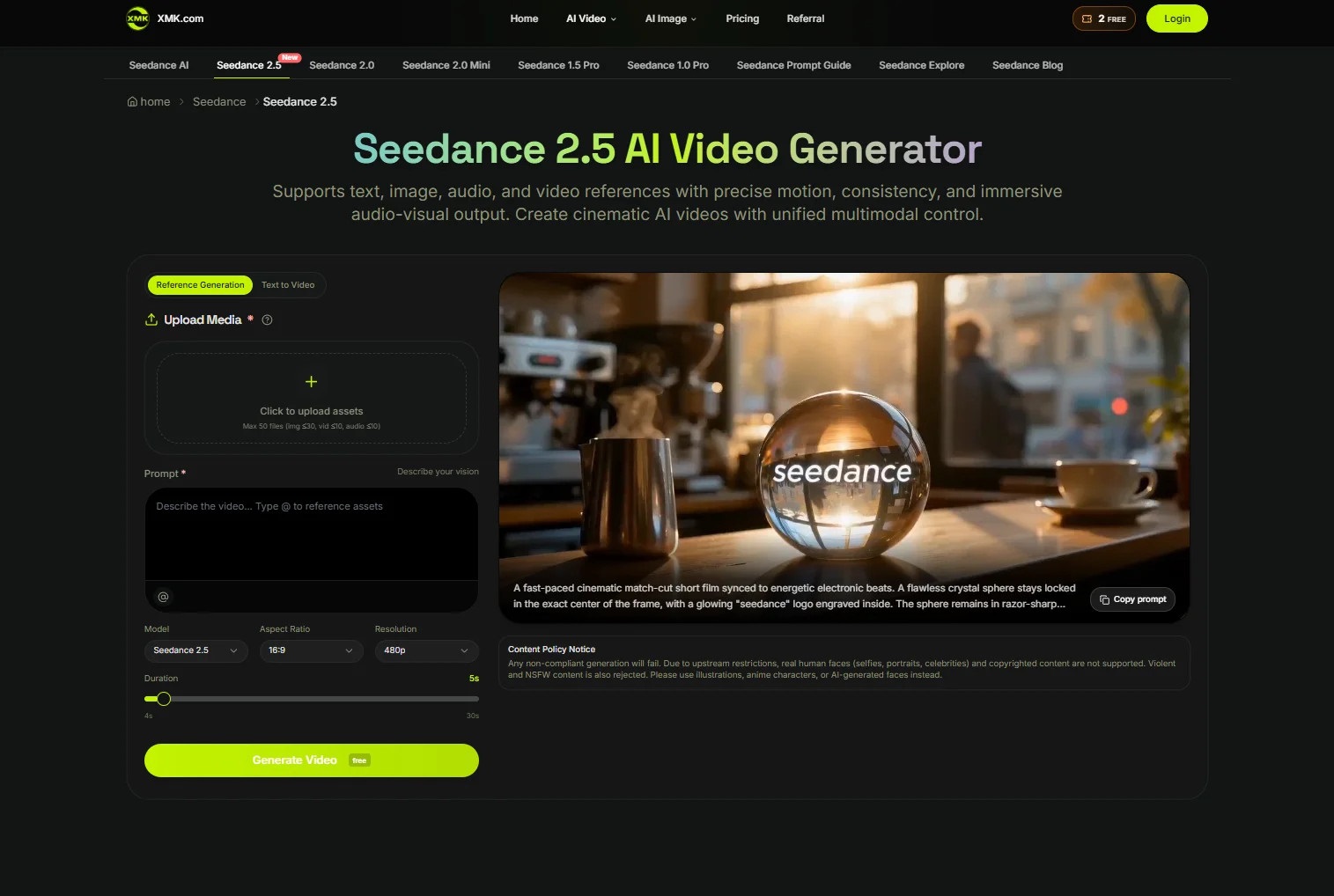
Once the master brief and language versions are approved, Seedance 2.5 ai can be considered for visual prototyping.
XMK describes Seedance 2.5 as accepting text alongside image, video, and audio references, with generation of up to 30 seconds and post-generation editing options.
For a multilingual team, the useful question is not whether AI can create the public message by itself. It is whether a visual draft can expose presentation problems early.
Perhaps a timeline moves too quickly. A French narration may need more time than the original draft allows. An Arabic version may require a different text layout. A diagram may need to remain on screen longer.
Those are production questions that can be explored before the final briefing is assembled.
Keep Facts Outside the Generative Layer
Reference inputs can guide a draft, but they do not guarantee factual fidelity.
A model may redraw a map, alter a number, distort text, change a logo, or modify the proportions of a chart even when the original asset was supplied as a reference.
For precise information, use the original verified material.
| Briefing element | Authoritative source |
| Dates and times | Approved master brief |
| Addresses | Official record |
| Numbers and fees | Verified document or dataset |
| Maps and routes | Trusted geographic source |
| Translated wording | Reviewed language version |
| Contact information | Official organisation record |
| Generated imagery | Supporting context only |
Where exact visual fidelity matters, verified maps, charts, text, logos, and information panels should be composited into the final video with conventional editing tools rather than recreated by the model.
A generated map that moves a route or a generated number that changes a fee is not a cosmetic error. In public-interest communication, it can change the meaning of the message.
One Structure Does Not Mean Identical Versions
A multilingual briefing can share the same editorial structure without forcing every language into exactly the same timing or layout.
A basic sequence might introduce the issue, explain what is changing, show the affected area, present the effective date, and direct viewers to an official source.
But narration length and reading speed vary between languages.
Arabic may require different spacing and right-to-left composition. Amazigh content may require an approved Tifinagh, Arabic, or Latin-script convention depending on the intended audience and institutional standard. French and English versions may also need different line breaks to remain readable on smaller screens.
Each version should therefore be reviewed as its own publication.
The final test is straightforward:
Would someone relying only on this language version receive the same verified information?
If not, the version is not ready.
Separate Prototyping From Publishing
The seedance 2.5 ai video also presents local re-draw as a way to target elements such as a product, background, or subject.
This may help refine a non-factual part of an internal prototype, but the complete clip should be reviewed again because nearby motion, composition, lighting, or other details may also change.
Factual maps, numbers, text, or documentary material should remain outside generative editing.
A practical workflow can stay simple:
- Verify — Create one authoritative master brief.
- Translate — Produce and review each language version.
- Prototype — Test the visual structure with approved, non-sensitive material.
- Assemble — Add verified maps, numbers, text, logos, and contact information using conventional editing.
- Review — Check each version for factual accuracy, language quality, accessibility, and visual clarity.
- Publish — Direct viewers to the authoritative source where appropriate.
Each final version should also be checked for captions, readable contrast, narration clarity, screen-reader-compatible accompanying text, and an accessible transcript where appropriate.
Sensitive Material Needs a Separate Decision
Public-interest organisations may hold material that should not be uploaded to an external AI service.
Confidential case records, health or financial information, private addresses, images of children or vulnerable participants, and unpublished internal material should not be treated as safe merely because names have been removed.
Removing a name or account number does not automatically make a document appropriate for external AI processing.
Teams still need to consider internal policy, consent, legal obligations, platform rules, and whether they have permission to upload the material at all.
When permission is unclear, teams can test an internal layout with generic components and clearly labelled placeholder data. All placeholder information should be removed and replaced with verified material before publication.
Platform eligibility is a separate question. XMK’s current product information states restrictions around real human faces, celebrity content, and copyrighted material. Organisations should therefore verify both their rights to use an asset and whether the selected service accepts that type of material before uploading it.
Clarity Before Automation
Multilingual public-interest communication is not successful simply because the same message can be produced faster in several languages.
Each version still needs to preserve the same verified facts, respect the audience’s language and context, and make clear what is factual and what is illustrative.
That includes details that are easy to overlook: writing direction, terminology, pronunciation, captions, dates, numerals, accessibility, and the script expected by the intended audience.
AI video can help test presentation. It should not become the authority for the message.
Automate presentation where useful; keep facts, translation, accessibility, and accountability under editorial control.