



Thirty traffic patrol motorcycles may benefit the public, but does purchasing police equipment represent the real purpose of CSR?
NEW DELHI (India CSR): Hyderabad’s latest effort to strengthen traffic management has been presented as an example of corporate social responsibility supporting urban public safety. Yet the initiative also raises an important policy question: Should corporate CSR budgets be used to purchase vehicles and equipment for routine government functions?
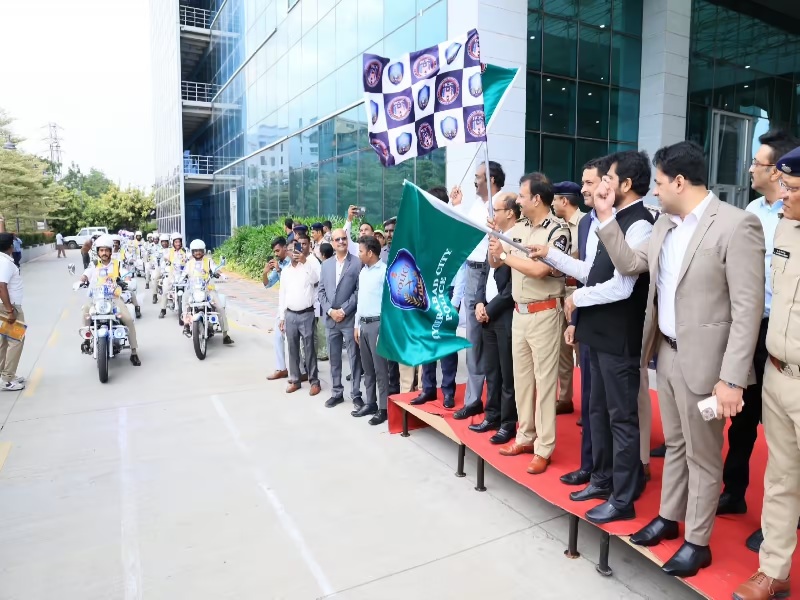
The Hyderabad City Security Council (HCSC), working with the Hyderabad Traffic Police, has deployed 30 new traffic patrol motorcycles reportedly procured through ₹1.6 crore in corporate CSR contributions.
The motorcycles will reportedly help police personnel clear traffic bottlenecks, respond to accidents and vehicle breakdowns, remove obstructions, enforce traffic regulations and provide quicker emergency assistance. Their induction takes Hyderabad’s Traffic Mobile Bike fleet to 80.
A ceremony was also organised to recognise 45 corporate sponsors supporting the city’s Traffic Marshals programme. The marshals have been deployed to address manpower shortages and assist police personnel with traffic regulation.
There is little doubt that better traffic management and faster accident response serve an important public purpose. The deeper issue, however, is whether buying motorcycles for a government police department constitutes meaningful CSR—or whether CSR is gradually being used to finance obligations that properly belong in the government budget.
The Central Question: Is This Really CSR?
India’s statutory CSR framework was created to encourage companies to address social, economic and environmental challenges. It was not intended merely to create an additional financing window for government departments.
Section 135 of the Companies Act, 2013 requires eligible companies to spend at least two per cent of their average net profits from the preceding three financial years on qualifying CSR activities.
Schedule VII identifies the broad areas in which this expenditure may be made, including healthcare, education, environmental sustainability, rural development, livelihood enhancement, social equality, disaster management and other recognised development priorities. India Code’s official Schedule VII does not expressly list the purchase of police patrol vehicles as an independent CSR activity.
The Ministry of Corporate Affairs has previously clarified that road-safety awareness, driver training, traffic education and emergency medical assistance may be treated as CSR when appropriately connected with Schedule VII. This permits a broad and liberal interpretation of eligible activities.
But a distinction must be maintained between:
- financing a social intervention addressing road safety;
- educating drivers and pedestrians;
- building emergency-response capacity;
- assisting accident victims; and
- purchasing operational assets for a government enforcement agency.
The first four clearly advance identifiable social outcomes. The fifth requires much closer scrutiny.
Public Benefit Alone Does Not Automatically Make an Expense CSR
Nearly every expenditure made by a government department can be described as serving the public.
Police vehicles improve public safety. Municipal garbage trucks promote sanitation. Government office computers may improve public-service delivery. Ambulances support healthcare. School buses facilitate education.
But if “public benefit” alone becomes the test, almost any government expenditure could be transferred to corporate CSR budgets. That would dilute the distinctive purpose of CSR and effectively convert it into supplementary public finance.
CSR is supposed to generate additional social value. It should address unmet community needs, test innovative solutions, strengthen vulnerable populations and produce measurable development outcomes. It should not become an informal mechanism through which essential departments routinely acquire vehicles, equipment, staff or infrastructure outside the normal budgetary and legislative process.
Road Safety Is a Valid CSR Concern
This does not mean that the Hyderabad initiative has no CSR justification.
Road crashes are a serious public-health and development challenge. Congestion delays ambulances, increases air pollution, wastes productive time and disproportionately affects pedestrians, workers, senior citizens and economically vulnerable commuters.
Patrol motorcycles can potentially:
- reach accident locations faster;
- provide immediate first aid;
- clear broken-down vehicles and obstructions;
- reduce secondary collisions;
- assist stranded commuters;
- improve traffic flow around hospitals and schools; and
- support rapid coordination during emergencies.
If the motorcycles are equipped with first-aid kits, emergency communication systems, body cameras and other safety tools—and are primarily deployed for accident response and public assistance—the project could reasonably be connected with preventive healthcare, public safety and road-safety outcomes.
The official announcement, however, also identifies enforcement and regulatory duties as major functions. Traffic enforcement is a core sovereign responsibility of the police. Corporate financing of enforcement assets consequently demands stronger governance safeguards than an ordinary community-development project.
CSR Must Not Become a Substitute for the Police Budget
Traffic regulation, policing, enforcement and emergency response are continuing responsibilities of the state. These functions require stable public financing, trained personnel, institutional accountability and legislative oversight.
Corporate contributions may complement public systems. They should not become essential for operating those systems.
When CSR funding is used to overcome a government department’s manpower or equipment shortage, several questions arise:
- Why was the requirement not met through the sanctioned police or state budget?
- Is CSR support additional to government expenditure, or is it replacing expenditure the government should have incurred?
- Will recurring costs such as fuel, insurance, repairs, salaries and replacement also be supported by companies?
- What happens when corporate funding ends?
- Does dependence on sponsors influence institutional priorities or public recognition?
- Are companies receiving disproportionate visibility, access or goodwill in return?
Without answers, a socially useful intervention can easily become an example of CSR cost-shifting—moving the financial burden of routine public administration from the state to corporations.
The ₹1.6-Crore Figure Needs Detailed Disclosure
The reported project cost also deserves clarification.
If the entire Rs. 1.6 crore related only to 30 motorcycles, the average expenditure would be approximately Rs. 5.33 lakh per vehicle. That figure cannot be assessed fairly without knowing whether it includes specialised equipment, cameras, tablets, first-aid supplies, communication devices, insurance, training, maintenance or programme-management costs.
A responsible CSR disclosure should specify:
| Disclosure Requirement | Information Needed |
|---|---|
| Total project value | Exact amount approved and spent |
| Corporate sponsors | Names and individual contributions |
| Cost breakdown | Motorcycles, equipment, training and administration |
| CSR category | Schedule VII provision under which expenditure was approved |
| Implementing arrangement | Whether HCSC acted as coordinator or implementing agency |
| Asset ownership | Entity in whose name the motorcycles are registered |
| Procurement process | Vendor-selection and price-comparison procedure |
| Recurring expenditure | Responsibility for fuel, insurance and maintenance |
| Performance indicators | Response time, accidents assisted and congestion cleared |
| Project duration | Whether it is a one-time or ongoing intervention |
A felicitation ceremony cannot substitute for financial and programme transparency.
Asset Ownership Is an Important Legal Issue
The CSR Rules regulate capital assets created or acquired through CSR expenditure. Such assets are generally required to be held by an eligible implementing entity, the project beneficiaries or a public authority.
Because the traffic police are part of the state administration, the motorcycles may potentially be held by a public authority. That can support the legal structure of the arrangement—but only if ownership, registration, transfer, use and maintenance are properly documented.
Companies must still establish that:
- their boards approved the project;
- the expenditure falls within their CSR policies and annual action plans;
- the activity is linked to Schedule VII;
- the implementing arrangement complies with the CSR Rules;
- the expenditure is not a disguised sponsorship or marketing expense; and
- utilisation of the money has been verified.
The responsibility for satisfying these requirements ultimately rests with the boards of the contributing companies.
Corporate Influence Over Policing Must Be Avoided
The involvement of private companies in police-related programmes also presents an ethical concern beyond CSR compliance.
Police institutions exercise coercive and regulatory authority. They investigate offences, regulate commercial activity, issue penalties and maintain public order. Their independence—and the public perception of that independence—must be protected.
Corporate support must never result in:
- preferential treatment for sponsors;
- branding of enforcement vehicles as corporate advertising;
- privileged access to senior police officials;
- reduced scrutiny of sponsoring businesses;
- deployment designed around commercial interests; or
- the use of CSR recognition as an indirect reputational transaction.
Even where no actual conflict exists, highly visible corporate sponsorship of police assets can create a perception of proximity between regulated businesses and law-enforcement institutions.
A clear, publicly available conflict-of-interest policy is therefore essential.
Traffic Marshals Require Separate Scrutiny
The Traffic Marshals programme raises an additional set of questions because it involves privately supported personnel assisting in regulatory duties.
The public should know:
- who recruits and employs the marshals;
- who determines their working conditions;
- what training and background verification they receive;
- whether they can stop vehicles or interact with alleged offenders;
- whether they have access to personal or enforcement data;
- who is responsible for misconduct or injury;
- whether they are insured; and
- what grievance-redress mechanism is available.
Traffic marshals may provide useful assistance, but they must not become a privately financed substitute for adequately staffed and publicly accountable traffic police.
Measuring Outcomes, Not Counting Motorcycles
The real measure of CSR is not the number of vehicles flagged off or sponsors felicitated. It is the social outcome produced.
The project should therefore publish baseline and post-intervention data, including:
- average accident-response time;
- number of accident victims assisted;
- number of breakdowns and obstructions cleared;
- reduction in congestion-clearance time;
- locations and communities served;
- first-aid interventions undertaken;
- reduction in secondary accidents; and
- public complaints concerning patrol personnel or marshals.
An independent assessment would help determine whether Rs. 1.6 crore generated proportionate and sustainable public value.
Verdict: Potentially Eligible, but Not Automatically Good CSR
The Hyderabad project should not be declared unlawful merely because the motorcycles will be used by the traffic police. Road safety, emergency assistance and preventive public health can legitimately form part of a CSR programme.
At the same time, labelling an expenditure “CSR” does not automatically make it responsible, additional or transformative.
The initiative sits in a sensitive grey area between social investment and financing routine state operations. Its legitimacy depends on the project’s approved purpose, Schedule VII linkage, procurement transparency, asset ownership, governance structure, safeguards against corporate influence and measurable road-safety outcomes.
The government must not treat CSR as a readily available fund for filling every administrative or budgetary gap. Companies, similarly, should not select police equipment merely because it offers high public visibility and easy ceremonial recognition.
The Real Purpose of CSR
The real purpose of CSR is not to buy goodwill, sponsor state machinery or replace public expenditure.
CSR should:
- address genuine and independently assessed social needs;
- prioritise vulnerable and underserved communities;
- create social value beyond routine government functioning;
- strengthen institutions without privatising public responsibility;
- encourage innovation and long-term solutions;
- produce measurable and transparent outcomes; and
- remain accountable to communities, not merely sponsors and officials.
Hyderabad’s patrol motorcycles may improve emergency response and road safety. That would be a worthwhile outcome. But the project will qualify as meaningful CSR only when the public can see not merely what was purchased, but why CSR money was required, how it was spent, who owns the assets and what measurable difference it created.
CSR should supplement the state’s development efforts. It must never become a quiet substitute for the state itself.



