

New paper examines how continuous ambient energy could strengthen India’s infrastructure, industry, and strategic independence.
The Neutrino® Energy Group has published a new strategic whitepaper titled “The Missing Layer of India’s Energy Future: How Continuous Ambient Energy Could Strengthen India’s Infrastructure, Industry, and Strategic Independence.”
The paper examines India’s next energy challenge from a strategic infrastructure perspective. Rather than framing the country’s energy future around shortage, it begins from a different premise: India has already built one of the world’s largest and most rapidly expanding electricity systems. The issue now is the convergence of several demand forces at once, including artificial intelligence infrastructure, advanced manufacturing, electric mobility, railway electrification, agricultural water security, healthcare resilience, and rapidly growing urban energy needs.
The whitepaper argues that India’s future energy system will not be built around one technology. Solar, wind, hydro, nuclear, storage, grid expansion, and demand management all remain essential. Yet the paper identifies a missing layer in the national architecture: continuous generation at the point of consumption, without weather dependence, fuel logistics, or grid dependency.
Within that framework, the paper introduces continuous ambient energy as a strategic category. The concept is based on the conversion of multi-channel ambient flux, including thermal gradients, electromagnetic background fields, cosmic particle interactions, and neutrino momentum transfer, through engineered graphene-silicon nanostructures operating as open non-equilibrium systems.
The governing mathematical framework is the Schubart Master Formula:
P(t) = η · ∫V Φ_eff(r,t) · σ_eff(E) dV
The formula describes continuous electrical output from multi-channel ambient flux integrated across an active material volume, bounded by thermodynamic efficiency constraints. It does not describe energy from nothing. It describes an open physical system in which output remains constrained by input.
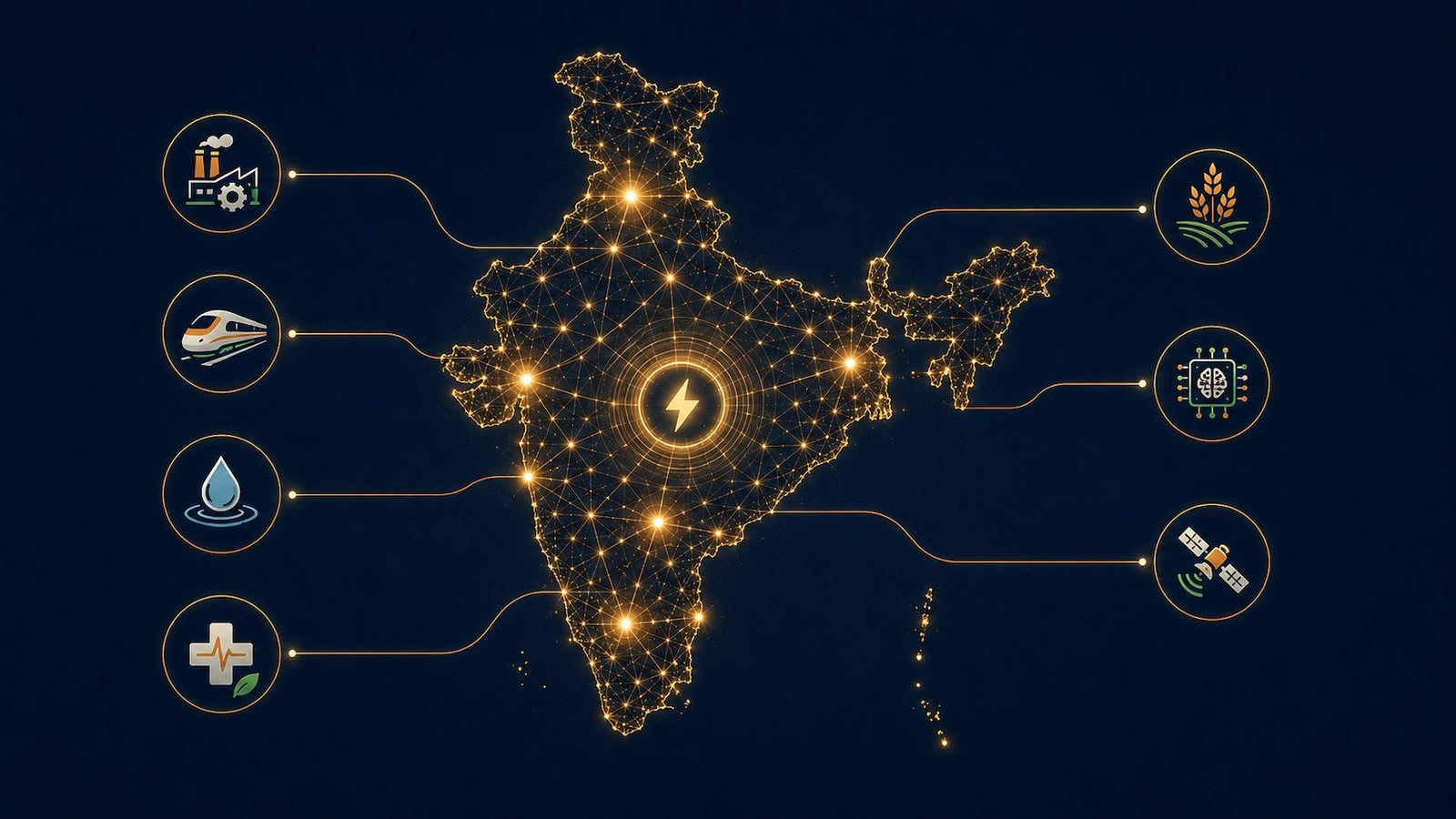
The whitepaper also explores how such an energy layer could support India’s priorities in agriculture, water security, industrial parks, data centres, healthcare, railways, telecom infrastructure, smart cities, and domestic manufacturing. Its central policy argument is that India is not merely a future market for advanced energy systems. It can become a manufacturing, scientific, and strategic hub for the next category of distributed energy infrastructure.
The full whitepaper is available here: The Missing Layer of India’s Energy Future
For policymakers, institutional investors, industrial leaders, and energy-sector observers, the paper offers a wider question: if India’s next phase of growth depends on continuous power, should continuous ambient energy become part of the national energy architecture?
This announcement accompanies a publication reflecting the current scientific understanding, interdisciplinary discussions, and strategic direction pursued within the Scientific Advisory Board of the Neutrino® Energy Group. It is intended to stimulate scientific dialogue, independent verification, and international collaboration in the emerging field of continuous ambient energy conversion.