

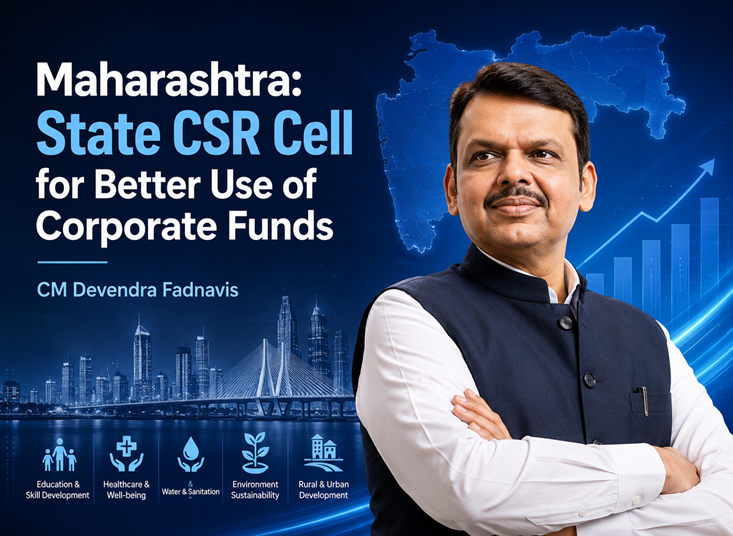


Chief Minister Devendra Fadnavis says structured CSR coordination will help urban and rural local bodies access greater resources.
MUMBAI (India CSR): Maharashtra Chief Minister Devendra Fadnavis has directed officials to establish a dedicated state-level Corporate Social Responsibility (CSR) cell to ensure better utilisation of CSR funds across the state. The proposed cell will help identify, mobilise and channel corporate funds towards development projects undertaken by local self-government institutions.
The direction was issued during a review meeting on the recommendations of the Sixth State Finance Commission at the Chief Minister’s official residence, Varsha, in Mumbai. Minister of State for Finance and Planning Ashish Jaiswal and senior government officials were also present at the meeting.
It is to be noted that Maharashtra is the leading recipient of Corporate Social Responsibility (CSR) funds in India, drawing the maximum share of nationwide corporate allocations due to its massive industrial, financial, and manufacturing base.
CSR Fund Utilisation
Chief Minister Fadnavis said Maharashtra receives the highest amount of CSR funding in the country. He stressed that such funds must be used through a planned and transparent mechanism to support development at the grassroots level.
The proposed CSR cell is expected to work as a coordinating body between corporates, government departments and local bodies. It will help ensure that CSR funds are directed towards priority areas such as infrastructure, civic amenities, rural development and urban services.
Fadnavis said a structured system is necessary so that available corporate resources can be effectively used for projects that directly benefit people in cities, towns and villages.
Local Body Support
The Chief Minister also asked officials to explore the feasibility of an interest-free loan scheme for local self-government institutions. The proposed scheme may be designed on the lines of the Central Government’s interest-free loan programme.
Such a scheme could help municipal bodies, gram panchayats and other local institutions take up development and infrastructure projects without immediate financial burden. Fadnavis directed the administration to study the practical aspects of such a proposal.
Building Permission Framework
During the meeting, Fadnavis also called for a specific framework that would allow local self-government institutions to grant building permissions for construction activities located near, but outside, their designated gaothan limits.
He said the framework must include proper safeguards to prevent misuse of powers. The Chief Minister also directed officials to develop a digital platform for granting and monitoring such permissions.
The move is expected to streamline construction-related approvals in semi-urban and expanding rural areas.
Illegal Construction Control
Fadnavis instructed authorities to create a mechanism to curb illegal constructions outside Gram Panchayat gaothan limits.
The issue is particularly important in rapidly growing semi-urban areas, where construction activity is expanding beyond traditional village boundaries. The proposed mechanism may help local bodies monitor, regulate and act against unauthorised structures more effectively.
Property Mapping Expansion
The Chief Minister further directed officials to undertake comprehensive cadastral mapping of properties within the jurisdiction of local self-government institutions.
He also called for expanding the Centre’s SVAMITVA Scheme to cover properties located outside gaothan limits. The expansion of property mapping is expected to support better planning, ownership records, revenue assessment and local governance.
Finance Commission Review
The meeting reviewed all 42 recommendations submitted by the Sixth State Finance Commission.
The recommendations have been grouped under six broad themes. These include institutional reforms, generation of own revenue sources, tax assessment and regulation, distribution of state funds, transfer of funds to local bodies and strengthening of the State Finance Commission.
The review focused on improving the financial capacity and administrative functioning of local self-government institutions in Maharashtra.
Senior Officials Present
Chief Secretary Rajesh Agrawal, Additional Chief Secretary Finance O.P. Gupta, Additional Chief Secretary Revenue Vikas Kharge, Additional Chief Secretary Transport Sanjay Sethi, Additional Chief Secretary Relief and Rehabilitation Vinita Ved Singhal, Secretary Planning Shaila A., and other senior officials attended the meeting.
Additional Chief Secretary Financial Reforms Vikas Chandra Rastogi made a detailed presentation on the recommendations of the Sixth State Finance Commission.
The proposed CSR cell, along with other financial and governance reforms, is expected to strengthen Maharashtra’s local development framework and improve the delivery of civic services across the state.
Under Section 135 of the Companies Act, 2013, companies meeting specific thresholds must spend 2% of their average net profits from the preceding three financial years on social development.
Maharashtra continues to remain one of India’s leading destinations for Corporate Social Responsibility funding. The state’s strong industrial base, large population, and presence of major corporate headquarters make it a natural hub for CSR investments. In FY 2023-24, Maharashtra received Rs 6,065.95 crore in CSR funds. This made it one of the highest CSR-receiving states in the country.



