• India CSR Awards 2025
  • India CSR Leadership Summit
  • Guest Posts
Monday, May 25, 2026
India CSR
  • Home
  • Corporate Social Responsibility
    • Art & Culture
    • CSR Leaders
    • Child Rights
    • Culture
    • Education
    • Gender Equality
    • Around the World
    • Skill Development
    • Safety
    • Covid-19
    • Safe Food For All
  • Sustainability
    • Sustainability Dialogues
    • Sustainability Knowledge Series
    • Plastics
    • Sustainable Development Goals
    • ESG
    • Circular Economy
    • BRSR
  • Corporate Governance
    • Diversity & Inclusion
  • Interviews
  • SDGs
    • No Poverty
    • Zero Hunger
    • Good Health & Well-Being
    • Quality Education
    • Gender Equality
    • Clean Water & Sanitation – SDG 6
    • Affordable & Clean Energy
    • Decent Work & Economic Growth
    • Industry, Innovation & Infrastructure
    • Reduced Inequalities
    • Sustainable Cities & Communities
    • Responsible Consumption & Production
    • Climate Action
    • Life Below Water
    • Life on Land
    • Peace, Justice & Strong Institutions
    • Partnerships for the Goals
  • Articles
  • Events
  • हिंदी
  • More
    • Business
    • Finance
    • Environment
    • Economy
    • Health
    • Around the World
    • Social Sector Leaders
    • Social Entrepreneurship
    • Trending News
      • Important Days
        • Festivals
      • Great People
      • Product Review
      • International
      • Sports
      • Entertainment
    • Case Studies
    • Philanthropy
    • Biography
    • Technology
    • Lifestyle
    • Sports
    • Gaming
    • Knowledge
    • Home Improvement
    • Words Power
    • Chief Ministers
No Result
View All Result
  • Home
  • Corporate Social Responsibility
    • Art & Culture
    • CSR Leaders
    • Child Rights
    • Culture
    • Education
    • Gender Equality
    • Around the World
    • Skill Development
    • Safety
    • Covid-19
    • Safe Food For All
  • Sustainability
    • Sustainability Dialogues
    • Sustainability Knowledge Series
    • Plastics
    • Sustainable Development Goals
    • ESG
    • Circular Economy
    • BRSR
  • Corporate Governance
    • Diversity & Inclusion
  • Interviews
  • SDGs
    • No Poverty
    • Zero Hunger
    • Good Health & Well-Being
    • Quality Education
    • Gender Equality
    • Clean Water & Sanitation – SDG 6
    • Affordable & Clean Energy
    • Decent Work & Economic Growth
    • Industry, Innovation & Infrastructure
    • Reduced Inequalities
    • Sustainable Cities & Communities
    • Responsible Consumption & Production
    • Climate Action
    • Life Below Water
    • Life on Land
    • Peace, Justice & Strong Institutions
    • Partnerships for the Goals
  • Articles
  • Events
  • हिंदी
  • More
    • Business
    • Finance
    • Environment
    • Economy
    • Health
    • Around the World
    • Social Sector Leaders
    • Social Entrepreneurship
    • Trending News
      • Important Days
        • Festivals
      • Great People
      • Product Review
      • International
      • Sports
      • Entertainment
    • Case Studies
    • Philanthropy
    • Biography
    • Technology
    • Lifestyle
    • Sports
    • Gaming
    • Knowledge
    • Home Improvement
    • Words Power
    • Chief Ministers
No Result
View All Result
India CSR
No Result
View All Result
Home Business

The Dangerous Belief System Behind India’s Recurring Project Delays

India CSR by India CSR
May 25, 2026
in Business
Reading Time: 7 mins read
India CSR
Share Share Share Share
WhatsApp icon
WhatsApp — Join Us
Instant updates & community
Google News icon
Google News — Follow Us
Get our articles in Google News feed

India is entering another large capex cycle. Across manufacturing, infrastructure, healthcare, education, logistics, real estate, energy and process industries, organisations are committing thousands of crores to new plants, facilities, expansions and development projects. These projects are not just engineering or construction assignments. They are tied to revenue plans, capacity creation, market entry, financing assumptions and competitive positioning.
Delays are no longer only a project problem

Admissions Open for BBA in CSR, Sustainability and ESG

When such projects get delayed, the loss is much larger than the visible cost overrun. Revenue starts late, capital remains blocked for longer, market opportunities are missed, and management bandwidth stays trapped in execution issues. Contractors, suppliers, consultants and internal teams remain engaged beyond the planned period. Equipment, manpower and decision-making capacity that should have moved to the next opportunity remain tied to an unfinished project.

In large capital projects, delay is not merely a schedule problem. It is a business problem.

Why large projects are difficult to execute

A large capital project is not executed by one organisation. It is a temporary system where the owner, consultants, equipment suppliers, contractors, statutory authorities, operating teams and multiple specialist agencies have to come together for a limited period and work toward one common goal.

But they are not one organisation. Each participant has its own commercial priorities, capacity constraints and business pressures. An equipment supplier may accept an order for one project, but the same supplier may also have dozens of other orders to deliver. Its business objective is to use capacity well, protect margins and keep multiple customers satisfied. A contractor may be working across several sites, trying to maximise billing, maintain cash flow and keep its workforce productive.

These are not wrong intentions. They are normal business realities. The difficulty begins when the project owner assumes that all these independent interests can be aligned simply through more dates, tighter follow-up and stronger pressure.

The usual response: more dates, more tracking, more pressure

Most large projects are managed through a familiar method. The project is broken into detailed activities. Dates are assigned to each activity. These dates are passed on to contractors, suppliers and internal teams. Once execution begins, every missed date creates a new round of review, explanation, revised commitment, escalation and follow-up.

Over time, the project environment becomes increasingly busy. More dashboards are created. More trackers are updated. More meetings are held. More software is introduced. Today, even AI is expected to help synchronise complex execution environments.

But if the underlying execution logic is flawed, better visibility only shows the delay more clearly. It does not prevent the delay from being created.

This is why spreadsheets continue to survive in project environments despite large investments in project management software. A spreadsheet is not sophisticated, but it is easy to change. When plans keep shifting, commitments keep getting revised and dependencies keep breaking, the tool that can be changed fastest often becomes the most practical tool.

This should make leadership reflect. If the plan requires constant rewriting, is the real issue the tool, or the way execution is being structured?

The belief behind many project delays

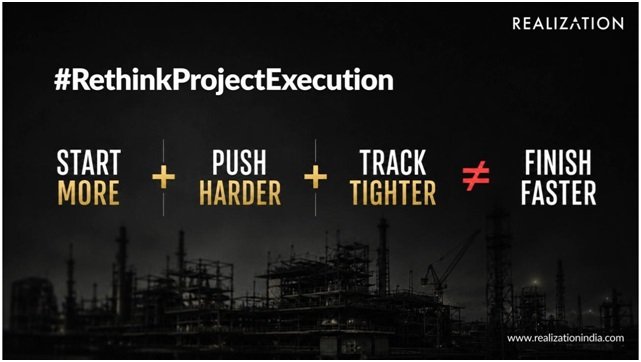
The deeper issue is a belief issue. Most large capital projects are driven, consciously or unconsciously, by the assumption that if we start more work, push harder, track tighter and keep everyone busy, the project will finish faster.

This belief is rarely stated openly, but it shapes execution behaviour every day. Starting more fronts is seen as progress. A crowded site is seen as momentum. High manpower deployment is treated as acceleration. Detailed activity tracking is treated as control. When delays appear, the usual response is to add more reviews, more follow-ups, more dashboards and more pressure.

But projects do not finish because many things have started. They finish when the right things are completed in the right sequence.

When the system is designed around starting more and keeping everyone busy, it creates a large volume of unfinished work. Civil work starts in several areas, but few areas become fully ready for the next agency. Installation begins, but connected services, access or utilities are not ready. Materials arrive, but drawings or approvals are pending. Contractors show progress, but handovers do not happen cleanly.

From a distance, the project looks active. In reality, the flow toward completion remains weak.

Conflict 1: contractors need billing, projects need handovers

The first major conflict appears at the contractor level. Contractors are often measured and paid on the basis of quantity completed. Naturally, they try to maximise billable progress. If a contractor can work in multiple areas and generate more volume, that becomes attractive. From the contractor’s point of view, this is rational. It helps billing, cash flow and resource utilisation.

But the project does not move forward merely because quantity is produced somewhere. The next agency needs a complete and usable front.

If civil work is partially completed in five areas but no area is fully ready for the next trade, the next contractor cannot execute smoothly. If structures, services or utilities are completed in fragments, subsequent work becomes interrupted. Everyone may show progress, but the project still struggles to move toward completion.

This is a fundamental difference. Contractors are often pulled toward volume. Projects need handovers. When the system rewards volume more than completion, scattered progress increases and real project movement slows down.

Conflict 2: everyone has reasons, so accountability weakens

The second conflict is accountability. In a delayed project, there is rarely one clean reason for delay. A supplier may miss a date because inputs were delayed. Inputs may be delayed because of design changes. Design changes may arise because site conditions or operational requirements changed. A contractor may underperform because the front was incomplete. The owner may push for faster work, but the material sequence may not support it.

By the time the issue reaches a review meeting, everyone has an explanation, and many of those explanations are valid.

This is where conventional accountability breaks down. Management can express frustration, demand revised commitments and escalate the issue, but if the dependency structure remains unresolved, the next commitment is also made on weak ground. The review may create pressure, but it does not create reliability.

Over time, the organisation becomes very good at explaining delays, but not necessarily better at preventing them.

Conflict 3: contract dates assume a cleaner world than execution allows

The third conflict is created by the dates themselves. At the planning and contracting stage, dates are often built on assumptions that look reasonable on paper: drawings will be released on time, approvals will not hold up work, vendors will supply as committed, contractors will mobilise as planned, resources will be available when required and site conditions will remain stable.

Large capital projects rarely operate in such clean conditions.

Once one major assumption changes, the effect travels through the project. A drawing delay affects procurement. A procurement delay affects installation. A partial handover affects contractor productivity. A design change affects already planned work. A late equipment delivery changes the commissioning sequence. The original dates begin to fall like dominoes.

The project then enters a continuous cycle of revising dates across agencies and packages. Dates that were intended to provide control begin to generate more negotiation and coordination because each new commitment remains dependent on several other moving parts.

Why pressure does not solve a structural problem

If work has been released before it is truly ready, pressure creates confusion. If resources are spread across too many open fronts, pressure creates multitasking. If contractors are rewarded for quantity rather than usable handover, pressure creates more fragmented progress. If revised dates are taken without resolving the dependency that caused the slip, pressure only creates the next missed commitment.

The belief that more activity means faster completion is therefore dangerous. It pushes the project toward more starts, more open fronts, more local optimisation and more coordination load. The project becomes busy, but not necessarily faster.

The Need to Rethink Project Execution

The way leaders define progress eventually determines the way projects are executed. If progress is represented by activity across many fronts, the project will continue to accumulate unfinished work and coordination pressure. If progress is represented by completed handovers that allow the next stage to move without interruption, the project begins to behave differently.

This requires a fundamental rethink of project execution. The question is no longer how to push every stakeholder harder against dates that keep shifting. The question is how to organise execution so that work moves towards completion with greater stability and predictability. For leaders responsible for large capital projects, that is the belief worth examining.

Author: Mohd Aadil Siddiqui, Director – Realization India
FKCCI
ADVERTISEMENT
Ambedkar Chamber
ADVERTISEMENT
ESG Professional Network
ADVERTISEMENT
India CSR Image 1 India CSR Image 2

CSR, Sustainability, and ESG success stories hindustan zinc
ADVERTISEMENT
India CSR

India CSR

India CSR® is the largest media on CSR and sustainability offering diverse content across multisectoral issues on business responsibility. It covers Sustainable Development, Corporate Social Responsibility (CSR), Sustainability, and related issues in India. Founded in 2009, the organisation aspires to become a globally admired media that offers valuable information to its readers through responsible reporting.

Related Posts

Celebrating International HR Day 2026 : Empowering People to Lead Change
Business

Celebrating International HR Day 2026 : Empowering People to Lead Change

2 hours ago
Five Dogs, Two Cats, One Toddler, and a Journey That Redefined What Family Truly Means
Business

Five Dogs, Two Cats, One Toddler, and a Journey That Redefined What Family Truly Means

2 hours ago
GenZCFO Wins Prestigious ‘Best NBFC & FinTech Advisor in India 2026’ Award at Bharat NBFC & Fintech Summit
Business

GenZCFO Wins Prestigious ‘Best NBFC & FinTech Advisor in India 2026’ Award at Bharat NBFC & Fintech Summit

2 hours ago
South Korea’s GPAI Reasoning Engine Effectively Tackles One of the World’s Hardest Exams, Pulling a Near-Perfect Score
Business

South Korea’s GPAI Reasoning Engine Effectively Tackles One of the World’s Hardest Exams, Pulling a Near-Perfect Score

2 hours ago
Chaap Craft India Strengthens India’s Premium Vegetarian Food Segment with Innovative Soya Chaap Solutions
Business

Chaap Craft India Strengthens India’s Premium Vegetarian Food Segment with Innovative Soya Chaap Solutions

6 hours ago
Binance
Business

Binance Launches Perpetual Futures for Pre-IPO Market Exposure, Starting with SpaceX

6 hours ago
Load More
FKCCI
ADVERTISEMENT
BBA - CSR, Sustainability and ESG, Rungta International Skills University Bhilai
ADVERTISEMENT

LATEST NEWS

The Dangerous Belief System Behind India’s Recurring Project Delays

Celebrating International HR Day 2026 : Empowering People to Lead Change

Five Dogs, Two Cats, One Toddler, and a Journey That Redefined What Family Truly Means

GenZCFO Wins Prestigious ‘Best NBFC & FinTech Advisor in India 2026’ Award at Bharat NBFC & Fintech Summit

South Korea’s GPAI Reasoning Engine Effectively Tackles One of the World’s Hardest Exams, Pulling a Near-Perfect Score

Chaap Craft India Strengthens India’s Premium Vegetarian Food Segment with Innovative Soya Chaap Solutions

Ambedkar Chamber
ADVERTISEMENT

TOP NEWS

South Korea’s GPAI Reasoning Engine Effectively Tackles One of the World’s Hardest Exams, Pulling a Near-Perfect Score

Godrej Enterprises Group Reports 19% Rise in Biodiversity Index

हिंदुस्तान जिंक की बायोडावर्सिटी पहल से 4.1 लाख से अधिक पशु एवं वन्यजीव लाभान्वित

How SIPs Build Wealth in Volatile Markets

IHCL Appoints Aejaz Shaikh as Hotel Manager – Taj Cidade de Goa Heritage

Corporate Events Emerge as India’s Powerful Business Investments

Load More
Ad 1 Ad 2 Ad 3
ADVERTISEMENT
Economy India Largest Media on Indian Economy and Business
ADVERTISEMENT

Interviews

R. Pavithra Kumar, CEO, JSW Foundation
Interviews

Redefining CSR and Driving Sustainable Social Impact: An Interview with R. Pavithra Kumar of JSW Foundation

by Rusen Kumar
April 16, 2026

Exploring impact-driven CSR models focused on skilling, sustainability, and inclusive growth

Read moreDetails
Jyoti Sagar, Founder Trustee, Genesis Foundation

Interview: Jyoti Sagar on 25 Years of Saving Young Lives at Genesis Foundation

April 8, 2026
Satish Singh, Chief People Officer at PNB Housing Finance

Interview: Satish Singh on ESG Leadership and CSR Impact at PNB Housing Finance

April 1, 2026
Ajeet Kumar Singh, Co-Founder and Managing Director of SAVE Solutions

Driving Financial Inclusion: Ajeet Kumar Singh on SAVE Solutions’ Growth Journey

March 30, 2026
Load More
ESG Professional Network
ADVERTISEMENT
STEM Learning STEM Learning STEM Learning
ADVERTISEMENT
Facebook Twitter Youtube LinkedIn Instagram
India CSR Logo

India CSR is the largest tech-led platform for information on CSR and sustainability in India offering diverse content across multisectoral issues. It covers Sustainable Development, Corporate Social Responsibility (CSR), Sustainability, and related issues in India. Founded in 2009, the organisation aspires to become a globally admired media that offers valuable information to its readers through responsible reporting. To enjoy the premium services, we invite you to partner with us.

Follow us on social media:


Dear Valued Reader

India CSR is a free media platform that provides up-to-date information on CSR, Sustainability, ESG, and SDGs. We need reader support to continue delivering honest news. Donations of any amount are appreciated.

Help save India CSR.

Donate Now

Donate at India CSR

  • About India CSR
  • Team
  • India CSR Awards 2026
  • India CSR Leadership Summit
  • Partnership
  • Guest Posts
  • Services
  • ESG Professional Network
  • Content Writing Services
  • Business Information
  • Contact
  • Privacy Policy
  • Terms of Use
  • Donate

Copyright © 2026 - India CSR | All Rights Reserved

No Result
View All Result
  • Home
  • Corporate Social Responsibility
    • Art & Culture
    • CSR Leaders
    • Child Rights
    • Culture
    • Education
    • Gender Equality
    • Around the World
    • Skill Development
    • Safety
    • Covid-19
    • Safe Food For All
  • Sustainability
    • Sustainability Dialogues
    • Sustainability Knowledge Series
    • Plastics
    • Sustainable Development Goals
    • ESG
    • Circular Economy
    • BRSR
  • Corporate Governance
    • Diversity & Inclusion
  • Interviews
  • SDGs
    • No Poverty
    • Zero Hunger
    • Good Health & Well-Being
    • Quality Education
    • Gender Equality
    • Clean Water & Sanitation – SDG 6
    • Affordable & Clean Energy
    • Decent Work & Economic Growth
    • Industry, Innovation & Infrastructure
    • Reduced Inequalities
    • Sustainable Cities & Communities
    • Responsible Consumption & Production
    • Climate Action
    • Life Below Water
    • Life on Land
    • Peace, Justice & Strong Institutions
    • Partnerships for the Goals
  • Articles
  • Events
  • हिंदी
  • More
    • Business
    • Finance
    • Environment
    • Economy
    • Health
    • Around the World
    • Social Sector Leaders
    • Social Entrepreneurship
    • Trending News
      • Important Days
      • Great People
      • Product Review
      • International
      • Sports
      • Entertainment
    • Case Studies
    • Philanthropy
    • Biography
    • Technology
    • Lifestyle
    • Sports
    • Gaming
    • Knowledge
    • Home Improvement
    • Words Power
    • Chief Ministers

Copyright © 2026 - India CSR | All Rights Reserved

This website uses cookies. By continuing to use this website you are giving consent to cookies being used. Visit our Privacy and Cookie Policy.