



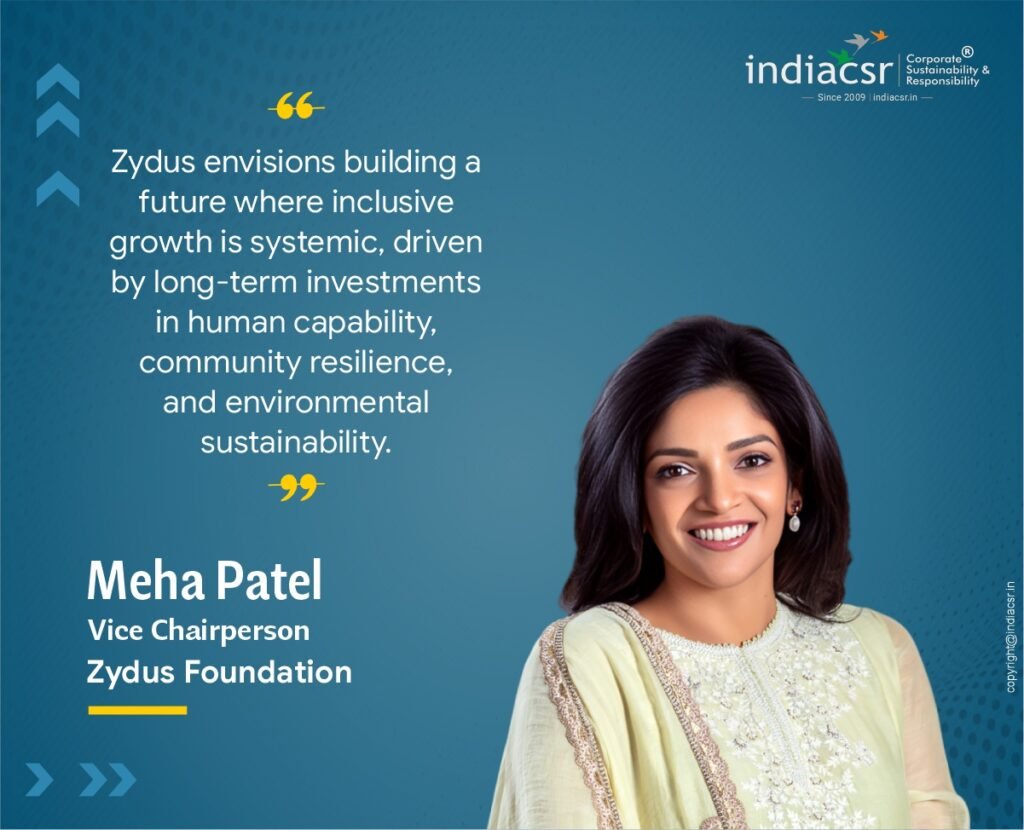
Vice Chairperson of Zydus Foundation shares how the organisation is advancing equitable healthcare, innovation, community empowerment, and environmental stewardship through its CSR initiatives.
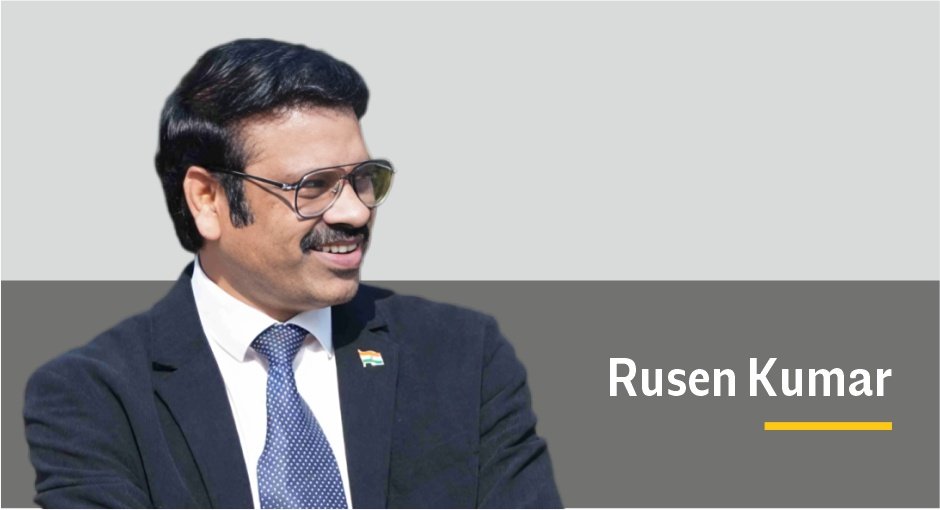
By Rusen Kumar
AHMEDABAD (India CSR): As India’s development journey accelerates, corporate social responsibility is increasingly expected to move beyond philanthropy toward building resilient communities and sustainable systems. Zydus Foundation, the CSR arm of Zydus Lifesciences, has embraced this philosophy through its integrated social development framework, Zydus Sristhi, which focuses on healthcare, quality education, livelihoods, innovation, environment, and employee engagement.
Under the leadership of Ms. Meha Patel, Vice Chairperson of Zydus Foundation, the organisation is expanding its efforts to strengthen rural and tribal healthcare ecosystems, foster grassroots innovation, enable sustainable livelihoods, and build climate-resilient communities. The foundation’s initiatives aim to address immediate needs and create long-term, community-owned solutions that promote inclusive growth.
In this exclusive conversation with Rusen Kumar, Editor, India CSR, Ms. Meha Patel discusses Zydus’ visionary approach to CSR, key initiatives in FY 2024–25, the role of partnership and innovation in driving impact, and the future roadmap for building equitable and sustainable development across India.
Excerpts of an interview:
India CSR: How does Zydus align its CSR initiatives with its broader vision of creating sustainable livelihoods and equitable education and healthcare access across India?
Ms. Meha Patel: Zydus envisions building a future where inclusive growth is systemic, driven by long-term investments in human capability, community resilience, and environmental sustainability. Under the framework of Zydus Sristhi, the organisation seeks to deepen and scale its interventions across health, education, research & innovation, skill development environment outcomes and employee volunteering, ensuring that impact is measurable, sustainable and community owned.
Under Swasthya, we aim to expand equitable access to quality healthcare by strengthening rural and tribal health ecosystems through infrastructure development, preventive healthcare initiatives, digital health integration, and outreach services. The future focus lies in reducing disparities in healthcare access, promoting early diagnosis and health literacy, and building self-sustaining healthcare models that serve vulnerable populations with continuity and excellence.
In the domain of Shiksha, the organization led the rebuilding of a higher‑education school in the suburbs, ensuring that students can continue their academic pursuits without disruption. It also established STEM Labs to ignite curiosity and foster scientific learning among young students. In addition, the organization supports schools for specially‑abled children through a range of dedicated educational initiatives.

Within the sphere of Shodh, the organization seeks to cultivate a robust grassroots innovation ecosystem that empowers local innovators to address real-world challenges. By expanding mentorship, incubation, and financial support mechanisms, Zydus aims to transform community-driven ideas into scalable solutions. The long-term aspiration is to institutionalize innovation as a driver of social progress, fostering partnerships that translate research and local knowledge into measurable development outcomes.
Through Saksham, Zydus envisions enabling sustainable economic inclusion by strengthening livelihood ecosystems for women, youth, and differently abled individuals. The organisation intends to align skill development initiatives with evolving market demands, promote entrepreneurship, and establish long-term income-generating models that enhance financial independence and dignity. The emphasis will be on scalable livelihood clusters and market linkages that ensure sustained economic mobility.
In the area of Saath, we envision strengthening climate resilience and environmental stewardship through comprehensive water security initiatives, watershed development, ecological restoration, and biodiversity conservation. Future efforts will focus on community-led environmental management, sustainable resource utilisation, and climate-adaptive practices that secure natural assets for generations to come.
India CSR: Zydus Organization has a strong focus on healthcare. Could you highlight some key programs in FY 2024–25 that have made a tangible difference in strengthening healthcare infrastructure, particularly in underserved and rural regions?
Ms. Meha Patel: During FY 2024–25, organisation significantly strengthened rural healthcare infrastructure under the Swasthya pillar, with focused interventions in aspirational and underserved geographies. Through our flagship project – Zydus Medical College and Hospital (ZMCH), Dahod Gujarat (1034 bedded), continues to serve as a critical healthcare backbone for tribal and rural populations across Eastern Gujarat and adjoining districts of Madhya Pradesh and Rajasthan. In the year alone, the hospital treated over 4,20,646 patients, conducted 39.98 lakh laboratory investigations and performed 2.21 lakh radiology investigations, supported by a dedicated team of 393 doctors and 600 nurses and paramedics. High-end diagnostics were made available free of cost, ensuring access to advanced care without financial burden. The hospital’s infrastructure and service expansion reinforced its role as a comprehensive tertiary care centre offering multi-specialty services, emergency care, modern operation theatres, blood bank facilities, and ambulance services. Free outpatient consultations, surgeries, anaesthesia, essential medicines, and patient meals further strengthened equitable healthcare delivery.
Beyond institutional strengthening, Zydus advanced maternal and child health outcomes by supporting 5,000 pregnant and lactating women in vulnerable urban clusters through early risk screening, ANC/PNC utilisation, and community-based health monitoring.
Sanitation infrastructure was strengthened through the construction of mega toilet blocks, benefiting more than 2,850 rural and tribal residential students annually, and contributing significantly to improve hygiene practices and better health outcomes across underserved regions of Maharashtra.
Additionally, nutritional support kits were distributed to tuberculosis patients in collaboration with district authorities, addressing critical gaps in patient recovery support systems in Gujarat.
India CSR: How is innovation being integrated into your CSR strategies in FY 2024–25? Are there any new approaches, models, or technologies that have enhanced the scale or impact of your initiatives?
Ms. Meha Patel: Zydus has integrated innovation into its FY 2024–25 CSR strategy through a combination of new technologies, strengthened frameworks, and support for grassroots innovators, engaging employees—resulting in enhanced scale, efficiency, and community impact.
To begin with, the company has aligned its CSR governance and reporting with globally recognised frameworks such as the GRI Standards, ensuring more data‑driven, transparent, and impact‑oriented planning of CSR programs. This reflects a shift toward integrated thinking and long‑term value creation rather than isolated interventions.
A major innovation highlight of FY 2024–25 is the Zydus Innovation Programme, which promotes grassroots technological solutions for social and environmental challenges. The 2024–25 winning innovation—developed by BillionCarbon—uses IoT‑enabled bioreactors to convert food waste into liquid biofertilizer concentrate and insect protein in just three days, achieving up to 95% biomass reduction. This model introduces cutting‑edge biotechnology and delivers scalable, circular-economy solutions that address waste management challenges across communities. Another winning innovation Swargorohan, an eco-friendly cremation system which reduces 85% wood usage per cremation and CO₂ emissions, demonstrate scalable and sustainable models that enhance impact. These technologies are now installed in various villages benefitting in saving existing trees and reducing the carbon footprint.
At a broader organisational level, Zydus emphasised innovation as a core pillar in its FY 2024–25 integrated annual report, positioning it as fundamental to transforming healthcare, strengthening community impact, and driving sustainable growth.

India CSR: What steps does Zydus take to engage local communities and ensure that CSR interventions lead to long-term empowerment rather than short-term support?
Ms. Meha Patel: Zydus places strong emphasis on community ownership, participatory planning, and capacity building to ensure that CSR interventions translate into long‑term empowerment rather than short‑term support. Our approach is grounded in structured community engagement processes and sustainability mechanisms designed to strengthen local systems.
First, we adopt a Participatory Rural Appraisal (PRA) and needs‑assessment framework to ensure that projects are designed with, rather than for, the community. This involves village consultations, baseline studies, and joint problem‑solving sessions that help prioritise interventions based on locally identified needs and resource gaps. Second, we invest in community‑led institutions, such as village development committees, water committee, and self‑help groups, ensuring that planning, implementation, and monitoring responsibilities are gradually transferred to empowered local bodies. These committees receive structured training on governance, financial management, operation and maintenance, and monitoring protocols, enabling them to sustain assets and benefits independently.
We also focus on capacity building and Behaviour‑Change Communication (BCC) to drive long‑term behavioural adoption—whether in water conservation, skill development, health practices, education, or livelihoods. Trained community mobilisers, field facilitators, and technical experts work closely with households to embed new practices, enhance local skills, and build confidence. To ensure the longevity of infrastructure and resources, the Organization implements operation and maintenance (O&M) systems, co‑ownership models, and community‑funded maintenance contributions, promoting accountability and long-term upkeep.
Additionally, we deploy periodic impact assessments to track progress, identify gaps, and ensure continuous improvement. Regular feedback loops with communities enable transparency and facilitate data‑driven course corrections. Most importantly, programmes are designed to integrate with existing government schemes and institutional frameworks, ensuring convergence, scalability, and long-term sustainability beyond CSR funding cycles.
Along with communities, we also institutionalise employee volunteerism as a core pillar of its social commitment. By creating structured and measurable engagement platforms, the organisation intends to leverage the professional expertise and collective energy of its employees to amplify community impact, foster a culture of shared responsibility, and deepen organisational purpose.
Through these measures, Zydus ensures that its CSR initiatives provide immediate support, build resilient communities, strengthened local institutions, and sustainable systems that continue to thrive long after the project cycle concludes.
India CSR: How does the organization measure the success and social impact of its CSR programs? Could you share key outcomes from recent initiatives that reinforce your commitment to impact-driven CSR?
Ms. Meha Patel: Zydus measures the success and social impact of its CSR programmes through a comprehensive framework that blends data, community insight, and independent evaluation. Impact is tracked using outcome‑based indicators such as improvements in health metrics, education levels, and livelihood stability, supported by baseline and endline studies that scientifically assess change over time. Continuous monitoring, digital dashboards, and field reviews help ensure transparency and timely course correction, while community feedback gathered through discussions and participatory tools ensures that interventions remain relevant and culturally grounded.
For large-scale initiatives, independent third‑party assessments are commissioned to evaluate effectiveness, sustainability, and scalability guided by global Standards. Success is defined by numbers, long‑term community transformation—strengthened systems, empowered local stakeholders, and reduced dependency—aligned with CSR and Sustainable Development Goal priorities.
Key outcomes of some of the flagship programmes demonstrating our Impact‑Driven CSR Approach are (FY 2024–25)
1) Under the Zydus Watershed Project implemented across Gujarat and Maharashtra, significant progress was achieved in strengthening water security, improving groundwater recharge, and building long‑term climate resilience in water‑stressed regions.
- Commissioned 150+ scientifically designed water‑harvesting structures, including recharge shafts, submerged recharge shafts, concrete bandharas, community ponds, farm ponds, check dams, and canal‑widening interventions. These structures were strategically located based on hydrogeological assessments to maximise recharge efficiency.
- Achieved an estimated 11.05 lakhs kilo litres of groundwater recharge potential, contributing to improved water-table stability, enhanced irrigation cycles, and reduced dependence on external water sources.
- The initiative benefited nearly 5,000 households across 16 water‑stressed villages in Viramgam (Gujarat) and Shirpur (Maharashtra), leading to enhanced water access for drinking, agriculture, and daily use.
2) Quality Healthcare access on free cost
- 4.20 Lac OPD patients treated and more than 44.1K IPD patients treated reflecting its growing importance as a regional healthcare hub.
- 48.9K surgeries providing critical and life-saving treatments to patients from marginalised communities.
- Over 39.98 lakh laboratory investigations and 2.21 lakh radiology investigations were carried out free during the year, enabling early detection and effective treatment of various medical conditions and reduce their out-of-pocket expenses and do not prevent tribal and rural populations from accessing quality healthcare
3) Zydus Foundation’s interventions in education have led to substantial improvements in access, quality, and learning outcomes across partner schools.
- Comprehensive upgrading of a secondary and higher secondary school, including the construction of 10 new classrooms, development of a playground, and provision of sanitation and safe drinking water facilities, resulting in a significantly improved learning environment.
- A significant majority reported a reduction in 96% absenteeism following the intervention. Students attributed this improvement to the enhanced school environment, which motivated them to attend school more regularly.
- Students displayed notable improvements in 10th and 12th board examination results, reflecting stronger academic preparedness and improved teaching‑learning processes.
- 200 bright and less privileged Pharmacy students from 18 states received education Ramanbhai IPA scholarships, enabling them to continue their graduation.
- STEM Labs led to 500+ students having hands-on practice for the Science concepts and sparked curiosity among the students.
- Over 300 specially-abled students are supported for their higher education through subject expert teachers’ sessions throughout the year
- 300 specially abled (Persons With Disability (PWD)) benefited through investing in the quality of education through improved learning facilities, teacher support systems, and modern educational resources
- 50 specially-abled students participated in the national sports game, and over 15 students received awards, which boosted their morale
- Parents reported high levels of satisfaction with the school environment, particularly regarding student safety, quality of learning, and overall school management.
4) Livelihoods & Women’s Economic Empowerment
- Over 500 women from 35 villages enhanced their livelihood skills through various vocational courses resulting into income generation
- Formation and strengthening of SHGs led to an increase in production and marketing of products
- 100+ inclusive students had livelihood skills training to become self-reliant
5) Employee Volunteering Programme
The Employee Volunteering Programme demonstrated strong organisational participation and commitment to community engagement.
- A total of 7,042 employees collectively contributed 4,328 volunteer hours across various community development and environmental sustainability initiatives.
- These contributions supported activities such as education programmes, health outreach, environmental conservation, and green initiatives, reflecting a growing culture of social responsibility and employee-driven impact within the organisation.
India CSR: What role do partnerships play in your CSR strategy? Can you share an example from FY 2024–25 where collaboration with government bodies, NGOs, or institutions significantly enhanced project outcomes?
Ms. Meha Patel: Partnerships play a central role in our CSR strategy, enabling us to scale impact, enhance technical capabilities, and ensure long‑term sustainability of our initiatives. By collaborating with government bodies, NGOs, and subject‑matter institutions, we are able to combine on‑ground experience with strategic expertise and leverage shared resources for deeper community outcomes.
In FY 2024–25, a key example of partnership‑enabled impact was the Zydus Watershed Project, executed through a multi‑stakeholder model involving a specialised NGO partner and local government bodies. The project targeted 22 water‑stressed villages in Viramgam (Gujarat) and Shirpur (Maharashtra), with a technical focus on improving groundwater recharge capacity, enhancing catchment hydrology, and stabilising water availability for agricultural use by 2027.
The collaboration with government departments facilitated land access, statutory clearances, hydrological data validation, and coordination with village‑level institutions. The NGO partner contributed technical expertise in watershed engineering, including site identification through hydrogeological mapping, design of recharge structures based on soil percolation rates, and deployment of community‑led operation and maintenance systems. Our role included programme architecture, financial provisioning, deployment of digital monitoring tools, and the establishment of a rigorous impact‑measurement protocol aligned with groundwater recharge and community‑benefit indicators.
Through this tripartite framework, the project achieved the construction of 150+ engineered water‑harvesting structures, such as recharge shafts, submerged recharge shafts, concrete bandharas, farm and community ponds, check dams, and canal‑widening interventions. These structures created an estimated 11.05 million cubic metres of groundwater recharge potential within Year 1, benefiting approximately 5,000 households through increased water-table stability, improved irrigation cycles. Based on hydrological modelling and structure‑wise recharge coefficients, the project is projected to achieve 3.24 million KL of cumulative recharge potential by 2027, positively impacting more than 12,000 families through the planned deployment of 250+ structures.
A unified governance mechanism—comprising joint technical reviews, community interface meetings, progress audits, and real‑time geotagged monitoring—ensured transparency, rapid issue resolution, and adherence to engineering and quality‑control standards. This partnership has demonstrated that integrated CSR–government–NGO collaborations can accelerate large‑scale watershed outcomes by combining technical precision, administrative alignment, and community ownership.
This initiative reinforced our conviction that structured partnerships are fundamental to delivering scalable, scientifically robust, and sustainable CSR impact.
India CSR: As a woman leader in CSR, what unique perspective do you bring to Zydus Organization ’s approach? How do you see women shaping the future of corporate social responsibility in India?
Ms. Meha Patel: As a woman leader in CSR, the perspective brought to work is naturally rooted in empathy, collaboration, and long‑term community connection. Women often approach social development with a holistic lens—viewing project, people, ecosystem, and the generational impact. At Zydus, we translate this into programmes that are outcome‑driven, inclusive, resilient, and sensitive to the lived realities of the communities we serve.
Women tend to excel at listening deeply and building trust with stakeholders at every level—whether it’s a grassroots health worker, a government partner, or a corporate leadership team. This strengthens the ability to design interventions that are grounded, context‑aware, and culturally aligned rather than one‑size‑fits‑all. It also ensures that community voices—especially those of women and children—are meaningfully integrated into programme design, resulting in stronger and more sustainable impact.
As CSR evolves from a transactional to a strategic, purpose-led function, women leaders are bringing emotional intelligence, ethical clarity, and mission-oriented decision-making into boardrooms, enabling organisations to prioritise meaningful social outcomes over symbolic initiatives. Their advocacy for education, healthcare, nutrition, livelihood enhancement, gender equity, and mental health is broadening the scope of CSR to address the needs of vulnerable and underserved communities more holistically. Additionally, women are strengthening collaboration across corporate, government agencies, NGOs, and community stakeholders, ensuring CSR initiatives are integrated into broader developmental frameworks rather than implemented in isolation. Their emphasis on data-driven decisions, transparent reporting, and rigorous impact assessment is further enhancing trust and credibility within the CSR ecosystem. As more women step into leadership roles across sectors, CSR in India is poised to become increasingly inclusive, community-centric, and innovation-led, with women playing a pivotal role in transforming CSR from a regulatory mandate into a purposeful and impactful national movement.
India CSR: How do you plan to expand or deepen CSR initiatives to respond to evolving social needs?
Ms. Meha Patel: As we move forward, our focus will remain on environment and livelihood sustainability, accessible healthcare, fostering innovation and skill development, and protection of cultural heritage.
Organisation aims to advance a systems‑strengthening CSR strategy focused on scale, resilience, and measurable impact, with interventions designed around climate mitigation, public‑health system integration, and evidence-backed education models. In water security, the Organization will expand watershed programmes to additional high‑stress basins using hydrogeological mapping, recharge‑coefficient modelling, and multi‑year catchment treatment plans to maximise groundwater recharge efficiency and climate resilience, transformation of urban public spaces. Healthcare efforts will deepen through enhanced advanced care delivery models, increased NCD screening coverage, and facility‑readiness upgrades.
The education roadmap prioritises on initiatives on research innovation systems pan India, expansion of school‑revitalisation frameworks, teacher‑training modules and learning‑outcome for specially-abled (Persons with Disabilities) students. Livelihood and women’s empowerment initiatives will be scaled through market-linked skill development, and enterprise incubation supported by data-driven monitoring. The strategy also embeds robust M&E architecture through geotagged asset tracking, real-time dashboards, baseline–midline–endline evaluations, and SROI assessments, while expanding employee volunteering and cross-sector partnerships to enable technical depth, administrative alignment, and outcome scalability.
Our team is committed to championing sustainability, supporting local communities, fostering collaboration, and driving impactful initiatives for a stronger community.
About the Author
Rusen Kumar, Editor of India CSR, is a renowned thought leader in the field of Corporate Sustainability and Corporate Social Responsibility (CSR). He regularly writes insightful articles and conducts interviews with industry leaders, policymakers, and development practitioners, promoting dialogue on responsible business and sustainable development.
(India CSR)


