

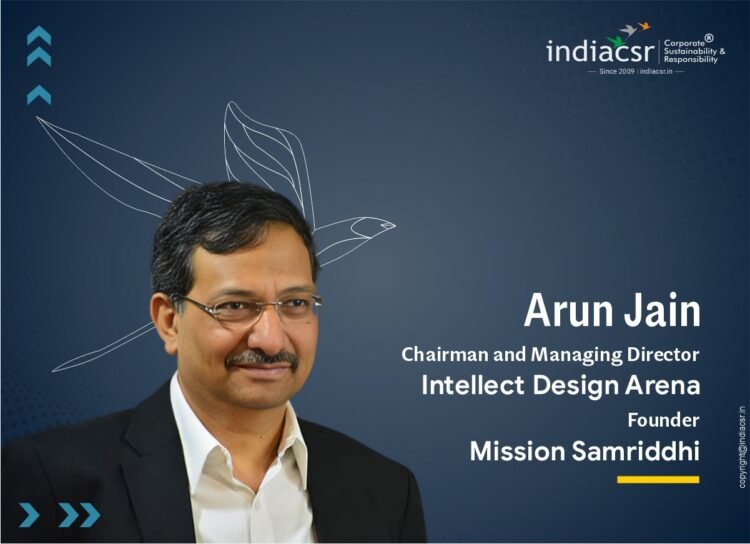


Arun Jain, CMD of Intellect Design Arena and Founder of Mission Samriddhi, on Transforming Villages into Entrepreneurial Ecosystems
By Rusen Kumar
CHENNAI: Arun Jain is not just a technology entrepreneur. He is a systems thinker. As the Chairman and Managing Director of Intellect Design Arena, he has spent over four decades building world-class financial technology platforms powered by Artificial Intelligence. But after exiting Polaris in 2016, Arun Jain turned his attention to one of India’s most complex challenges — rural development, village development and rural transformation.
Through Mission Samriddhi, he has designed a structured, data-driven, design-thinking-based rural transformation model that is currently active across 500 panchayats, 82 clusters, and 21 states. His philosophy challenges subsidy-driven development and advocates for entrepreneurship-led village ecosystems.
In this in-depth conversation with Rusen Kumar, Editor, India CSR, Arun Jain speaks about his beginnings, Civilisation Economics, design thinking, village entrepreneurship, AI as a great equaliser, and why philanthropy must move from fragmented charity to systemic transformation.
In this detailed interview, he explains his philosophy.
Q: After building a successful global fintech company, what inspired you to focus on rural transformation?
Arun Jain: After selling Polaris in 2016, I had capital, time, and the freedom to think about what next. Like many in my position, my first instinct was conventional philanthropy — build ten schools, ten hospitals, maybe even a university.
But reflection changed my direction. I asked myself a simple question: Tamil Nadu alone has nearly 50,000 schools. What meaningful difference would ten more create? Even if they were excellent institutions, their impact would remain marginal within such a vast system.
The problem in India is not merely the lack of institutions. The deeper issue is the lack of systemic thinking. We build projects, not ecosystems. We inaugurate buildings, but we rarely redesign systems.
Having spent decades applying structured design thinking in global financial technology, I began to wonder why the same disciplined approach could not be applied to rural India. That question became the foundation of Mission Samriddhi — a structured effort to redesign village economies rather than add isolated charitable assets.
Q: How does Mission Samriddhi differ from traditional CSR or philanthropy models?
Arun Jain: Most philanthropy and CSR in India operate in silos. One organisation works in primary education. Another in healthcare. A third supports livelihoods. While each effort is well intentioned, development cannot succeed in fragments. If a child receives help in primary school but drops out in high school, the chain breaks. If skill training is given but there is no access to markets or finance, the effort stagnates. Mission Samriddhi brings multiple stakeholders into a single village ecosystem. Today, 116 organisations participate in this collaborative framework.
Instead of spreading small resources across hundreds of villages, we concentrate structured efforts within selected panchayats. Education, health, entrepreneurship, engineering exposure, financial literacy, and governance reform work together in alignment. This creates continuity. Transformation becomes layered and measurable rather than symbolic. Our approach is ecosystem-based, not activity-based. Sustainable change happens when systems are aligned and interventions reinforce each other over time.
Q: You emphasise moving from “livelihood” to “entrepreneurship.” Why is this distinction important?
Language defines mental boundaries. Language influences identity, and identity influences aspiration. We call villagers “beneficiaries.” We call farmers “livelihood earners.” We reserve the word “entrepreneur” for urban startup founders.
But a farmer takes enormous risks. He invests capital, manages uncertainty every season, deals with price volatility, and faces climate risk. By every economic definition, he is already an entrepreneur. Yet we rarely recognise him that way. When society labels someone as livelihood-dependent, it unconsciously restricts his mental horizon.
Mission Samriddhi seeks to change that identity. We want villagers to see themselves as enterprise builders, not subsidy recipients. This shift is psychological before it is economic. Once a person begins to see himself as a value creator, his decisions change. Risk-taking becomes strategic. Planning becomes long-term. The move from livelihood thinking to entrepreneurship thinking is a transformation of self-perception.
Q: Is there a structured framework behind your rural transformation model?
Arun Jain: Yes, Mission Samriddhi is deeply systemised. It operates through 38 core transformation elements covering education, governance, enterprise development, infrastructure, and behavioural change. We have built a 1,400-point development index to measure progress objectively. Each village follows month-wise execution planning, and data tracking systems ensure accountability. Villagers themselves assess maturity levels. Many begin around a score of 600 and gradually improve through structured interventions.
This self-assessment builds ownership. Currently, we are active in 500 panchayats across 82 clusters in 9 states including Assam, West Bengal, Odisha, Maharashtra, Tamil Nadu, Uttar Pradesh, and Bihar. This is not an ad-hoc charitable programme; it is a disciplined five-year transformation journey. When systems thinking is applied consistently, measurable progress becomes visible. Structure removes ambiguity. Data creates clarity. And clarity accelerates change.
Q: You have spoken strongly against subsidy-driven development. Why?
Arun Jain: Money is enabling — not primary. Subsidy without capability-building creates dependency. No individual becomes prosperous through sustained subsidy. It limits thinking. Institutional subsidies — such as vaccination programs — are necessary. But direct cash or passive support reduces initiative. Rural India historically sustained empires through productivity. The soil is the same. The resources are the same. What has changed is mindset. We must move from welfare psychology to capability psychology. It conditions people to wait rather than act.
I am not opposed to institutional subsidies like vaccination programmes or public infrastructure. Those are necessary for societal stability. However, direct cash transfers or passive support cannot generate sustainable prosperity. Historically, rural India sustained powerful empires through productivity and enterprise. The soil is still fertile. Resources still exist. What has eroded is confidence and structured thinking.
When we overemphasise subsidy, we weaken initiative. We must move from welfare psychology to capability psychology. That means investing in skills, systems, entrepreneurship, and leadership. Prosperity grows when people believe they can produce, innovate, and compete. Dependency shrinks ambition. Capability expands it.
Q: Many believe rural communities lack education or exposure. How do you address that?
Arun Jain: That assumption is incorrect. Innovation is natural in villages. Survival under constraint requires creativity. Degree is not education. Education is the ability to solve problems. For three years, I deliberately unlearned my biases. My wife and I visited villages regularly, listening more than speaking. Villages historically were designed as self-sustaining ecosystems — water systems, distance planning, local skills. There is deep embedded intelligence there. Our intervention is not to replace their thinking. It is to structure and amplify it.
That perception is often shaped by urban bias. Innovation is natural in villages because survival under constraint demands creativity. Degree is not education. Education is the ability to solve real problems. For three years, my wife and I travelled extensively through villages, listening carefully and deliberately unlearning our assumptions. We observed that traditional villages were designed as self-sustaining ecosystems — with water harvesting systems, distributed skills, social governance mechanisms, and community accountability.
There is deep embedded intelligence in rural India. Our role is not to replace local wisdom but to structure and amplify it. When modern tools and systems thinking integrate with local knowledge, outcomes improve dramatically. Respect must precede intervention. If you approach villages assuming deficiency, you will design poor solutions. If you approach them recognising potential, transformation becomes collaborative.
Q: You often use the phrase “Civilisation Economics.” What does it mean?
Arun Jain: Civilisation Economics builds capability from aspiration to enterprise.
Its pillars include:
- Dream-building for students (Classes 9–12)
- Tinker Labs and Young Tinker on Wheels (hands-on exposure)
- Applied Engineering (practical mechanical and systems knowledge)
- Entrepreneurship training
- Business literacy
- Business model development
- Transition from SHGs to Private Limited companies
Why are startups only urban phenomena? Why not private limited companies in villages? Why is cooperative thinking the ceiling for rural enterprise? Why should private enterprise remain confined to cities? Why should rural ambition stop at cooperative structures? The mental barrier must be broken. Civilisation Economics aims to create a mindset where villages see themselves as productive economic ecosystems capable of building scalable enterprises.
Q: What role does Design Thinking play in this model?
Arun Jain: Design Thinking is foundational to Mission Samriddhi.
The sequence is simple and disciplined:
- Define the problem clearly
- Apply first-principle thinking
- Convert insights into system thinking
- Implement with measurement and accountability
We begin by identifying the real problem, not just the visible symptoms. Then we examine root causes through first principles. Those insights are translated into structured systems with measurable milestones. Execution is disciplined. Outcomes are tracked, evaluated, and refined continuously.
Many development programmes fail because they are event-driven rather than system-driven. Without structure, initiatives fade after initial enthusiasm. Village transformation cannot be achieved through isolated activities. It requires a minimum three-year design cycle with iteration, feedback, and accountability.
Design Thinking brings clarity. It brings structure. It brings measurable progress. When systems are engineered properly and modern knowledge is applied consistently, village transformation within five years becomes realistic and scalable.
Q: How do you see Artificial Intelligence contributing to rural development?
Arun Jain: Artificial Intelligence can become a powerful equaliser. Over the past decade, we have invested more than Rs. 2,000 crore in AI technologies. AI reduces information asymmetry by making knowledge accessible. A rural entrepreneur can access market trends, pricing analytics, crop advisories, and operational insights once available only to large corporations.
We aim to extend AI access to tier-2 and tier-3 cities through scalable franchise models. However, technology alone cannot transform societies. Mindset must lead. When ambition, structure, and AI combine, rural productivity can accelerate significantly. AI democratises knowledge. Structured thinking converts knowledge into prosperity.
**
Under the leadership of Arun Jain, Mission Samriddhi — India’s pioneering social impact platform for holistic rural development — has commenced its landmark 10th National Summit in Chennai from 26 to 28 February in Chennai. The three-day convergence brings together over 320 grassroots leaders, educators, administrators, development practitioners, and institutional partners from 15 states to collaboratively design a measurable five-year transformation roadmap for 1,800 villages within its network, marking a decisive transition from grassroots experimentation to structured national scale.
About the Author: Rusen Kumar, Editor of India CSR, is a renowned thought leader in the area of Corporate Sustainability and Responsibility (CSR)


