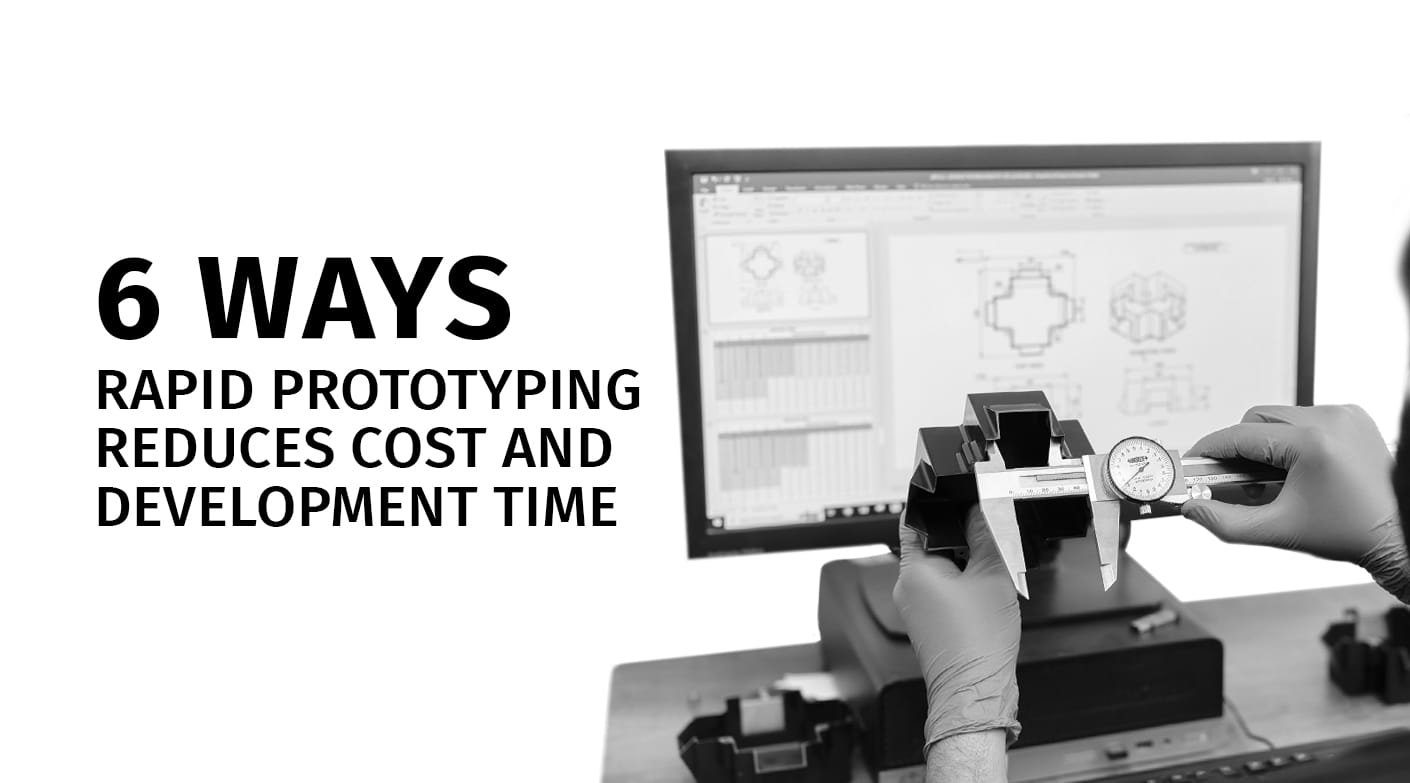



Why not test, fail, revise, and make your product flawless before investing heavily in production? This is what rapid prototyping makes possible. In a world where pace and accuracy are the keys to success, companies that repeat more often do not win; they take control of the market.
Rapid prototyping is no longer a technique that is only practiced by large manufacturers, but it is now a strategic requirement. At this point, it does not matter whether you are a startup trying to validate an idea or an enterprise trying to optimize production cycles; being able to create, test, and refine fast is invaluable.
In this blog, we’ll explore 6 powerful ways rapid prototyping reduces cost and development time, while highlighting the practical advantages of working with a reliable prototyping service provider like Cubein in India.

Understanding Rapid Prototyping
Rapid prototyping is a model of developing physical or digital prototypes of a product promptly with the help of technologies such as 3D printing, CAD modelling, and additive manufacturing. Prototypes can now be created in days (or hours) instead of weeks or months.
As a matter of fact, the incorporation of the rapid prototyping technique by Lockheed Martin, an aerospace and defence company, helped them save up to 50% of product validation timelines.
This is the dramatic effect that makes companies quickly turn towards sophisticated prototyping techniques. Furthermore, this method can help businesses to experiment and test early, keep on iterating, and proceed to production with confidence.
6 Key Ways Rapid Prototyping Reduces Cost and Development Times
1. Early Detection of Design Flaws
Among the most notable rapid prototyping benefits, one can distinguish the possibility of finding design problems at the initial stage.
The traditional product development process usually postpones testing to later stages, and by this time, it becomes very costly to correct the mistakes. This approach is inverted by Rapid prototyping. Through the development of early-stage models, teams can experiment on functionality, usability, and aesthetics prior to making a commitment to production.
This initial approval eliminates expensive redesigns, minimizes material waste, and eliminates delays due to a last-minute change. Rather than finding faults in the production, companies correct them when they can be cheap and easy to handle.
Essentially, rapid prototyping makes sure that errors are not just easy to correct but also not expensive to regret.
2. Faster Iterations Accelerate Development Cycles
Rapid prototyping is excellent when it comes to speed. The time spent in traditional prototyping may require several weeks, but rapid prototyping may be able to provide results within a few days. This speed offers the ability to have several iterations in a short period. The designers as well as engineers are able to test alternatives, get feedback, and continually refine the product without slowing the project down.
Development is dynamic and agile instead of a linear process. This greatly reduces the time-to-market, providing the companies with a competitive advantage.
An example is the teams that have a mature prototyping partner: they can conduct parallel iterations, i.e., test several design ideas at the same time instead of one at a time.
3. Decreased Tooling and Production Costs
Conventional manufacturing typically involves large tooling, molds, and installation- even to test in the early stages. These are prohibitive costs in case the design changes frequently. Rapid prototyping does not involve such huge investments. Since the prototypes are built using additive manufacturing, there is no need to use costly molds or tooling at the initial stages.
This means that companies do not need to put in massive capital into an idea before they can validate it. It is especially useful with startups and SMEs, which must be very mindful of budgets.
Rapid prototyping is less expensive since it lowers the cost of tooling, and it is flexible at all times of the development process.
4. Improved Communication and Stakeholder Alignment
One of the hidden costs in product development is miscommunication. When teams utilise only sketches or computer models, misinterpretations may result in wrong assumptions and poor choices.
This is addressed by the rapid prototyping, as it enables the stakeholders to feel and test the real prototype models. All individuals get a clear picture of the product, whether it is internal teams, clients, or investors.
This transparency results in quicker approvals, reduced revisions, and improved inter-departmental alignment. Feedback becomes more precise, and decisions are made with confidence.
5. Improved Testing and Pre-Production Testing
Testing a concept in theory is never as reliable as testing it in reality. Rapid prototyping will allow actual testing of product performance, ergonomics, and functionality in the real world.
Through testing of materials, stress points, usability, and assembly processes, engineers can test them prior to actual production. This will minimize the chances of failure and will guarantee that the end product will be of good quality.
Early design validation assists businesses in avoiding costly recalls, redesigns, and production faults. Research indicates that rapid prototyping assists in minimizing risks because it enables the assessment to be made continuously during development.
6. Reduced Time-to-Market = Increased Competitive Advantage
In the contemporary business environment, speed can be the definition of success. The sooner you launch, the sooner you get market share. Rapid prototyping increases the speed of the whole product development cycle, from concept to production. The time taken to design, test, and approve products can be reduced, hence enabling businesses to introduce the products much faster.
It is particularly relevant in markets like consumer electronics, automotive, or healthcare, where the innovation cycles are short and competition is high. Companies that adopt rapid prototyping can respond quickly to market demands, adapt to changing trends, and stay ahead of competitors.
This is further augmented by working with Cubein, an experienced Rapid prototyping service provider in India, which would offer the added benefit of cost-effectiveness as well as technical expertise.
How Businesses Use Rapid Prototyping
Consider a firm coming up with a new consumer product. They do not have to wait months to get their last prototype, but they make several iterations in weeks. All versions are tried, revised, and enhanced based on actual feedback.
This cycle guarantees that the end product will be in line with the expectations of the user, besides minimizing the time taken to develop the product.
To attain this agility, many of the innovative firms work with partners who specialise in it. These vendors, such as Cubein, provide a complete services package, including design verification, through functional prototyping, to enable organizations to simplify the development process.
Conclusion
Rapid prototyping is not a mere tool; it is a strategic benefit. From reducing costs and accelerating development to improving product quality and market readiness, its impact is undeniable.
In the need to be more innovative, minimise risks, and bring products to market efficiently, the right partner can make all the difference.
Cubein is a reputable prototyping service provider in India that assists companies in bringing their ideas to reality within a short time, with precision and at a low cost.
| Transform Your Product Ideas into Reality Faster with Cubein Contact now! |
FAQs
1. What is the effect of rapid prototyping on the cost of product development?
Rapid prototyping does not require costly tooling and is able to identify design problems early on, minimising rework and waste of materials.
2. What industries are best able to take advantage of rapid prototyping?
Rapid innovation cycles are very helpful to the automotive, healthcare, consumer electronics, and manufacturing industries.
3. How fast is rapid prototyping compared to traditional methods?
Rapid prototyping can reduce the development time to a few weeks or months as it enables faster iterations.
4. Why choose a prototyping service provider in India?
India is a hub of good service providers, like Cubein, which offers cost-effectiveness, qualified expertise, and innovative technologies, making it a suitable choice for scalable product development solutions.