




Imagine a child watching a drone they have spent weeks designing and building suddenly crash to the ground.
The propellers stop. The excitement disappears. For an adult, it may look like a failed experiment. For the child, it can feel as though weeks of imagination, effort and hope have collapsed in a few seconds. What happens next may be the most important part of that child’s education, and it is where the importance of innovation in school education becomes much larger than laboratories, inventions and exhibitions.
Does the child find the courage to begin again? Do they become curious about what went wrong? Can they question their own decisions and discover something they had not understood before? And does the school recognise the significance of that moment, or does it only celebrate the drone that eventually flies?
Answering those questions requires more than an innovation programme. It requires observation, evidence and a willingness to learn from the children themselves.
The importance of innovation in school education today
Seen from inside a school, access to innovation spaces is still uneven. India has nearly 15 lakh schools, and a little over 10,000 have an Atal Tinkering Lab, roughly one school in 150. Even the 50,000 additional labs announced in the Union Budget for 2025–26 would bring that figure to about one school in 25. For most schools, an innovation space is something they must plan, fund and justify themselves.
Schools selected under the Atal Innovation Mission receive ₹20 lakh: ₹10 lakh to set up the lab and ₹2 lakh a year for five years to run and maintain it. The grant pays for the room and keeps it working. What a school learns from that room, and whether the learning reaches every child, depends on decisions the school must make for itself.
What is a school innovation lab?
A school innovation lab is a setting where children identify a problem, investigate it, work with materials, test an idea and improve it in response to what they discover. It may contain tools, electronics or fabrication equipment, but a room full of machines does not automatically create independent thinkers.
The stronger question is who does the thinking. Does the child decide what is worth investigating? Can the child explain why a design changed? Is there time to test an idea that might fail? Do adults provide technical knowledge and safety without taking ownership of the problem away from the student?
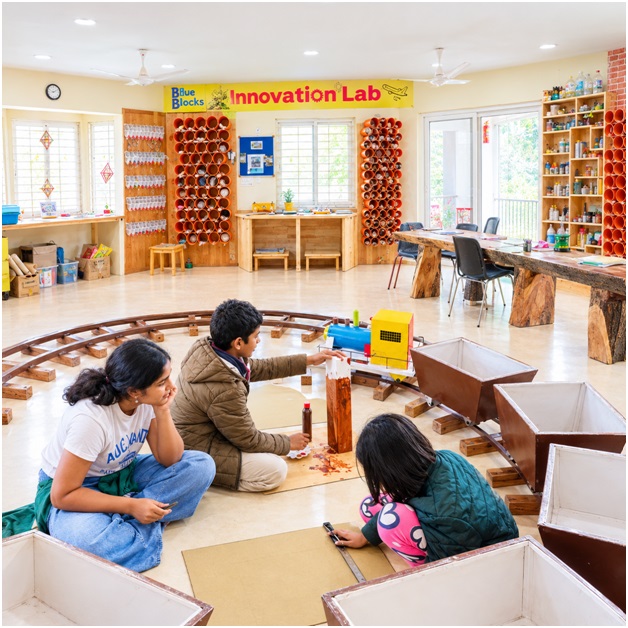
Families comparing examples of innovation labs in schools will find that Blue Blocks runs four: the Innovation Lab, Drone Lab, Biomimicry Hive and Space Lab. Each offers a different field of enquiry. What connects them is the opportunity to move from observing a problem to creating and examining a possible response.
What should count as evidence that innovation is happening?
A completed model establishes that students made something. It does not, by itself, establish that they became more inventive, resilient or capable of solving unfamiliar problems.
Schools need to distinguish three things. An artefact is the model, drawing, design journal or application that shows what was attempted. An observation records how the child worked: the questions asked, ideas reconsidered, help requested and revisions made. A measured outcome is a stronger claim, requiring a clear definition of the ability being studied, a suitable method and attention to other possible explanations.
The point is not to turn every creative moment into a score, but to understand the conditions under which worthwhile thinking develops.
What are examples of innovation projects done by students?
At Blue Blocks, Elementary students conceived drones for needs they noticed around them and filed five patent applications. One child, who saw his mother working late hours, came up with the idea of a security drone to keep her safe. Another concept, shaped by the pandemic, was a system to monitor people’s health and screen for illness when close contact was not possible. Others included a drone to help rescue a person trapped in a borewell and one to deliver essential supplies and medical assistance to people in remote locations. In the Biomimicry Hive, student investigations have drawn on seed dispersal, termite ventilation and the preservation of seeds.
What unites these ideas is where they began. None started with a tool or a competition brief. Each began with a person the child cared about or a situation that troubled them. Empathy is often the first step in invention, and it is a step that schools can observe and record as carefully as any finished prototype.
A difficult outcome can still reveal serious work
Blue Blocks students also developed the SBB-1 satellite payload with professional technical support. It was authorised for flight and integrated for ISRO’s PSLV-C62 mission. On 12 January 2026, the launch vehicle encountered an anomaly, and the payload did not reach its intended orbit.
What followed says more about the students than the launch itself. Their first thoughts were not for their own payload, but for the scientists and engineers whose years of work on the mission had been lost. Rather than treating the setback as an ending, they returned to the work, and a second payload is now being built.
For schools, the episode is a reminder of what records should capture. A list of achievements would note a payload that never reached orbit. A fuller account would note students who understood the scale of effort behind a launch, felt its loss on behalf of others and chose to begin again.
How Blue Blocks studies children’s innovation
At Blue Blocks, innovation and research are designed to work together. The school’s research arm, Blue Blocks Micro Research Institute, observes children during their everyday work in the school’s environments rather than in settings arranged for a study. Guides record what they see on structured observation cards, and the Institute uses checks to ensure that different observers record the same behaviour in the same way.
Some of what is recorded would never appear on a report card. In the Drone Lab, guides note how long a student takes to begin again after a crash, the very moment described at the start of this article. Over time, records like these show which conditions help children persist, question and improve their ideas, and guides draw on them to decide what to offer each child next.
The Institute’s longest-running project is a study of innovation development from birth to eighteen, which began in 2017 and follows children across their years at the school. Educators and families interested in the importance of innovation in school education can read how the Institute approaches this work.
Opportunity matters as much as talent
Inventiveness is often treated as the gift of a few exceptional children. Research points instead to opportunity. A 2019 study by Alexander Bell, Raj Chetty and colleagues, published in The Quarterly Journal of Economics, found that childhood exposure to inventors and innovative environments influenced who went on to invent in the United States. Access to people, tools and experiences, in other words, shapes who gets the chance to become an inventor.
This is one reason Blue Blocks begins early. Its Innovation Lab introduces roughly 500 tools over a child’s eighteen years at school. Young children start with pouring jugs, scissors and tweezers that build precise control of the hand. Elementary children progress to hand saws, drills and soldering irons. Adolescents work with laser cutters, 3D printers and CNC machines.
Where can you see student innovation at work?
Parents searching for an “innovation based school hyderabad”, an “innovation lab school hyderabad” or a “school with innovation curriculum hyderabad” can see this approach in practice at Blue Blocks: four labs, five patent applications conceived and filed by Elementary students, a student-built satellite payload and research that follows children from the early years to adolescence.
The same work is relevant to companies that support schools through their corporate social responsibility (CSR) funding. It shows what such funding can make possible beyond equipment: mentorship from professionals, real community problems for students to investigate and research that records what children actually learn.
Frequently asked questions
Does a school need expensive equipment to teach innovation?
Not necessarily expensive, but an innovation lab does need a proper set-up. That means tools suited to the children’s age, safe working spaces, materials for building and testing, and regular time to use them. Equipment alone is not enough. Mentors are needed to guide children in careful observation, encourage them to keep going after failure and help them test their ideas, so that the space builds inventive thinking rather than simply holding equipment.
At what age should innovation work begin?
The foundations appear early. Precise hand control, sustained attention and persistence with a difficult task develop well before formal engineering or coding begins. Programmes that start only in secondary classes may miss the years in which these habits first form.
How can schools study innovation without reducing children to scores?
They can examine observation records, design journals, students’ explanations, revisions and collaboration. If a school claims an improvement in creativity or problem-solving, it needs a suitable research method. Effort and completed projects matter, but they are not automatically evidence of measured developmental gains.
Why should parents and communities care about child research?
Good research helps people distinguish a promising educational experience from a demonstrated result. It makes schools more accountable for how they support children, protects against exaggerated claims and can guide improvements. Responsible work also explains its limitations, respects children’s privacy and welcomes findings that challenge assumptions.
The responsibility that comes with invention
It is easy to applaud the child who produces something remarkable. A greater responsibility belongs to the adults and institutions around that child: to make opportunities available, to ask difficult questions, to record what really happened and to let the evidence improve what they do next. The goal is not a school full of impressive exhibits, but a community in which children learn that creating something new also means taking responsibility for what their creation may do to the world.



