
Explore how India’s fight against Naxalism transformed the Red Corridor into a Green Growth Corridor through security, development, and rehabilitation.
India has successfully traversed a decisive phase in its battle against Naxalism and Maoist violence. Over the past 12 years, this has emerged as a significant triumph in national security. The nation has broken free from the stranglehold of Naxalism and can now breathe a sigh of relief. The power of the Constitution and the rule of law have won, replacing the dominance of bombs and guns. Regions once known as the ‘Red Corridor’ have transformed into hubs of development and green growth. There is an onset of progress over fear and darkness. By systematically eradicating this decades-old menace within a defined timeframe, the pledge for a ‘Naxal-Free India’ has—as of March 31, 2026—culminated in a historic achievement, marking a moment of immense pride for the nation…
Where once the echoes of gunfire resounded, now ring the songs of development. Where nights were once shrouded in fear, now shine the rays of hope. Where silence once reigned in the forests, today life smiles. Today, India is scripting a new history through its courage and resolve.

These lines, which resonated in Parliament on March 30, 2026, serve as a poetic expression of the eradication of Naxalism in India and the transformation taking place in Naxal-affected regions. Where once there were guns, today there is employment; where fear and darkness once prevailed, today development is taking place. This describes a new era—one filled with development, security, and aspirations—where progress has taken the place of violence. It stands as a testament that when policy, intent, and leadership work in unison, even the impossible becomes possible.
Often, certain dates and moments become etched in history in golden letters forever. One such date has now become March 31, 2026. Until now, March 31 has been remembered as the last day of the financial year and globally for events like the inauguration of the Eiffel Tower and the first time an African American was allowed to vote in the United States. But now, this date will also be remembered as a symbol of a “Naxal-free India” and socio-economic development. Regions that had long remained deprived of development due to the “Red Terror” will now witness the beginning of a new journey of progress. It will be achieved. Exactly one day before March 31—the designated date for India to become Naxal-free—Union Home Minister Amit Shah proclaimed the fulfillment of this resolve from the supreme temple of democracy. Along with it, the decades-old Naxal problem was a violent ideology that hindered development in tribal areas and fuelled unrest.
The firm and clear policy of the central government has brought this issue to an end. March 31, 2026, has gone down in history as a date that will be remembered for centuries to come for having eradicated a decades-old problem from its very roots. Under a multi-pronged strategy, the central government implemented a policy characterised by robust security operations, accelerated development initiatives, and compassionate engagement. These concerted efforts by the government played a crucial role in dismantling the Naxalite infrastructure and its cadre. In fact, when Prime Minister Narendra Modi took charge of the office, India’s internal security was severely affected across three highly sensitive regions: Jammu & Kashmir, the Northeast, and the Red corridor affected by left-wing extremism. For 4-5 decades, thousands of people had lost their lives due to turmoil in these areas, and there had been significant property damage. A significant portion of the national budget was being spent on managing these hotspots instead of on the development of the poor. The security forces, too, suffered casualties; however, after 2014, focused attention was given to all three critical hotspots, and work was carried out based on a clear long-term strategy.
THE GENESIS OF NAXALISM
Originating from the Naxalbari movement of 1967 in West Bengal, it spread primarily across the “Red Corridor,” affecting states like Chhattisgarh, Jharkhand, Odisha, Maharashtra, Kerala, West Bengal, Madhya Pradesh, and parts of Andhra Pradesh and Telangana.
The year 1971 witnessed the highest number of violent incidents—3,620—in the history of independent India. Subsequently, during the 1980s, the People’s War Group expanded its reach to these states. After this decade, various Left-wing factions began to merge with one another, culminating in the formation of the prominent CPI (Maoist) faction in 2004. Naxalite violence assumed an extremely grave dimension. The corridor stretching from Pashupati to Tirupati came to be known as the “Red Corridor”. This Red Corridor encompassed 17 per cent of the country’s geographical area, and a population of 120 million was affected by this menace, who were forced to live in abject poverty for years. At that time, 10 percent of the nation’s population was living under the constant shadow of Naxalite violence.
“It is true that Maoist violence had stalled the progress of several districts across Central and Eastern India. That is why, in 2015, our government formulated a comprehensive ‘National Policy and Action Plan’ to eradicate Maoist violence. Alongside a zero-tolerance approach towards violence, we have also focused on boosting infrastructure and social empowerment to bring about positive changes in the lives of the poor people residing in these regions.” – Narendra Modi, Prime Minister
“Since 2014, our government has launched a massive offensive against Naxalite-Maoist terror. We have neutralized the ‘Urban Naxals’ and their supporters who operated from within our cities; we have won the ideological battle; and we have confronted the Naxals head-on within their very strongholds. The results of these efforts are evident to the entire nation today.” – Narendra Modi, Prime Minister
National Policy and Action Plan – 2015
The Central Government’s strategy—centered on security, infrastructure development, dismantling Naxal financial networks, and a surrender policy—has yielded positive results. Left-Wing Extremism (LWE), commonly known as Naxalism, was one of India’s most formidable internal security challenges. With the assistance of the Central Government and the affected state governments, these regions have now been declared Naxal-free. Efforts undertaken to liberate the nation from Naxalism…
- To eradicate the problem of Naxalism at its roots, the ‘National Policy and Action Plan to Deal with LWE’ was approved in 2015. This framework focused on various strategies, including security-related measures, developmental activities, and ensuring the rights and entitlements of local communities.
- In LWE-affected states, the Central Government undertook measures such as the deployment of Central Armed Police Forces, the establishment of India Reserve Battalions, provision of helicopter support, police training and modernization, and the supply of necessary funds, arms, and equipment; additionally, provisions were made for intelligence sharing and the construction of fortified police stations.
From the ‘Red Corridor’ to a Naxal-Free India (2014–2026)
Naxalite violence. In comparison, the country’s two other hotspots, Kashmir and the Northeast, saw 1 per cent of the landmass plagued by terrorism and 3.3 per cent by general unrest, respectively. Against this backdrop, starting in 2014, under the leadership of Prime Minister Modi, the central government initiated a comprehensive strategy focusing on three key pillars: dialogue, security, and coordination. In this regard, the period from 2014 to 2026 is poised to be etched in the history of India’s internal security as a “Golden Era.” Union Home Minister Amit Shah has stated on multiple occasions: “We will undoubtedly succeed in freeing the entire country of Naxalite violence by March 31, 2026.” In this same direction,
Rs. 3681.73 crore was released to LWE-affected states to enhance the capacity of the states, under the Security Related Expenditure (SRE) Scheme since 2014-15.
More than 10,000 youths in the Northeast have laid down their arms and joined the mainstream, and a monumental task of establishing peace in the region has been accomplished through over 12 peace accords. In Jammu & Kashmir and Ladakh as well, a new era of development has commenced following the abrogation of Article 370.
INDIA FREE FROM ‘RED TERROR’
One of India’s biggest achievements in national security over the past 12 years has been breaking the backbone of Naxal–Maoist terrorism. Before 2014, the situation in our country was such that Naxalite-Maoists ran their own parallel governments right in the heart of India. In those regions, the Constitution of India did not function.
Continuous Decline in Violence
- The implementation of the ‘National Policy and Action Plan 2015’ led to a reduction in violence. Left-Wing Extremism (LWE)—which had posed a grave challenge to the country’s internal security—was brought under control.
- The number of districts affected by LWE declined from 126 in 2014 to just 11 in December 2025. Now, no district remains ‘extremely affected.’
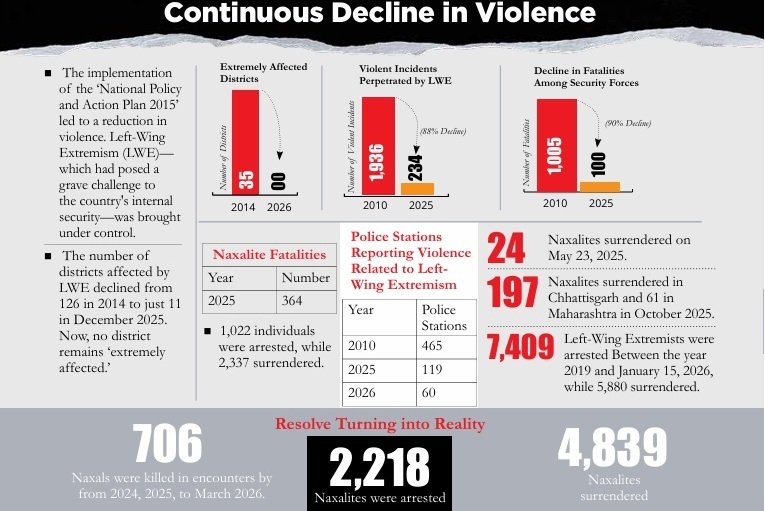
Decline in Left-Wing Extremism: Key Indicators at a Glance
| Indicator | Base Year | Base Value | Latest Year | Latest Value | Change |
|---|---|---|---|---|---|
| Decline in Fatalities Among Security Forces | 2010 | 1,005 | 2025 | 100 | 90% decline |
| Violent Incidents Perpetrated by LWE | 2010 | 1,936 | 2025 | 234 | 88% decline |
| Extremely Affected Districts | 2014 | 35 | 2026 | 0 | 100% decline |
| Naxalite Fatalities | 2025 | 364 | — | — | Single-year figure |
| Police Stations Reporting Violence Related to Left-Wing Extremism | 2010 | 465 | 2026 | 60 | 87.1% decline |
- 1,022 individuals were arrested, while 2,337 surrendered.
Arrests, Surrenders and Encounter Data of Naxal Cadres
| Indicator | Period / Date | Number | Remarks |
|---|---|---|---|
| Naxals killed in encounters | 2024, 2025, to March 2026 | 706 | Total killed in encounters during the stated period |
| Naxalites arrested | Not specified | 2,218 | Total arrests mentioned |
| Naxalites surrendered | Not specified | 4,839 | Total surrenders mentioned |
| Left-Wing Extremists arrested | 2019 to January 15, 2026 | 7,409 | Cumulative arrests during the stated period |
| Left-Wing Extremists surrendered | 2019 to January 15, 2026 | 5,880 | Cumulative surrenders during the stated period |
| Naxalites surrendered | May 23, 2025 | 24 | Single-day surrender figure |
| Naxalites surrendered in Chhattisgarh | October 2025 | 197 | State-wise figure |
| Naxalites surrendered in Maharashtra | October 2025 | 61 | State-wise figure |
Resolve Turning into Reality
Rs. 50,000 incentive is provided upon surrender, and the amount doubles in case of collective surrender.
Rs. 10,000 per month financial assistance is provided for up to 36 months, along with housing support under the PM Awas Yojana for all beneficiaries.
The Impact of Rehabilitation and Incentives is Also Evident
- The rehabilitation package provides—among other provisions—for an immediate grant of ₹5 lakh for high-ranking LWE (Left-Wing Extremism) cadres, and ₹2.5 lakh for other LWE cadres.
- Each surrendering individual is provided with a mobile phone.
- Compensation is provided for the surrender of weapons.
- Skill training and toolkits are distributed at rehabilitation centers.
- Upon a Panchayat being declared ‘Naxal-free,’ a grant of ₹1 crore is allocated for development.
- Provisions include free education up to the 12th grade for their children. Loans up to ₹2 lakh for women and up to ₹5 lakh for men.
Police and administration were unable to function there, and the machinery of governance appeared utterly helpless in the face of these groups. Before 2014, around 125 districts of the country were affected by Maoist violence. However, as a result of the tireless efforts of the last 12 years, the nation today is breathing freely, having been freed from Maoist terror. Millions of people, for the first time in generations, have come out from the shadow of fear and are now part of the mainstream of development. In those very regions where Maoist Naxalites once prevented the construction of roads, schools, and hospitals, and would even bomb existing infrastructure. They used to gun down doctors, prevent the installation of mobile towers, attack security force camps to free prisoners, loot weapons, extort commissions from contractors engaged in infrastructure projects, and set fire to trucks and railway freight; yet now, highways are being built there, and new industries are being set up. The nation owes this success to the dedication, sacrifice, and valour of its security forces. Consequently, in 2025, Prime Minister Narendra Modi gave the entire nation his solemn assurance: that until the country is completely liberated from the scourge of Naxalite-Maoist terror, he will neither pause in his efforts nor rest until the mission is accomplished.
“Many major tasks—which the people of this country have desired since the time of independence—have been accomplished during these 12 years under the leadership of Narendra Modi. Furthermore, the creation of a Naxalism-free India is also taking shape precisely under Narendra Modi’s administration. In a sense, these 12 years have proven to be extremely auspicious for the nation.” – Amit Shah, Union Home Minister
DIALOGUE → SECURITY → COORDINATION
Under the leadership of Prime Minister Narendra Modi, India’s fight against Naxalism is anchored in a triad of security, development, and social justice. Through sustained and active cooperation between the Centre and the States, the nation achieved the goal of becoming ‘Naxal-free’ by March 31, 2026. This stands as a testament to a decade of the government’s decisive policy and its unwavering commitment to peace and development. The government has adopted an integrated, multi-pronged, and
The Three Dates… A Shift in Direction
For development, the Central Government adopted a “Whole-of-Government” approach; while, to tighten the security noose, it shifted its strategy toward a “Whole-of-Agency” perspective—a transformation in which three specific dates scripted the decisive narrative…
- Through an “All-Agency Approach,” entities such as the NIA, ED, and various intelligence agencies launched a multi-pronged offensive against the networks, funding channels, and support systems of the Naxalites.
- Leveraging the “Whole-of-Government” approach, development initiatives had already been set in motion across the affected regions.
- August 20, 2019: A meeting was convened at the Union Ministry of Home Affairs, wherein a comprehensive blueprint was drafted addressing various facets—including police coordination, police modernization, the integration of former Naxalites into the police force, and coordination with intelligence agencies.
- August 24, 2024: Following the elections in Chhattisgarh, a change of government had taken place. Union Home Minister Amit Shah visited the state, where a joint strategy was formulated between the Centre and the State. On this very date, an announcement was made: India would be rendered Naxal-free by March 31, 2026.
- March 31, 2026: Just one day before the target date for the realization of the pledge for a Naxal-free India, the Union Home Minister made a formal announcement in the Lok Sabha.
Modernization of Police Forces
- State police forces were provided with assistance under the ‘Modernization of Police Forces’ scheme.
- Under this scheme, the Central Government provided assistance to State Governments for weapons, Information Technology equipment, communication systems, training, mobility, police housing, and other infrastructure.
- Under the ‘Special Infrastructure Scheme (SIS)’—a sub-scheme of the main plan—special forces, State Intelligence Branches, District Police units, and fortified police stations were established in Left-Wing Extremism (LWE) affected states.
- To strengthen security infrastructure, more than 656 fortified police stations were established.
Rs. 1,224.59 Crore: Assistance has been provided to central agencies through this scheme since the year 2014-15.
Security Infrastructure Strengthening in Naxal-Affected Areas
| Infrastructure / Facility | Number | Time Period / Status | Remarks |
|---|---|---|---|
| Fortified police stations established | 596 | Over the past 11 years | Strengthening security infrastructure |
| Police stations reporting Naxal-related incidents | 350 to 60 | Then to now | Sharp decline in affected police stations |
| New camps for Central Armed Forces | 406 | Since 2020 | Expanded force presence in affected areas |
| Night-landing helipads constructed | 68 | Not specified | Improved mobility and operational response |
| Bullet- and blast-proof vehicles provided | 400 | Not specified | Enhanced personnel safety |
| Hospitals built for personnel | 5 | Not specified | Health support infrastructure improved |
The government has placed special emphasis on curbing the flow of funds to Left-Wing Extremist (LWE) groups. In particular, continuous action has been taken to uncover the nexus between the Communist Party of India (Maoist) and those providing them with financial support. Coordinated and effective measures have been undertaken jointly by state police forces and central agencies to prevent LWE groups from accessing funds and other resources. Measures taken by the government to dismantle the financial networks of LWE groups include:
Measures to Curb Funding
- To curb terror financing, a specialized unit named the “Countering Terrorist Financing (CTF) Cell” was established within the Ministry of Home Affairs in 2011. This cell coordinates with various intelligence and enforcement agencies to take action against terrorist financial networks.
- The National Investigation Agency (NIA) also established a “Terror Funding and Fake Currency Cell” (TFFC) to investigate and prosecute cases involving terrorist financing and Fake Indian Currency Notes (FICN).
- To combat the circulation of FICN within the country, an “FICN Coordination Centre” (FCORD) was established to facilitate the sharing of intelligence and information among various security agencies at both the central and state levels.
- Various sanctions were imposed against terrorist organizations and their members under United Nations Security Council Resolutions and the Unlawful Activities (Prevention) Act. These measures included the freezing and seizure of funds and assets, thereby curbing the flow of funds to terrorist organizations.
- In 2016, two multi-disciplinary groups were constituted within the Ministry of Home Affairs—one at the central level and the other at the state level—to monitor the flow of funds to LWE cadres.
Rs. 40 crore worth of assets were seized by the NIA through its dedicated anti-Naxalite financing unit, while states also seized assets exceeding Rs. 40 crore, effectively curbing Naxalite funding networks.
12 Crore Rupees were attached by the Enforcement Directorate. This action inflicted severe moral and psychological damage upon the ‘Urban Naxals’ and resulted in even tighter control over their information warfare networks.
Robust strategy against Naxalism—an approach that has proven successful in replacing the fragmented methodologies of previous administrations. Guided by the clear principles of Dialogue → Security → Coordination, the government successfully rendered every Naxal-affected region completely Naxal-free by March 2026.
According to Union Home and Cooperation Minister Amit Shah, the past was characterised by a fragmented approach, reactive incident-based actions, and a complete absence of a permanent policy framework. In a sense, the steering wheel of the government’s response was effectively in the hands of the Naxals. However, since 2014, the steering of the government’s campaigns and programmes has firmly rested with the Ministry of Home Affairs, Government of India. This marks a monumental shift in policy.
Union Home Minister Amit Shah states, “Our government’s policy is clear: for those who wish to lay down their arms and surrender, a ‘red carpet’ awaits them, and they are welcomed. However, if they choose to wield weapons to kill innocent tribals, it becomes the government’s sacred duty to protect those innocent tribals and confront the armed Naxals.”
Coordination between the Centre and the States has improved, and the capabilities and policing systems of the States have been enhanced. Coordination between the Central Armed Forces and the State Police has been strengthened.
Development-Centric Initiatives
On the development front, in addition to the government’s flagship schemes, special initiatives have been undertaken for several areas affected by Left-Wing Extremism (LWE). Particular emphasis has been placed on the expansion of road networks, improvement in telecommunication connectivity, education, skill development, and financial inclusion. Prominent among these are:
- To strengthen the road network, two special schemes—the Road Requirement Plan (RRP) and the Road Connectivity Project for LWE Affected Areas (RCPLWEA)—have been implemented.
- Under the Special Central Assistance (SCA) scheme—aimed at bridging gaps in public infrastructure in the most severely LWE-affected districts—a total of ₹3,953.67 crore has been released since the scheme’s inception in 2017.
- On October 2, 2024, Prime Minister Narendra Modi launched the ‘Dharti Aaba Janjatiya Gram Utkarsh Abhiyan’ from Jharkhand. The objective of this campaign is to ensure access to basic amenities in over 15,000 villages. Furthermore, the government is continuously strengthening the ‘3-Cs’—namely Road Connectivity, Mobile Connectivity, and Financial Connectivity—in these regions to accelerate the pace of development and ensure that the people have access to better facilities.
Development and Connectivity Initiatives in LWE-Affected Districts
| Development Indicator | Number / Extent | Remarks |
|---|---|---|
| Bank Branches opened | 1,804 | Opened in Left-Wing Extremism-affected districts |
| ATMs installed | 1,321 | Expanded banking access |
| Banking Correspondents deployed | 37,850 | Strengthened last-mile financial inclusion |
| Roads approved | 17,589 km | Approved under road connectivity schemes |
| Roads constructed | 12,000 km | Already completed out of approved roads |
| Post offices offering banking services | 6,025 | Opened by India Post in LWE-affected districts |
| Telecom towers installed | 9,233 | Improved telecom connectivity |
| Industrial Training Institutes (ITIs) opened | 46 | Promoted skill development |
| Skill Development Centers opened | 49 | Expanded training infrastructure |
| Eklavya Model Residential Schools established | 259 | Improved quality education in tribal areas |
For the first time, the Government of India adopted a clear-cut policy, devoid of any ambiguity. State police forces and central security agencies were granted operational autonomy. Simultaneously, a practical bridge was established between the central and state governments to ensure effective coordination in intelligence gathering, information sharing, and operational execution. A tight clampdown was imposed on the supply of illegal weaponry. Between 2019 and 2026, significant success was achieved in disrupting the Naxals’ arms supply chain. Furthermore, the National Investigation Agency (NIA) and the Enforcement Directorate (ED) cracked down heavily on those involved in financing Naxal activities.
Furthermore, strict measures were implemented to curb the Naxalites’ network of “Urban Naxal” support, legal assistance, and the crafting of media narratives. Targeted actions were initiated against members of the Central Committee. Targeted operations, such as ‘Operation Octopus’ and ‘Operation Double Bull’, were executed. Joint training programmes were also launched for the DRG, STF, CRPF, and COBRA forces, enabling these four agencies to conduct joint operations.
Concurrently, forensic investigations were initiated, location tracking systems were deployed, and data regarding mobile phone activity were made available to the state police. Software for scientific call log analysis was developed, and social media analysis was utilised to identify their covert supporters. These measures not only accelerated the anti-Naxal operations but also yielded concrete results.

New Dimensions in the Development of Bastar
- Naxalism has been virtually eradicated from Bastar.
- To achieve this, a campaign was launched to establish a school in every village across Bastar.
- A drive was undertaken to open a ration shop in every village.
- Community Health Centers (CHCs) and Primary Health Centers (PHCs) were established in every Tehsil and Panchayat.
- Aadhaar cards and Ration cards were issued, and beneficiaries received facilities such as 5 kg of free rations and gas stoves.
- Sports were promoted through initiatives such as the ‘Bastar Olympics’ and ‘Bastar Pandum’.
A 240-bed super-specialty hospital was established in Jagdalpur. Previously, this region lacked even basic Primary and Community Health Centers.
Works worth Rs. 2,212 crore were undertaken under the Civic Action Programme, covering health camps and the provision of medicines.
- Exchange programs were organized for tribal youth.
- Special security-related expenditure initiatives were introduced for the states:
Infrastructure Support and Community Participation in Bastar
| Initiative / Activity | Amount / Participation | Remarks |
|---|---|---|
| Special Infrastructure Scheme | ₹5,000 crore | Allocated under the scheme |
| Central funds for critical public infrastructure | ₹4,000 crore | Provided for essential infrastructure |
| Long-term development support | ₹3,000 crore | Provided over a period of 10 years |
| Extended Special Infrastructure Scheme | ₹2,000 crore | Additional allocation under the extended scheme |
| Artists participated in Bastar Pandum | 1.20 lakh | Cultural participation |
| Tribal people participated in sports activities | 5.50 lakh | Sports outreach and community participation |
“In just the past year alone, more than 2,100 Naxalites have surrendered; over 900 arrests have been made; and security forces have neutralized more than 300 hardline Naxalites—those who were unwilling to lay down their arms. The result of this is that areas once forced to live under the shadow of fear are today being infused with a new energy of development.” Narendra Modi, Prime Minister
NAXAL-FREE INDIA – A LANDMARK DATE
March 31, 2026, has emerged as a landmark date in the history of India. To achieve this objective, a multi-pronged strategy was adopted. This strategy encompassed relentless operations by security forces, comprehensive development initiatives, and rehabilitation policies. Conducted through inter-agency cooperation, these operations achieved unprecedented success in dismantling the Maoist network and restoring peace in the affected regions. This marks the first instance in which a government set a definitive deadline to completely eradicate such challenges and successfully delivered on that promise. In April 2025, Union Home Minister Amit Shah categorically stated that Naxalism would become a thing of the past
“What constitutes the Maoist ideology? What is its guiding motto? When we attained independence, we proclaimed—‘Satyameva Jayate’ that truth shall always prevail. Their motto, however, asserts that ‘Power flows from the barrel of a gun.’ In their context, the word ‘power’ does not signify development, but rather the mere survival of their own ideology. There is absolutely no discourse on development here; they harbor no faith in democracy.” Amit Shah, Union Home Minister
Across the entire country, including Chhattisgarh, by March 31, 2026. He reiterated this commitment to the nation and its citizens on multiple occasions. To realize this objective, security forces conducted several operations. In 2022, ‘Operation Octopus’ was carried out in the Budha Pahad region of Bihar. That same year, ‘Operation Double Bull’ was conducted in Gumla, Lohardaga, and Latehar, and all three regions became Naxal-free within a matter of days. Similarly, from September 1 to 3, 2022, ‘Operation Thunderstorm’ was executed in the Seraikela, West Singhbhum, and Khunti districts of Jharkhand. In June–July of 2022, ‘Operation Bhimbandh’ was conducted in the Munger district. ‘Operation Chakrabandha’ was carried out in the Gaya and Aurangabad districts of Bihar.
In May 2025, achieving a historic milestone in the resolve to create a Naxal-free India, security forces eliminated 31 Naxals during the largest-ever anti-Naxal operation conducted at Karreguttalu Hill on the Chhattisgarh-Telangana border. Karreguttalu Hill, which was once ruled by red terror, now proudly hoists the tricolour. This was a remarkable operation that the security forces completed in a mere 21 days. It stands as the largest anti-Naxal operation to date in which the security forces suffered zero casualties.
Achieving yet another historic feat, security forces neutralised 27 dreaded Naxals—including Nambala Keshav Rao (alias Basavaraju), the general secretary of the Communist Party of India (Maoist), in Narayanpur. Basavaraju was considered the backbone of the Maoist movement. It was after three decades that a Maoist leader of such high stature was eliminated. Following “Operation Black Forest”, 54 Maoists were arrested across various states, while 84 others surrendered.
GREEN ZONE OF DEVELOPMENT
The past decade has, in a sense, marked an era of peace and progress. For a long time, the nation fell victim to various forms of violent incidents, be it terrorism or Naxalism.
Prime Minister Narendra Modi states, “Hundreds of districts across the country are emerging from the clutches of Naxalism and breathing the air of freedom. We take pride in the fact that our country’s Constitution prevails over bombs, guns, and pistols; our Constitution is emerging victorious. For the nation’s bright future, it is clearly evident that what were once known as the ‘Red Corridors’ are today transforming into ‘Green Growth Zones’.”
The transformation witnessed in Naxal-affected states—particularly in Chhattisgarh—is truly remarkable and inspiring. This state was once defined by Naxalism and backwardness; today, that very same state is becoming a symbol of prosperity, security, and stability. Today, the ‘Bastar Olympics’ is a topic of discussion in every corner of the country.
In Chilkapalli village of Bijapur, electricity reached the residents for the very first time in seven decades. In Rekavaya village of Abujhmad, construction work for a school has commenced—a first since the country gained independence. Today, a breeze of developmental activity is sweeping through the villages of these previously affected regions. Now, in place of the red flag, the tricolour waves with pride. Today, regions like Bastar are no longer defined by fear but by an atmosphere of celebration. There is no doubt that after 2014, the central government made sincere efforts to bring misguided youth back into the mainstream with sensitivity.
Therefore, in a programme in October 2025, Narendra Modi said: “Over the past decade, thousands of Naxalites have laid down their arms. Let me give you figures from the last 75 hours: one of the greatest satisfactions of my life is that in these 75 hours, 303 Naxalites have surrendered. At one time, they used to wield the .303 rifle; today, 303 of them have surrendered. And these are not ordinary Naxalites—some had a bounty of Rs. 1 crore on their heads, some Rs. 15 lakh, and others Rs. 5 lakh. All of them had rewards declared in their names. A large quantity of weapons has also been recovered from them. All these individuals have given up guns and bombs and are ready to embrace the Constitution of India. When a government is fully committed to the Constitution, even those who have gone down the wrong path turn back and fix their eyes on the Constitution. They are now joining the mainstream of development. People are accepting that they were on the wrong path. They spent five decades, sacrificing their entire youth, but the changes they had envisioned did not come. Now, they will move forward with faith in the Constitution of India.”
Special Courts
- The NIA was strengthened, and State Investigative Agencies (SIAs) were established in Left-Wing Extremism (LWE)-affected states.
- Four LWE Special Courts were inaugurated in Chhattisgarh, and exclusive courts were also established in other states.
280 new camps have been established since 2019, along with 15 Joint Task Forces and deployment of 6 Central Reserve Police Force battalions to support State Police operations.
“What changed after 2014? The CAPF remains the same. The State Police forces, too, remain unchanged. What was introduced after 2014 was a clear-cut policy backed by strong political will. Narendra Modi made it unequivocally clear that unlawful activities would not be tolerated in any corner of this country.” Amit Shah, Union Home Minister
Source: Govt of India
(India CSR)
Naxalism is the product of Left-wing ideology
Union Home Minister and Minister of Cooperation, Amit Shah, replies to the discussion in the Lok Sabha on the efforts to free the country from Left-Wing Extremism (LWE) in March 2026
- Naxalism did not spread because of poverty; rather, poverty spread because of Naxalism
- Communist Party was not formed to oppose injustice, but to oppose our parliamentary system
- Days of those who indulge in Naxalite violence are now over
- Root cause of Naxalism is not lack of development but Left-wing ideology, which was accepted by the leader of then ruling party to win the Presidential electionin 1969
- Naxal-free India is one of the biggest successes of the Modi government
- How can a Communist Party whose foundation is inspired by the ideology of another country ever do good for India?
- Maoists did not choose the Red Corridor to oppose discrimination, but because the government’s reach was weak there
- Supporters of Left-wing ideology have not considered Bhagwan Birsa Munda, Shaheed Bhagat Singh or Subhas Chandra Bose as their ideals, but have instead chosen “Mao” as their ideal
- This is the Modi government — whoever picks up arms will have to face the consequences
- Bastar had lagged behind in development because of the shadow of Red Terror
- Now that the shadow of Red Terror has been removed, Bastar is developing
- Naxal-free India is one of the most historic and important successes of the Modi government
- Entire credit for this goes to the Central Armed Police Forces, especially the jawans of COBRA and CRPF, the state police — particularly the Chhattisgarh Police and DRG jawans — and the local tribals
- Where Left-wing extremists did not allow development to reach for decades, the Modi government is now taking development to every household
- Modi government is not a government that gets scared, but a government that delivers justice to everyone
- Without the support of those in power, it would have been impossible to create a Red Corridor right in the middle of the country, stretching from Tirupati to Pashupatinath
- Left-wing ideology has lost its base, which is why all Leftists are busy inventing different theories to save their existence
- Objective of Left-wing ideology is to create a vacuum in the State, governance, Constitution and security, and then carry out bloodshed — and this will no longer succeed
- Naxalites burnt schools, dispensaries and banks in villages, and then misled people by saying that development had not reached there
- I have read many articles by intellectuals who talk about the human rights of Naxalites, but not a single one of them was written for the mother whose child was forcibly taken away by Naxalites or for the widows of the martyrs killed by Naxalites
- Guiding slogan of Left-wing ideology is not “Satyamev Jayate”, but “Power flows from the barrel of the gun”
- By living with Naxalites, the main opposition party and its leaders have themselves become Naxalites
- In the massacres carried out by Naxalites, their supporters are equally complicit as those who commit the violence
- NAC, formed during the rule of the main opposition party, was filled with Naxal supporters
- Those who describe the security forces’ anti-Naxal operations as a fight against injustice must visit the Bastar Olympics and BastarPandum
- Whether it is meeting Naxalites or supporting them, leader of opposition always appears to stand with the Naxalites
- Naxalites, who run a parallel government and justice system and exploit tribals, are staunch opponents of democracy
- Union Home Minister and Minister of Cooperation Shri Amit Shah today replied to the discussion in the Lok Sabha under Rule 193 on the efforts to free the country from Left-Wing Extremism (LWE).
While replying to the discussion, Union Home Minister Amit Shah said that the Left-wing extremists and their supporters had presented a false narrative before innocent tribals that they were fighting for their rights and to deliver justice to them. He said that Naxalism has now been almost completely eradicated from Bastar, and a campaign has begun to build schools and open ration shops in every village there. The Home Minister said that those who advocate for Naxalism should explain why all this did not happen from 1970 till now. He added that after the government of Shri Narendra Modi came to power in 2014, every poor person across the country received a house, gas connection, drinking water, insurance up to ₹5 lakh, and 5 kg of free food grains. However, the people of Bastar were left out because the truth was denied and due to the shadow of Red Terror, development could not reach there. Shri Shah said that Red Terror was not there because there was no development; rather, development could not happen there because of Red Terror. But today, the shadow of Red Terror has been removed, and Bastar is developing.
Amit Shah said that this is the government of Narendra Modi Ji, and whoever picks up arms will have to face the consequences. The Home Minister said that the government is sensitive and wants to listen to all problems and resolve them. He said that the government has made schemes, but the Left-wing extremists and their supporters will not allow their implementation because they want their ideology — that is, their illegal rule — to continue there. Shri Shah said that even after 75 years of independence, the main opposition party ruled the country for 60 years, yet how did the tribals remain deprived of development? He added that it is now Narendra Modi Ji who is bringing development. He said that the opposition party should introspect and see who is really at fault.
Union Home Minister said that a complete Red Corridor had been created across 12 states, including Chhattisgarh, Telangana, Andhra Pradesh, Odisha, Maharashtra, Madhya Pradesh, Jharkhand, Bihar, Bengal, Kerala, parts of Karnataka, and 3 districts of Uttar Pradesh. In these areas, 12 crore people lived in poverty for years and 20,000 youths lost their lives, who is responsible for this. He said that the root cause of Naxalism is not the demand for development, but an ideology. Root cause of Naxalism is not lack of development but Left-wing ideology, which was accepted by the leader of then ruling party to win the Presidential election in 1969.
Amit Shah said that former Prime Minister Dr. Manmohan Singh had openly admitted before the entire country that the biggest internal security challenge facing the nation, compared to Kashmir and the Northeast, was the armed Maoists. He said that a change occurred in 2014, and under the leadership of Prime Minister Modi Ji, several long-standing problems have been resolved. Article 370 and 35A were removed, a grand temple has been built at Ram Janmabhoomi, GST has become a reality, the Citizenship Amendment Act (CAA) has been enacted, and 33% reservation has been provided for women in legislative bodies. Shri Shah said that all the major tasks that the people of this country had been aspiring for since the time of independence have been accomplished in the 12 years of Narendra Modi Ji’s government. And now, the creation of a Naxalism-free India will also happen under the rule of Narendra Modi Ji. Shri Shah said that the past 12 years have proved to be very auspicious for the country. In these 12 years, a lot has been done to free the country from poverty, to bring a new education system for the youth, to ensure internal and external security, and to set aside policies not connected with the country’s core values. He said that if one looks at the most historic and important decisions, then without any hesitation, a Naxalism-free India would rank at the top.
Union Home Minister said that the credit for the major development of a Naxalism-free India, which is about to take shape in the country, goes entirely to our Central Armed Police Forces, especially the jawans of CoBRA and CRPF, the state police — particularly the jawans of Chhattisgarh State Police and DRG — and the local tribals. He said that the people have also made a significant contribution to the elimination of Left-Wing Extremism.
Shri Amit Shah said that this ideology has nothing to do with development or the demand for development. He questioned what this ideology is. What is Maoist ideology? What is their guiding slogan? Their guiding slogan is “Power flows from the barrel of the gun.” He said these people are not fighting for development, but for the survival and victory of their ideology, and to capture power by spreading their ideology among innocent tribals. They have no faith in democracy. He said that some people have gone to the extent of comparing them with Shaheed Bhagat Singh and Bhagwan Birsa Munda. Are you comparing Shaheed Bhagat Singh and Bhagwan Birsa Munda — who fought against the British — with those who break the Constitution, pick up arms and kill innocent people? He said this ideology believes that only a prolonged war can spread their ideology. They have no hesitation even in shedding the blood of their own people. The supporters of this ideology have not taken Bhagwan Birsa Munda, Shaheed Bhagat Singh or Subhas Chandra Bose as their ideals, but have instead chosen Mao as their ideal.
Union Home Minister and Minister of Cooperation said that the truth is that they had deliberately chosen the entire Red Corridor because the reach of the state was weak there. Innocent tribals were misled and weapons were placed in their hands. He said that the tribals who, since before 15 August 1947, had considered Bhagwan Birsa Munda, TilkaManjhi, Rani Durgavati and the Murmu brothers as their heroes — how did those same tribals start considering Mao as their hero by the time 1970 arrived? Shri Shah said that it was not because of development or injustice, but because of the difficult geography and the absence of the state that the Leftists chose this area to spread their ideology and began misleading the innocent tribals. He said that the Left-wing extremists did not allow development to reach that area for years, but now under the governance of Prime Minister Shri Narendra Modi Ji, development is reaching every household there. The Home Minister said that Naxalism did not spread because of poverty; rather, poverty remained in the entire region for years because of Naxalism. He said that the roots of Naxalism are not linked to poverty and lack of development, but are ideological.
Shri Amit Shah said that the literacy rate in Naxalbari was 32%, in Bastar it was 23%, in Saharsa, Bihar it was 33%, and in Ballia, Uttar Pradesh it was 31%. Similarly, the per capita income in Naxalbari was ₹500, in Bastar it was Rs. 190, in Saharsa Rs. 299, and in Ballia Rs. 374. He said that the per capita income in all four regions was more or less similar, yet Left-wing extremism flourished in Naxalbari and Bastar, but not in Saharsa and Ballia. This happened because the geography of Saharsa and Ballia was not favourable to them. There were no dense forests, rivers and streams, or hills to hide in. There was no favourable condition to carry weapons, conduct their movement, suppress the tribals, or forcibly link them with their ideology.He said that if development were the criterion, if per capita income were the criterion, then there were many parts of the country where development had not reached in 1970, but why did Naxalism not spread there?
Union Home Minister said that this is not a government that gets scared, but one that delivers justice to everyone. He said that the Naxalite movement began in the 1970s from Naxalbari and Bengal. In the single year of 1971, there were 3,620 incidents of violence there. By the 1980s, the People’s War Group was formed and the movement spread to the states of Maharashtra, Madhya Pradesh, and Odisha. In the 1990s, the Left-wing ideology began to shrink and mergers started between extremist groups and Left-wing parties. In 2004, two major groups merged and formed the CPI (Maoist). From 1970 to 2004, except for four years, the entire period was under the rule of the main opposition party.
Shri Amit Shah said that this was the period when the movement that started from Naxalbari spread to 12 states, covering 17% of the country’s land area and more than 10% of its population. He said that without the support of those in power, it would have been impossible to create a Red Corridor right in the middle of the country, stretching from Tirupati to Pashupatinath. He said that out of the weapons that have been seized, 92% were looted from the police. Police stations and bullets were looted, and they were used to kill innocent jawans, children, and farmers. The Left-wing ideology propagated this through propaganda as if it were a delusion — spreading the narrative that arms were being picked up to escape injustice, in order to sustain their ideology.
Union Home Minister and Minister of Cooperation said that the fundamental principle of democracy is that any problem can be solved through debate, not through weapons. He said that the Naxalites tried to create a vacuum in this country — a vacuum of the State, a vacuum of governance by destroying all systems, a vacuum of the Constitution by ending faith in it, and a vacuum of security by burning down police stations. The Home Minister said that the days of Maoists and Naxalites who indulge in violence are now over, and under the Modi government, this will not continue for long.
Shri Amit Shah said that we should not make the mistake of considering Maoist extremists as people fighting a battle with arms against injustice, because Left-wing ideology has lost its base. That is why all Leftists are busy inventing different theories to save their existence. Their only agenda is to create a vacuum in the country. Their objective is to create a vacuum in the State, governance, Constitution, and security, and then carry out bloodshed but this will no longer succeed. Shri Shah said that the Naxalites have hanged many innocent villagers by labelling them as “enemy informers”. They have staged a farce in the name of “People’s Court”, where there is no lawyer, no judge — they themselves sit as judges, deliver verdicts themselves, and hang people themselves.
Union Home Minister said that the Naxalites created a false narrative in the name of ‘People’s government’, and worked to stop development schemes. Their aim was to target the Constitution and the justice system and create a vacuum in the Constitution. Those who are now saying “talk to them” should know that I have gone to Bastar and said on public platforms more than 50 times that they should lay down their arms and the government will make complete arrangements for their rehabilitation. He said that our government’s policy is clear – dialogue is held only with those who surrender their weapons, but those who fire bullets are answered with bullets.
Shri Amit Shah said that as soon as the Communist government was formed in Soviet Union, the CPI was established here in 1925. The Communist government was formed in Soviet Union and at the same time the CPI was founded here. Is there any relationship between the two? The Soviet government sponsored and helped in the creation of Communist parties across the world. Now, how can a party whose foundation itself was inspired by another country ever think of the welfare of our nation? These people had even supported the British. In 1964, the Communist Party of India (Marxist) was formed. It is important to understand why CPI(M) was created. When the CPI already existed, why was CPI(M) formed? In 1964, a dispute arose between Soviet Russia and China. As a result, two different ideological Communist governments emerged in the two Communist nations. As soon as these governments with different ideologies came into being, a China-supported party — the CPI (Marxist) — was created here. After that, in 1969, the CPI (ML) was established to oppose parliamentary politics. Its objective was not to create a vacuum for development or to protect rights. Its stated objective in its constitution was to oppose parliamentary politics and carry out an armed revolution.
Union Home Minister said that they formed the CPI (Marxist) with two objectives — armed revolution and opposition to parliamentary politics — and these are the same people who are today’s Maoists. After that, in 1975, as soon as they received support from the Congress, the MCC (Maoist Communist Centre) was formed and it became a central party in Bihar and Jharkhand. Then the PWG (People’s War Group) was formed in 1980, which was Andhra-centric. In 1982, the CPI (ML) Party Unity was formed in Bihar with the objective of Dalit-Kisan Central Armed Struggle. In 1998, the People’s War Group was formed and the Maoists united under it. Even after doing all this, they did not succeed. In 2000, the PLGA (People’s Liberation Guerrilla Army) was created and a guerrilla force was established. In 2004, the PWG and MCC merged. In 2014, Modi Ji came to power and by 2026, the end of all of them has been achieved. This is their 101-year history from 1925 to 2026. Do not glorify this history by calling it a struggle against injustice. These people want to capture power through bullets instead of votes. Some people do not understand through dialogue. In such cases, force has to be used to protect innocent citizens from their atrocities. This is our party’s government and Narendra Modi Ji has ensured the security of every citizen. Whoever commits injustice against citizens – if they understand, it is fine; otherwise, this force has been created for this very purpose. It will be used; results will come, and today the results have already started coming.
Shri Amit Shah said that Urban Naxals say that we should hold talks with the Maoists who roam around with arms because they are fighting for injustice; they should not be killed, and there should be sympathy for them. He said that not a single intellectual writes for the farmers who become disabled, for the more than 5,000 jawans of the security forces who have been martyred, for their widows, or for their orphaned children. He said that their humanity is only for those who break the Constitution and roam around with weapons. They have no humanity for the citizens who are being killed by their weapons. We cannot accept this dual character of humanity. These people are not humanitarians; they are supporters of the Naxalites. These people want to spread their ideology by putting weapons in the hands of the poor, but their days are also over now.
Union Home Minister said that Salwa Judum started in 2005 as a government-supported people’s movement. Tribal youth were made Special Police Officers (SPOs) and were given training to fight against those spreading terror. Salwa Judum was started by Shri Karma, who was later killed by the Naxalites. On 5 July 2011, Nandini Sundar and others filed a petition in the Supreme Court. The Supreme Court, under Justice Sudarshan Reddy, ruled that this fight by the state against Naxalites was illegal and immediately ordered the surrender of their weapons. As a result, their weapons were taken back, and the Naxalites selectively killed people associated with Salwa Judum. And the same Justice Sudarshan Reddy later became the opposition’s candidate for the post of Vice President. Those who respect the country’s law and order would never make Sudarshan Reddy their candidate. He said that if a person, while acting as a judge, uses his personal ideology, wears constitutional robes, converts his ideology into an order, and delivers a judgment that leads to the death of thousands of innocent tribals, then we strongly condemn this judgment. Ideology cannot be placed above the welfare of the people.
Shri Amit Shah said that under the leadership of Prime Minister Modi Ji, since 2014, approval has been given for constructing 17,589 kilometres of roads in Naxalism-affected areas, out of which 12,000 kilometres of roads have already been built. Development is happening because Naxalism is gradually being eradicated. We have installed nearly 5,000 mobile towers at a cost of ₹6,000 crore. Narendra Modi Ji has also decided to install another 8,000 4G towers under two other schemes. In the last 12 years, 1,804 bank branches have been opened, 1,321 ATMs have been installed, 37,850 Banking Correspondents have been appointed, and 6,025 post offices have been opened. All this has happened in just 12 years. We did not hold talks with the Maoists; we eliminated them and pushed development forward. We have built 259 Eklavya Model Residential Schools. Along with this, 46 ITIs, 49 Skill Development Centres, and 16 Skill Development Centres have been established. We have spent nearly ₹800 crore on all these in the last 12 years. Under civic programmes, works worth ₹212 crore have been carried out, related to health camps and medicines. We have also launched programmes for tribal youth exchange. For security, we introduced the SRE (Security Related Expenditure) scheme, under which ₹3,000 crore has been provided to the states in 10 years. We also brought the Special Infrastructure Scheme and provided ₹5,000 crore under it. He asked why all this did not happen from 1970 till now? Whenever previous governments tried to do it, those people would carry out blasts and kill them. We eliminated those who carried out the blasts, and now development is taking place.
Union Home Minister and Minister of Cooperation said that since 2014, a clear policy and strong political will have been attached to this work. He said that Narendra Modi Ji has made it absolutely clear that no illegal activity will be tolerated in any part of the country – whether it is Kashmir, the Northeast, or Left-wing Extremism-affected areas – and strict action will be taken against it. There has been complete alignment between the Centre and the states. We have improved the capacity of the states in governance, government functioning, and policing. Coordination between CAPF and state police has been enhanced. A system has been put in place to percolate actionable intelligence down to the ground level and responsibilities have been clearly defined. We started an All-Agency Approach and struck not only at weapons, but also at the entire network, including NIA, ED, intelligence agencies, as well as their funding and support systems. We introduced an effective surrender policy. In development and governance, we left no vacuum. Earlier, where there was no presence of the state, today the state is present. The biggest reason for the defeat of Naxalism is that the state has now reached every village and panchayats have been formed there. For development, we adopted a Whole of Government approach, and for tightening the noose of security, we adopted a Whole of Agency approach.
Shri Amit Shah said that he would like to mention three important dates – 20 August 2019, 24 August 2024, and yesterday, 31 March 2026. On 20 August 2019, a meeting was held in the Home Ministry in which the entire police coordination, modernisation, induction of retired Naxalites into the police force, and their coordination with intelligence agencies – all of this was designed on 20 August. At that time, there was an opposition party government in Chhattisgarh which did not cooperate. Bihar had already become Naxalism-free before 2024. Maharashtra had become Naxalism-free before 2024, except for one tehsil. Odisha had become Naxalism-free before 2024. Jharkhand had become Naxalism-free before 2024, except for one district. Only Chhattisgarh was left because the opposition party’s government there had been protecting the Naxalites. In January 2024, our government was formed in Chhattisgarh and from the very next day, we received full support and assurance. A joint strategy was prepared and on 24 August 2024, we had announced that by 31 March 2026, Naxalism would be completely eradicated from the entire country.
Union Home Minister said that after this, we increased the security grid. In 11 years of Prime Minister Modi Ji, 596 fortified police stations have been built. The number of Naxal-affected districts, which was 126 in 2014, has come down to just two today. The number of most-affected districts, which was 35 in 2014, is now zero. The number of police stations recording Naxal incidents, which was 350, has come down to 60 today. In the last 6 years, 406 new CAPF camps have been established, 68 night landing helipads have been built, 400 bullet-proof and blast-proof vehicles have been provided to our jawans, five hospitals have been built for our jawans, and the entire communication system has been strengthened.
Shri Amit Shah said that if we look at the combined figures for 2024, 2025 and 2026, a total of 706 Naxalites were killed in encounters till March 2026 in these three years. 2,218 were arrested and sent to jails, while 4,839 surrendered. He said that the opposition talks about dialogue. The approach of governance should be that dialogue should be held with those who want to talk, but those who fire bullets at our jawans, farmers, tribals and children must be answered with bullets. We have used all three — dialogue, security and coordination. We have utilised the latest technology for precise surveillance and analysed a large number of telephone bills. The Home Ministry led the entire campaign with the help of location tracking systems, mobile phone activities, scientific call logs, social media analysis, and support from forensic and technical institutions. This success has been achieved through drone surveillance, satellite usage, imaging technology and Artificial Intelligence-based data analysis. In Bihar, Operation Octopus was conducted in the Burha Pahad area in 2022. Operation Double Bull was conducted from 8 to 25 February 2022 in Gumla, Lohardaga and Latehar districts, after which all three districts became free from Naxalism. Operation Thunderstorm was conducted from 1 to 3 September 2022 in Saraikela, West Singhbhum and Khunti districts of Jharkhand. Operation Bhimbarg was conducted in Munger district in June and July 2022. Operation Chakrbandha was conducted in Gaya and Aurangabad districts of Bihar in 2022, and all these areas were freed from Naxalism. Operation Black Forest was conducted on a hill spread over 50 km in length and 37 km in width on the Telangana-Chhattisgarh border. The Naxalites had established a permanent camp there with arrangements to sustain fighting for 5 years – including weapons, solar lights, factories for making a large number of IEDs, and food grains stocked for 5 years. Besides this, 400 to 500 cadres were gathered there.
The Home Minister said that at 45 degrees Celsius temperature, the stones on the hill would become extremely hot. Jawans would sweat 2 to 3 litres, but they did not utter a word of complaint. The operation continued for 21 days. More than 30 Maoists were killed there, while the rest were either killed in encounters with the police as they came down or surrendered. We seized the entire cache of arms and ammunition. This operation effectively ended the Maoist movement in Maharashtra, Chhattisgarh (Bastar) and Telangana. Shri Shah said that the jawans of COBRA, CRPF, DRG and Chhattisgarh Police have broken the fort of the Naxalites with inhuman patience and courage.
Union Home Minister said that at the beginning of 2024, there were a total of 21 members in the Central Committee and Politburo, which constituted the central leadership of their party. One has been arrested, seven have surrendered, 12 have been killed, and one is absconding – talks are also underway with him. All 21 Central Committee and Politburo members have been neutralised and their central structure has been completely broken. In Dandakaranya, there was a State Committee of 27 members. Three were arrested, 20 surrendered, 11 were killed, and talks are continuing with two. Their main State Committee in Dandakaranya has been eliminated. In the MMC State Committee of Madhya Pradesh, Maharashtra and Chhattisgarh, only three members were left – all three have surrendered. In Odisha, four were left – one surrendered and three were killed. In OSC (Odisha), there were only 10 members – five surrendered and five were killed. In the Disturbed Region Bureau, one was arrested, three were killed, and one is absconding. In Telangana, six surrendered and three were killed – not a single one is left. Thus, their Politburo and CMC have been completely wiped out. We had set a target to make the country Naxalism-free by 31 March, and we have achieved it. There is no hesitation now in saying that the country has become Naxalism-free. Basvaraju, their General Secretary, has been neutralised. Hidma, who had killed 27 people, has been neutralised. Gajurella Ravi, who was active for 11 years, has been neutralised. Kadari Satyanarayana Reddy, active for 46 years, has been neutralised. Ganesh Uike, active for 44 years, has been neutralised. Venugopal has surrendered – he was active for 46 years. Vasudev has surrendered – he was active for 36 years. Palluri Prasad Rao Chandna, active for 46 years, has surrendered. Ramdev Manjhi Debu, active for 36 years, has surrendered. Tipri Tirupati, active for 44 years, has also surrendered. All the top armed Maoist leaders have been eliminated. We have adopted an attractive rehabilitation policy under which an incentive of ₹50,000 is given for surrender, which is doubled in case of group surrenders. The government provides mobile phones to all. Additional compensation is given for depositing weapons. Skill training and tool kits are provided at rehabilitation centres. We give them ₹10,000 per month for 36 months. Prime Minister Narendra Modi Ji has gifted all of them houses under the Pradhan Mantri Awas Yojana. As soon as a village becomes Naxalism-free and a panchayat is formed, ₹1 crore is given for the development of the village.
Shri Amit Shah said that who is responsible for ruining the lives of 15,000 children by the Naxalites? You sit in air-conditioned chambers under the protection of the courts and write articles, while lives have been destroyed there and no one cares.He said that those who consider themselves champions of human rights should be asked who will worry about the human rights of a girl child who could not even apply mehndi till the age of 32? He said that only Narendra Modi Ji will worry about her, and no one else.He said that those who snatched away their rights will have to answer for it sooner or later.Shri Shah said that all those who have supported the Naxalites directly or indirectly through words or in disguised form are equally complicit in this sin as those who roam around with guns.
Union Home Minister said that we have made several efforts for their employment and jobs by setting up skill centres. We have provided free education up to Class 12 for their children. We have arranged loans of Rs. 2 lakh for women and ₹5 lakh for men. We are promoting culture and sports there through the Bastar Olympics and Bastar Pandum. More than 1.20 lakh artists participated in Bastar Pandum and 5.50 lakh tribals took part in the sports events. Those who call this a fight for justice should visit Bastar Pandum and Bastar Olympics. Shri Shah said that you have plenty of time to deliver speeches in support of those who have committed atrocities on the victims.
Shri Amit Shah said that when the government of former Prime Minister Dr. Manmohan Singh was formed, a National Advisory Council (NAC) was created. A new extra-constitutional forum was set up in the form of the National Advisory Council that virtually made laws for the country. He said that Harsh Mander was one of its members, whose NGO Aman Vedika had given responsibility to the wife of a top Naxal leader. Records show that she was involved in kidnapping cases in urban areas. He said that this NAC was formulating policies for the country. Ramdayal Munda used to say that Naxal operations were harsher than necessary. He said that this covert support had only emboldened the Naxalites. He mentioned that Nandini Sundar, Ramachandra Guha, E.A.S. Sarma and others were also associated with the Salwa Judum case. He asked that when members of an extra-constitutional authority — which was even above the Prime Minister — are supporters of Naxalism, how will the morale of the Naxalites ever be broken? He said that this was done by the main opposition party. This is history, and those who oppose this fact should know that in the coming days, hundreds of books will be written that will be filled with your deeds.
Union Home Minister said that the Leader of Opposition has been seen many times in his long political career with Naxalites and their sympathisers. He said that several Naxal frontal organisations participated in the Bharat Jodo Yatra and there is a record of it. He said that in 2010, he was seen on stage with Lado Sikoka in Odisha. Sikoka gave an inflammatory speech from the same stage and was also garlanded by him. He said that in 2018, the Leader of Opposition met Gummadi Vitthal Rao alias Gaddar in Hyderabad, who was close to their ideology. In May 2025, he met the Coordination Committee of Peace. He said that when Hidma – the one who killed 172 jawans – was eliminated, slogans were raised at India Gate: “How many Hidmas will you kill? A Hidma will emerge from every house.” The Leader of Opposition himself shared the video of these slogans.
Shri Amit Shah said that the supporters of Naxalites have supported Naxalism from 1970 till March 2026. He said that this is support for massacre, and if there is one culprit behind the killing of 20,000 people, it is the Left-wing ideology of the main opposition party. He said that by living with Naxalites, this party and its leaders have themselves become Naxalites. He said that the people of this country will have to give their answer in the elections, because this matter will not stop here – it will go to the court of the people.
(PIB/India CSR)
Naxal-Free India: How Integrated Strategies Defeated Left-Wing Extremism – India CSR