

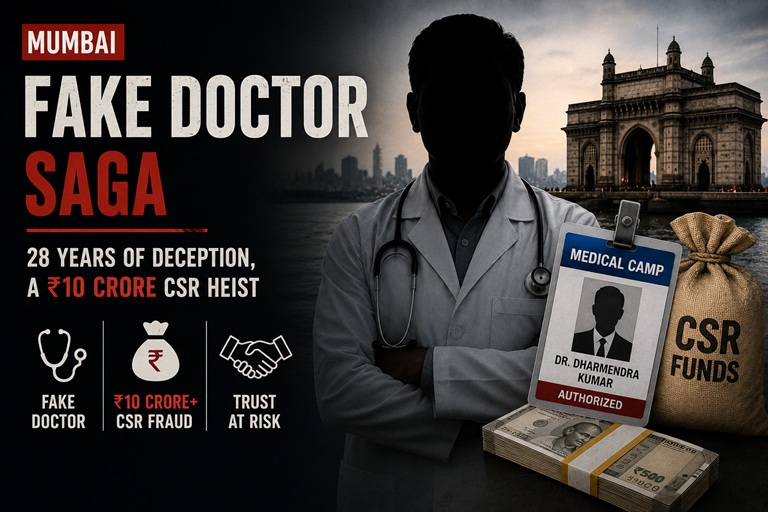


Mumbai Fake Doctor Saga: 28 Years of Deception, a ₹10 Crore CSR Heist, and the Fragile Trust in India’s Healthcare and Philanthropy
MUMBAI (India CSR): In a city that never sleeps, where glamour rubs shoulders with grit, a 50-year-old man from Bihar allegedly lived a double life for nearly three decades. He wasn’t just any impostor—he posed as Dr. Dharmendra Kumar, complete with forged identity cards, visiting cards, PAN documents, medical certificates, and even medical supplies. Mumbai Police Crime Branch arrested him recently, uncovering what investigators describe as a sophisticated multi-state fraud involving the misuse of Corporate Social Responsibility (CSR) funds to the tune of over Rs. 10 crore in just the last three years.
The Arrest: A Routine Probe Turns Explosive
The breakthrough came during the investigation of another high-profile case involving a fake Deputy Commissioner of Police (DCP). Crime Branch officials summoned the accused for questioning after he had organized medical camps linked to that probe. When he presented his visiting card as “Dr. Dharmendra Kumar,” red flags went up. Interrogation revealed he hadn’t even cleared Class 12, let alone earned a medical degree.
A raid on his premises yielded a treasure trove: fake IDs, certificates from various institutions, project reports tied to companies and individuals across Maharashtra and other states, and medical equipment. Police registered a case at Juhu Police Station (later handled by Crime Branch Unit-1) under relevant sections of the Bharatiya Nyaya Sanhita (BNS), the Maharashtra Medical Practitioners Act, and the National Medical Commission Act. The accused was remanded to police custody till July 16, 2026.
How the Scam Allegedly Unfolded
For 28 years, the man allegedly cultivated an aura of medical authority. He organized medical camps, including ones for Bollywood workers that reportedly attracted top stars. Photos with celebrities became props to build credibility and “environment” (mahaul) among potential marks.
This facade allegedly enabled a deeper fraud. Using forged documents and multiple bank accounts—often with associates—he diverted CSR funds meant for social welfare projects. Preliminary probes point to inter-state operations, with documents linking projects in multiple states. CSR, mandated under the Companies Act, 2013, requires corporations to spend 2% of their profits on initiatives like healthcare, education, and community development. In theory, it’s a force for good. In practice, as this case suggests, it can become a soft target for exploitation when oversight is lax.
The scale—Rs. 10 crore in three years—raises uncomfortable questions about due diligence by corporations and NGOs. How many “projects” were audited superficially? How often do glossy reports and celebrity endorsements mask ground realities?
India’s Endemic Quackery Problem
This isn’t an isolated incident. Maharashtra, and Mumbai in particular, has seen repeated cases of fake doctors infiltrating clinics, hospitals, and even government setups. From quacks performing risky procedures to impostors in civic hospitals during the pandemic, the pattern reveals systemic vulnerabilities: weak verification of credentials, reliance on self-declared qualifications, and the sheer demand for affordable healthcare in a populous nation.
Patients in underserved areas often can’t afford—or access—verified doctors. This creates a market for charlatans who offer quick fixes, empathy, and lower costs. The accused’s long run (nearly 28 years) suggests he exploited this gap effectively, potentially treating patients while endangering lives with unqualified care. Investigations are now probing whether he actually practiced medicine.
Trust, Regulation, and Societal Complicity
This case forces us to confront deeper failures:
- The Celebrity Halo Effect: Bollywood associations provided instant legitimacy. In an image-driven society, a photo with a star can override scrutiny. Does our obsession with glamour make us blind to substance?
- CSR as a Double-Edged Sword: While CSR has funded genuine initiatives, weak monitoring enables leakage. Companies tick compliance boxes, but do they verify impact? This scam highlights the need for blockchain-tracked funds, third-party audits, and stricter penalties for diversion.
- Identity and Impersonation in the Digital Age: Forged documents persist despite Aadhaar and digital registries. The National Medical Commission and state councils must strengthen real-time verification. Yet, enforcement lags—low conviction rates for quacks persist due to delays and institutional apathy.
- Human Cost: Beyond financial loss, fake doctors risk lives. Misdiagnosis, wrong treatments, or false hope in medical camps erode public trust in the entire healthcare system. Vulnerable populations—slum dwellers, migrant workers, Bollywood’s support staff—bear the brunt.
- The Psychology of Long Cons: How does someone sustain a lie for 28 years? Charisma, compartmentalization, and societal willingness to trust titles without verification play roles. It mirrors larger scams where authority figures exploit hope.
What Lies Ahead?
Further investigation will trace the money trail, identify accomplices, and assess patient harm. Corporations whose CSR funds were allegedly misused must cooperate transparently. This could expose a wider network.
As a society, we must ask: Why does India, with its robust regulatory frameworks on paper, repeatedly fail at ground-level enforcement? Strengthening medical councils, public awareness campaigns on verifying doctors (via NMC portals), and tech-enabled fund tracking in CSR are immediate steps. But real change demands cultural shifts—prioritizing substance over optics, vigilance over blind trust.
In the end, this “doctor” who wasn’t one didn’t just steal money. He allegedly stole credibility from a profession built on saving lives and exposed cracks in our systems of accountability and compassion. The case isn’t just about one man’s arrest—it’s a mirror to how easily trust erodes when vigilance sleeps. What will it take for us to stop looking the other way?



