




Molded pulp or EPS foam? The real question is which one keeps your product showroom-perfect.
A 2026 TNO life-cycle study, commissioned by the EPS trade group EUMEPS, attributes up to 72 percent of a TV’s modeled packaging-related impact to damage in transit, and an India Plastics Pact survey reports that 84 percent of shoppers place high importance on packaging in purchase decisions.
In the pages ahead we’ll walk you through the evidence (surface scuff, humidity creep, drop shocks, tooling math, and those looming EPR fees) so you can validate the swap before you promise it to the market.
Begin with an equal-performance brief, not a preferred material
Start by freezing today’s facts, not tomorrow’s hopes. Put the EPS system on a single sheet: cushion density, wall thickness, product touch points, carton outside dimensions, pallet pattern, and current damage rate. Map the real route, from the first conveyor jolt to the last-mile bike run, and note the exact test you already trust (for many consumer-electronics teams that’s ISTA 3A with ASTM D4332 conditioning).
Invite molded pulp only after that baseline is crystal clear. Both proposals face the same drops, humidity cycles, compression loads, and cosmetic limits, inside the same carton, over the same miles. When protective performance matches, shift the spotlight to tooling, cost, and compliance instead of wishful “greener” claims.
Because that balancing act spans design, testing, logistics, and finance, you may want a design-led sustainable packaging partner to keep every stakeholder working from one playbook.
Surface contact is the first approval gate
Every insert touches the product, so we begin where scratches begin.
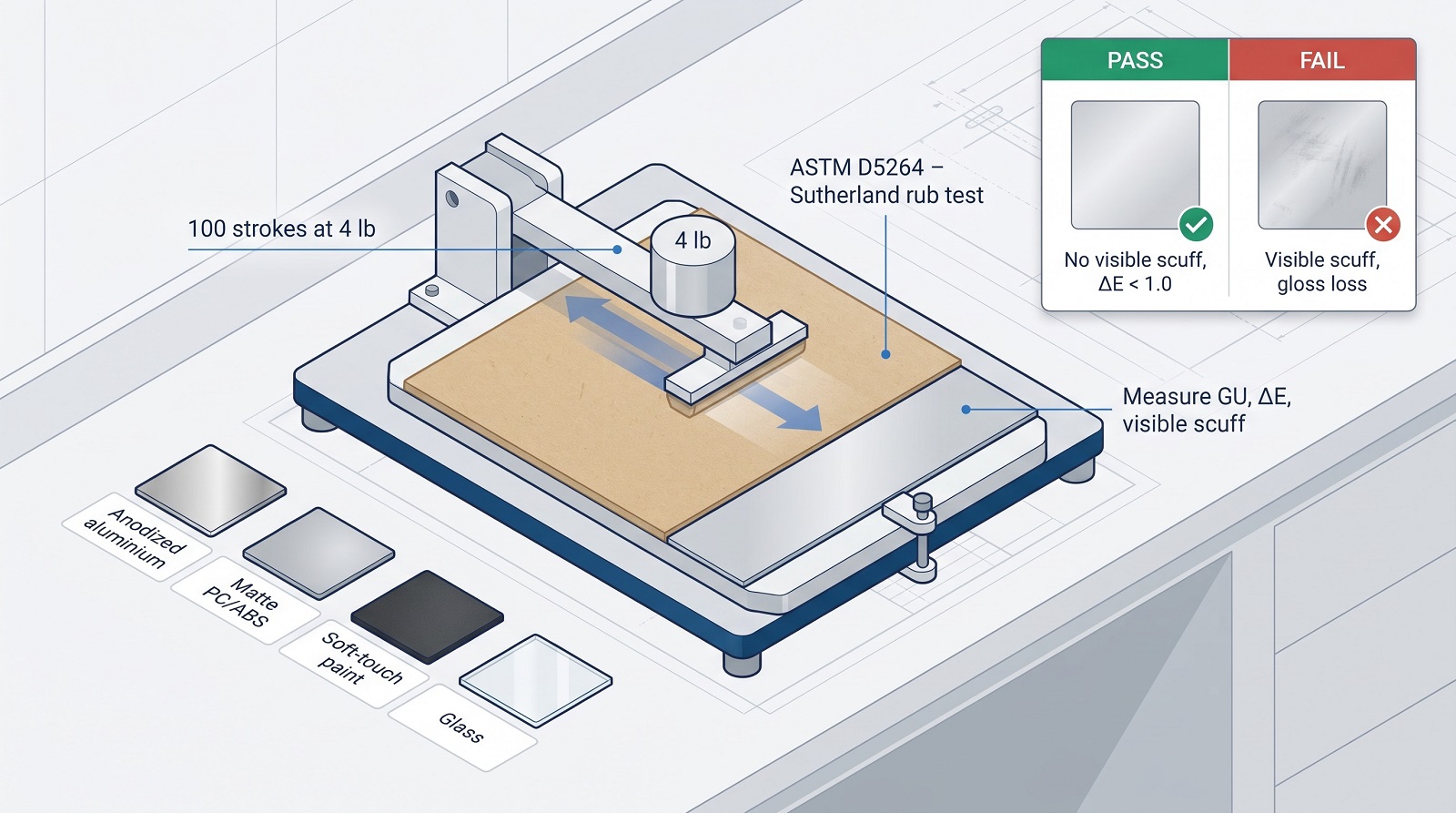
- Gather production-finish coupons (anodized aluminium, matte PC/ABS, soft-touch paint, glass).
- Clamp each coupon in the jig with the pulp sample on top, set to the same contact pressure measured in pack-out trials.
- Run a Sutherland rub test (ASTM D5264 is the usual starting point) for up to 100 strokes at 4 lb. Google’s Plastic-Free Packaging Design Guide describes Sutherland rub tests at that setting against common product enclosure materials.
Record gloss loss (GU), colour shift (ΔE), and any visible scuff. Clay fillers in molded pulp can abrade a black powder-coat before the first drop; a mark that fails here will only worsen after hot-humid conditioning and vibration.
The part passes only when every coupon leaves the bench looking showroom-new. One scuffed logo can scrap the environmental win, and any cost saving.
Finish grade determines the tooling bill
Surface quality comes from tooling, not luck. In the International Molded Fiber Association’s guide, a transfer-molded Type 2 part uses one forming mold and one transfer mold, and its surfaces are relatively smooth on one side only. A thermoformed Type 3 part uses multiple heated molds, which gives smooth surfaces and well-detailed forms. Every extra mold adds to the tooling bill.
As one supplier put it on r/Packaging: “Rough like an egg carton takes two sets of molds. Smoother like you see in less expensive headphones for example take at least four sets of molds. Ultra smooth like Apple iPhone inserts you can be looking at 6 sets of molds.” Another added: “I can’t tell you how many times i’ve had a customer approach me about doing molded pulp and went back to using foam after they realized just how much they’d spend in tooling.” Treat those counts as supplier experience and confirm them with your own supplier.
Before you celebrate a low part price, request the full list: prototype, forming, transfer, hot-press, trim, and backup tools, plus the revision policy in writing. Smoothness without sticker shock happens only when every tool, cycle, and cavity appears on the quote.
Humidity can change the pack before the first drop
Pulp is hygroscopic; it pulls in water long before a carton leaves the dock. In a monsoon-season warehouse at 38 °C and 85 percent RH, the hot-humid profile defined in ASTM D4332 conditioning, an insert can absorb moisture, gain weight, and warp just enough to pinch a button or bow a screen. By the time the drop test starts, the cushion is softer, clearances are tighter, and risk is higher.
That’s why we run the full pack, both the pulp candidate and an EPS control, through 72 hours of D4332 hot-humid conditioning, then move straight into the chosen ISTA sequence. We track mass gain, cavity drift, retention force, and denesting ease. If ink or dye touches the product, we send the design back to tooling. Zenpack’s consumer-electronics work shows why: on Lora DiCarlo’s packaging, the molded paper-pulp inserts shredded and bled ink onto the silicone devices, so Zenpack replaced them with a deeper, form-fitting soft-touch insert.
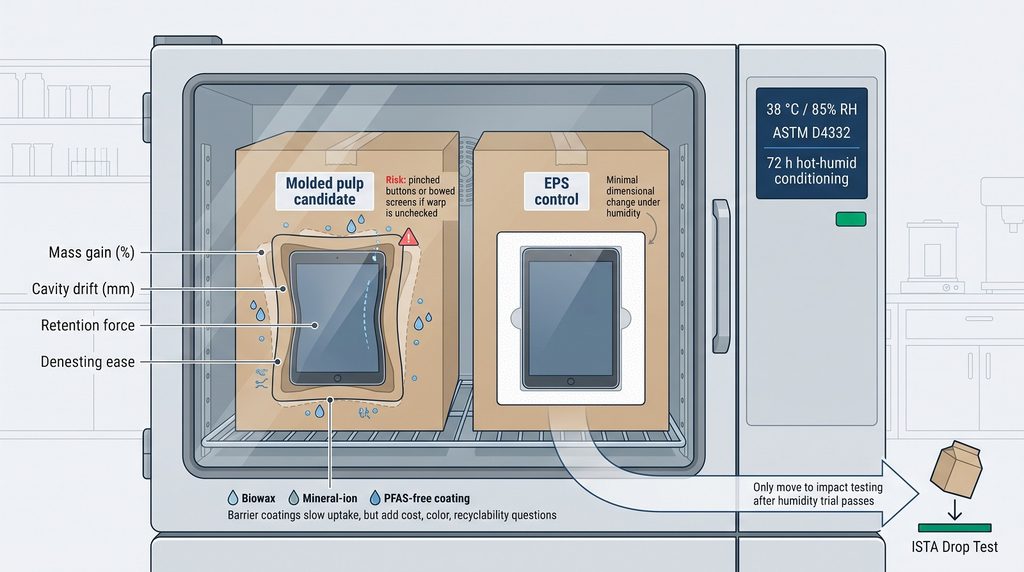
Barrier coatings such as biowax, mineral-ion, and PFAS-free films can slow water uptake, but each adds cost, colour, and a recyclability question. We test the recipe, not the brochure.
The tray moves to impact testing only when it holds shape, sheds no fibres, and releases the device cleanly after the humidity trial.
Drop performance must include crush travel and carton growth
A lab pass is worthless if the cushion collapses, the carton swells, and freight costs jump.
- Set the target. Use ASTM D3332 to map the product’s fragility curve: how many g’s crack the board, loosen the lens, or break a battery tab. Instrument the weakest assemblies, not just the shell.
- Compare materials. EPS acts like a spring; it rebounds and is ready for the next hit. Molded pulp behaves like a crumple zone; ribs buckle and stay down. Foundational 1994 research by Eagleton and Marcondes compared moulded pulp with EPS and found limits under multiple impacts.
- Measure crush travel. How many millimetres must the pulp move to keep peak shock below the g-limit? Five millimetres of extra stand-off can stretch the outer box enough to drop pallet count or push a parcel into a higher dimensional-weight band.
- Check repeatability. After repeated impacts, does the tray still nest and the lid close without force? A pulp insert that shortens after the first route could force a bigger replacement box mid-program.
Pass only when peak acceleration stays under the fragility limit, the product shows no functional or cosmetic damage, and any carton growth leaves the business case intact. Protect the product first, then protect the pallet pattern.
Production readiness needs its own trial
Lab wins don’t ship boxes. You still need to prove the insert on a live line.
Start with denesting. An automated denester can separate up to 120 trays per minute, according to equipment supplier Freshtech, but only when the trays release cleanly. If operators pull trays apart manually, or the machine double-picks, the entire line slows. One five-second fumble can blow the cycle-time target.
Next, run a full-speed pack-out. Measure picks per minute, orientation errors, torn edges, and dust on belts. Molded pulp sheds fibres, and EPS scatters beads; either by-product can jam a vision sensor or clog a vacuum cup. Record the reject rate against a cap you set in the brief, for example ≤ 1 percent per shift.
Audit the supplier: wall-thickness Cp/Cpk, moisture at pack-out, cavity-to-cavity variation, spare meshes, backup moulds, and written monthly capacity. A beautiful sample means little if the plant cannot repeat it during peak season.
Move to the cost gate only when the line sustains rate, rejects stay inside the limit, and the supplier proves redundancy in writing. That is true production readiness, whether the cushion is molded pulp or EPS.
Build the total cost of ownership first, then layer on EPR
Unit price shouts the loudest, but it is rarely the biggest line on the spreadsheet.
- Model the whole spend. Start with part cost, then amortise the full tooling bill over the realistic SKU life. Add extra carton board if the tray grows, plus inbound freight on larger blanks. Fold in pack-out labour, automation tweaks, and any cycle-time hit. Finish with warranty returns; even a one-percent bump in damage can erase a material saving in weeks.
- Add compliance market by market.
- India. According to India’s Central Pollution Control Board, an EPS insert is normally reported as rigid plastic packaging (Category I) and faces recycled-content targets plus plastic-EPR certificate costs, or, if you miss them, an environmental-compensation back-stop of ₹2,900 per tonne for Category I packaging. A molded-pulp tray sits outside plastic EPR today, but the Ministry’s December 6 2024 draft paper-packaging EPR stays on the risk register.
- United Kingdom. UK government base fees for 2025 to 2026 charge £423 per tonne for plastic and £196 for paper and card. For 2026 to 2027, illustrative fees add red, amber, and green modulation: red is 20 percent above amber, and the green discount is illustrative at about 9 percent.
- European Union. The PPWR, which began applying in August 2026, ties fees to recyclability class, not material label, so a non-recyclable coated pulp tray can cost more than a widely recycled EPS insert.
Run the maths SKU by SKU. Only then will you know whether pulp, foam, or a hybrid cushions the balance sheet as well as the product.
Compare environmental performance per successful delivery
Carbon math comes last for a reason: if the product arrives broken, every kilogram of “saved” plastic is noise.
We set the functional unit as one device delivered intact, then track everything that touches that outcome: pulp mass, EPS mass, fibre source, recycled content, drying energy, carton size, freight bump, and the real damage-and-return rate. TNO’s 2026 life-cycle analysis of packaging for TVs and washing machines found that a ±50 percent change in the assumed damage rate led to an average ±34 percent shift in climate impact, showing that protection assumptions can outweigh material differences.
Energy mix matters, too. A thermoformed pulp tray dried on coal-based power can out-emit an EPS cushion molded on renewables; swap the grids and the ranking reverses. The same applies to coatings: PFAS-free biowax looks virtuous until it cuts recycling yield downstream.
So we model multiple scenarios, plug in plant-specific electricity data, and keep the spreadsheet live. The winner is the insert (pulp, EPS, or hybrid) that keeps the product safe and cuts impact in the real lane, not the brochure lane.
Use evidence gates for the pilot decision
After the lab and line trials, we ask six yes-or-no questions. Green means proceed, amber limits the scope, and red pauses the launch.
- Product contact. No visible scuff, ΔE < 1.0, and zero loose fibres after the ASTM D5264 rub and hot-humid conditioning.
- Conditioned transport. The device stays within cosmetic and functional limits after the full ISTA 3A sequence at 38 °C / 85 percent RH (ASTM D4332 conditioning).
- Cube. Outer-carton growth remains inside the guardrail set in the brief, so pallet count holds.
- Operations. Line speed meets the baseline, and functional rejects stay ≤ 1 percent per shift, including automated denesting without double-picks.
- Supply. Tooling, capacity, spare meshes, backup moulds, and disaster-recovery plans all appear in the contract.
- Business & ESG. Live TCO plus functional-unit LCA still beat the EPS baseline when the latest damage and energy numbers are plugged in.
All green? Launch molded pulp. Any amber? Start with a hybrid or limited-SKU release. A single red sends us back to the design table; no public claims until every gate is closed.