




Modern vape heating systems face a difficult engineering balance.
Users may want stronger vapor output, but increasing heat can also place more thermal stress on the oil. Lower temperatures may help preserve flavor characteristics, but insufficient heating can reduce vapor production. Longer draws create another challenge because the heating area needs to remain continuously supplied with oil.
Cilicon developed DeliFlow 2.0 around these competing requirements.

Rather than treating vapor output, flavor, and consistency as separate problems, the technology combines changes to the heating element and ceramic structure into one atomization architecture.
At the center of the system are four main ideas:
- dual-mesh heating;
- an expanded low-temperature heating area;
- larger ceramic pores;
- and a reinforced ceramic body.
Understanding how those features interact provides a clearer picture of what DeliFlow 2.0 is designed to do.
What Is DeliFlow 2.0?
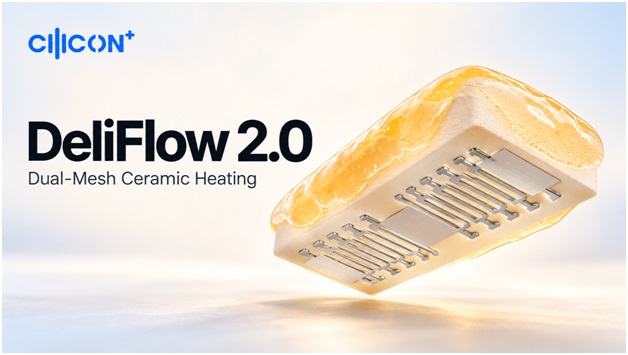
Cilicon DeliFlow 2.0 is a ceramic atomization technology that combines two mesh heating elements within a ceramic core architecture.
Cilicon positions the technology around three performance goals:
Clouds. Flavor. Consistency.
The idea behind the platform is not simply to make the heater hotter.
Instead, DeliFlow 2.0 changes both the heating surface and the ceramic structure so that heat generation and oil delivery can work together more effectively.
According to Cilicon, the current platform is designed primarily for:
- Live Resin
- Cured Resin
These thicker premium oils place particular demands on both oil transport and heating stability.
The Core Engineering Problem: More Output Usually Means More Heat
Producing more vapor generally requires more energy to be transferred into the oil.
The simplest way to increase output might appear to be raising temperature.
But concentrated heat can create several trade-offs.
Higher local temperatures may expose the oil to greater thermal stress.
Repeated heating can also affect oil remaining close to the active heating zone.
During longer draws, the ceramic must continue delivering oil quickly enough to replace what is being vaporized.
This creates a three-way engineering problem:
Output requires energy.
Flavor benefits from controlled thermal exposure.
Consistency requires stable oil delivery and heating over time.
DeliFlow 2.0 approaches all three through changes to the complete ceramic heating system.
Dual Mesh Expands the Active Heating Area
The most visible difference in DeliFlow 2.0 is its dual-mesh architecture.
Mesh heaters use a thin conductive structure with a relatively broad active surface.
When electrical current passes through the mesh, resistance converts that electrical energy into heat.
DeliFlow 2.0 uses two mesh heating elements rather than relying on a single mesh structure.
The important benefit is not simply that there are “two heaters.”
The additional mesh increases the available active heating area.
A larger active surface gives engineers more flexibility in how energy is distributed through the ceramic.
Instead of concentrating more power into a very small heating zone, the system can apply energy across a broader area.
That distinction helps explain why dual mesh can support stronger output without treating higher peak temperature as the only solution.
Dual Mesh Does Not Automatically Mean Twice the Temperature
The phrase “dual mesh” can easily be misunderstood.
Two mesh elements do not necessarily mean that the oil is exposed to twice the temperature.
Heating power, resistance, mesh geometry, ceramic contact, and control logic all influence thermal behavior.
The purpose of DeliFlow 2.0 is better understood in terms of heating area rather than simply maximum heat.
By expanding the active surface, the technology is designed to vaporize more oil across a larger region.
This allows vapor output and thermal distribution to be addressed at the same time.
Why the Low-Temperature Heating Area Matters
Cilicon also describes DeliFlow 2.0 as having an expanded low-temperature heating area.
This does not mean the core operates at a universally “low” temperature.
Vaporization still requires sufficient thermal energy.
Instead, the concept refers to achieving useful vapor production while reducing reliance on highly concentrated heating.
A broader active area can distribute energy differently from a small, intensely heated region.
That matters because flavor compounds in premium oils can be sensitive to repeated thermal exposure.
Cilicon positions the expanded lower-temperature zone as a way to maintain fuller vapor production while reducing unnecessary high-heat exposure to the oil.
Flavor Is a Thermal-Management Problem
Flavor performance is often discussed as if it comes only from the oil.
Hardware also matters.
The temperature reached by the active heating area, how evenly that temperature is distributed, and how much oil is repeatedly exposed to heat can all influence the resulting aerosol.
A heating system therefore needs to do more than simply reach vaporization temperature.
It also needs to manage where and how that heat is applied.
DeliFlow 2.0 addresses this through the combination of:
- a larger active heating area;
- dual mesh;
- ceramic oil delivery;
- and lower-temperature heating zones.
This is why the platform should be viewed as a thermal architecture rather than simply a more powerful coil.
More Heating Area Creates More Demand for Oil
Increasing active heating area creates another engineering challenge.
If more oil can be vaporized at one time, the ceramic needs to replenish the heating region quickly enough.
Otherwise, the heating system can outrun the oil-delivery system.
That imbalance can become more noticeable during:
- longer draws;
- repeated draws;
- higher-output operation;
- or use with thicker oils.
This is where the ceramic structure becomes just as important as the mesh itself.
Ceramic Pore Size Is Part of the Heating System
Porous ceramic contains microscopic pathways through which oil can move toward the active heating area.
The characteristics of those pores influence how easily oil travels through the ceramic.
Cilicon states that DeliFlow 2.0 uses a ceramic pore size approximately 30% larger than its comparison baseline.
The purpose is to help thicker oils move through the ceramic more effectively.
This change is particularly relevant because DeliFlow 2.0 also increases heating capacity.
More active heating area needs adequate oil supply.
The dual-mesh heater and ceramic pore structure therefore solve different sides of the same problem.
The heater determines how energy reaches the oil.
The ceramic determines how oil reaches the heater.
Why Larger Pores Are Not the Whole Story
It would be incorrect to conclude that larger ceramic pores are always better.
Oil delivery depends on multiple factors, including:
- viscosity;
- temperature;
- pore distribution;
- ceramic geometry;
- intake design;
- reservoir pressure;
- and heating rate.
Changing pore size can also affect the physical structure of the ceramic.
A ceramic body needs enough porosity to transport oil while remaining strong enough to survive manufacturing, assembly, shipping, and repeated thermal cycling.
This introduces another trade-off.
Improving oil movement should not make the core mechanically fragile.
Reinforcing the Ceramic Structure
According to Cilicon, DeliFlow 2.0 uses a reinforced ceramic body that reaches three times the strength of standard cores used as its comparison baseline.
That reinforcement is important because the ceramic is doing several jobs at once.
It needs to:
- transport oil;
- support the heating structure;
- tolerate temperature changes;
- maintain its geometry;
- and remain stable during repeated use.
The combination of larger pores and greater strength is therefore more meaningful than either specification alone.
One change supports fluid transport.
The other addresses the structural demands created by that change.
Why Long Draws Are a Useful Stress Test
A heating system may perform well during a short first draw and behave differently under sustained use.
The first activation often begins with:
- a cool device;
- a saturated ceramic;
- and a charged battery.
A longer draw creates more demanding conditions.
The heating area remains active for longer.
Oil must continuously move through the ceramic.
The core accumulates more thermal energy.
The ceramic and mesh need to remain stable while these processes occur simultaneously.
Cilicon specifically connects DeliFlow 2.0’s reinforced ceramic structure with maintaining stability during long, heavy pulls.
This makes ceramic strength a functional part of the atomization system rather than simply a durability specification.
How the Four Main Features Work Together
The easiest way to understand DeliFlow 2.0 Ceramic Heating Tech is to look at its four major elements as one system.
1. Dual Mesh
Expands the active heating area and supports stronger vapor production.
2. Expanded Low-Temperature Heating Area
Distributes useful heating across a broader region instead of relying only on concentrated high heat.
3. 30% Larger Ceramic Pores
Supports oil movement through the ceramic, particularly for thicker premium oils.
4. 3× Ceramic Strength
Reinforces the porous ceramic structure so it can remain stable during more demanding heating conditions.
These are not four unrelated product features.
They form a chain.
More active heating area increases oil demand.
Greater oil demand requires stronger oil delivery.
Changing the ceramic pore structure introduces mechanical requirements.
The reinforced ceramic addresses those requirements.
That relationship is the central engineering logic behind DeliFlow 2.0.
Clouds, Flavor, and Consistency
Cilicon summarizes DeliFlow 2.0 around three outcomes: clouds, flavor, and consistency.
Each corresponds to a different part of the architecture.
Clouds
Dual mesh increases the available heating area, supporting greater vapor production.
Flavor
The expanded low-temperature heating zone is intended to reduce excessive thermal exposure while maintaining useful output.
Consistency
Larger ceramic pores support oil replenishment, while the reinforced ceramic structure is designed to remain stable during repeated and extended heating.
The three goals are connected.
Strong output is difficult to sustain if the heater cannot receive enough oil.
Flavor control becomes harder if output depends entirely on extreme local temperature.
Consistency becomes harder if the ceramic cannot tolerate the thermal and structural demands of the system.
DeliFlow 2.0 is designed around balancing all three.
Why Live Resin and Cured Resin Are the Main Applications
Cilicon currently lists Live Resin and Cured Resin as the primary applications for DeliFlow 2.0.
These oils can place higher demands on an atomization system because oil movement and flavor preservation are both important.
A thicker oil needs to reach the heating area consistently.
At the same time, the heating system needs to provide enough energy for strong aerosol production without relying only on excessive localized temperature.
This makes the combination of dual mesh, ceramic oil delivery, and thermal control particularly relevant to these applications.
It is also why oil compatibility should be understood as a relationship between formulation and hardware rather than as a universal property of ceramic.
How DeliFlow 2.0 Differs From the Original DeliFlow
DeliFlow 2.0 builds on Cilicon’s earlier DeliFlow ceramic platform, but the two should not be treated as identical.
The original DeliFlow platform is positioned around premium oils and uses a ceramic architecture focused on oil absorption, even heating, and lower-temperature performance.
DeliFlow 2.0 introduces a different heating configuration built around dual mesh.
It also emphasizes:
- a larger active heating region;
- increased ceramic pore size;
- reinforced ceramic strength;
- and stronger vapor output.
The transition from DeliFlow to DeliFlow 2.0 therefore involves both the heating element and the ceramic body.
It is not simply a change in power settings.
Dual Mesh vs. Dual Core
DeliFlow 2.0 should also be distinguished from dual-core systems.
A dual-core device typically uses two separate heating-core assemblies.
DeliFlow 2.0 instead uses two mesh heating elements within a single ceramic-core architecture.
That distinction affects complexity.
A single ceramic core with dual mesh does not require two completely separate atomization assemblies.
Cilicon uses this architecture in GEMINO, where the company describes the device as using one ceramic core with two mesh heaters.
This provides an example of how DeliFlow 2.0 moves from a standalone technology platform into an actual AIO device.
DeliFlow 2.0 in GEMINO
GEMINO is currently one of the clearest product implementations of DeliFlow 2.0.
The device combines:
- one ceramic core;
- dual-mesh heating;
- postless architecture;
- 1 mL and 2 mL capacity options;
- adjustable power;
- and a digital display.
The key point is that DeliFlow 2.0 remains the atomization technology inside the device.
GEMINO is the product platform.
This distinction matters because one technology can potentially support different future hardware designs without those products needing to share the same exterior form.
What DeliFlow 2.0 Does Not Mean
Technical terminology can easily become oversimplified.
DeliFlow 2.0 does not mean:
“Dual mesh is always better than single mesh.”
Performance depends on the complete heating, oil-delivery, airflow, and power system.
“Larger ceramic pores are always better.”
Pore design needs to match oil characteristics and the rest of the ceramic structure.
“Lower-temperature heating means weak vapor.”
DeliFlow 2.0 specifically uses increased heating area to address output while controlling thermal concentration.
“Three-times stronger ceramic means three-times better performance.”
Ceramic strength refers to the material property described by Cilicon, not a universal multiplier for vapor quality or device lifespan.
“Every oil should use DeliFlow 2.0.”
Cilicon currently positions the platform specifically around Live Resin and Cured Resin.
These distinctions keep the technology claims connected to what the architecture actually changes.
Why DeliFlow 2.0 Is a System, Not a Single Feature
The most important idea behind DeliFlow 2.0 is that modern atomization performance does not come from one component.
Dual mesh alone does not determine oil supply.
Ceramic pores alone do not determine thermal distribution.
Ceramic strength alone does not determine vapor output.
Low-temperature heating alone does not determine flavor.
The performance comes from how these variables interact.
That is why DeliFlow 2.0 is better understood as a ceramic heating system rather than simply a dual-mesh coil.
It combines:
energy delivery + oil transport + thermal management + ceramic structure.
That system-level approach is what separates a named heating platform from a single hardware feature.
Frequently Asked Questions
What is DeliFlow 2.0?
DeliFlow 2.0 is Cilicon’s dual-mesh ceramic heating technology designed around vapor output, lower-temperature thermal management, oil delivery, and heating consistency.
What oils is DeliFlow 2.0 designed for?
Cilicon currently lists Live Resin and Cured Resin as the primary compatible applications.
Does DeliFlow 2.0 use two ceramic cores?
No. The current architecture uses dual mesh within a ceramic-core system rather than two completely separate ceramic cores.
Why does DeliFlow 2.0 use dual mesh?
The two mesh elements expand the active heating area, giving the system more surface over which to apply thermal energy.
What does “low-temperature heating” mean?
It refers to increasing useful heating area while reducing reliance on highly concentrated heat. It does not mean that the core stays cool.
Why did Cilicon increase ceramic pore size?
Cilicon states that DeliFlow 2.0 uses pores approximately 30% larger to help thicker oils move through the ceramic more effectively.
How strong is the DeliFlow 2.0 ceramic?
Cilicon states that its reinforced ceramic body reaches three times the strength of the standard cores used as its comparison baseline.
Is DeliFlow 2.0 the same as DeliFlow?
No. DeliFlow 2.0 builds on the earlier platform but introduces dual-mesh heating and additional changes to the heating area and ceramic structure.
Which Cilicon product currently uses DeliFlow 2.0?
GEMINO is a current AIO product using DeliFlow 2.0 dual-mesh ceramic heating.