

A complete manual for students, graduates, and professionals aiming to create a lasting difference by conducting responsible business.
By Rusen Kumar and Suhana Agrawal
In an era of climate urgency, social inequality and a fast-paced regulatory environment, Corporate Social Responsibility (CSR) is no longer a fringed element of the public relations component of business strategy, but rather a fundamental aspect of contemporary business strategy. CSR provides one of the most promising and impactful career opportunities today to those professionals who seek business, social impact, and sustainability careers together.
This has been a major change in India. India is the pioneer nation to make CSR a legal requirement in the world under Section 135 of the Companies Act, 2013, having established one of the most organised social investment ecosystems globally. Companies above a certain threshold are required to spend at least 2% of their average net profits on CSR activities each year. A report by CareEdge Analytics and Advisory states that total CSR expenditure in India was 34,909 crore in FY24 with a CAGR of 8.74% in FY20 and FY24.
This article discusses the career in CSR, the positions offered, the skill sets they need and how future practitioners can acquire the appropriate background with the assistance of specific academic programmes that are already being offered in India.
What is Corporate Social Responsibility?
Corporate Social Responsibility can be defined as the belief in businesses to conduct operations ethically and give back to society and the environment in a positive way in addition to legal requirements. It spans a wide spectrum of operations that finance education programmes, rural livelihoods, access to healthcare, environmental sustainability, gender equity and so on.
Contemporary CSR has become part of Environmental, Social, and Governance (ESG) models, is consistent with the United Nations Sustainable Development Goals (SDGs), and has a direct impact on a company’s brand image, shareholder relationships, compliance with regulations, and talent management. Nowadays, CSR is no longer a choice among big organisations in India; it is a legal requirement and a strategic necessity.
Roles within the CSR Ecosystem
The CSR sphere is so varied and includes corporate foundations, NGOs, consulting firms, research institutions, and government agencies. The most notable ones are:
- CSR Executive / Manager: He or she leads the CSR strategy of a company, he/she manages budgets, he/she finds an NGO partner, he/she controls the compliance with Schedule VII of the Companies Act, and he/she measures the impact of the programme.
- ESG Analyst / Sustainability Officer: analyzes the environmental and social performance of a company, prepares BRSR and GRI-compliant sustainability reports, and provides advice on ESG reporting to investors and regulators.
- Impact Assessment Consultant: Designs and undertakes Social Return on Investment (SROI) research and social audits to quantify the actual effect of CSR programmes.
- CSR Compliance Officer: Oversees the CSR compliance of a company, under the legal provisions of Section 135 and the CSR Rules, such as the appropriateness of reporting to the CSR Committee and board.
- NGO Programme Manager: Works on the ground to implement CSR-funded initiatives in areas such as education, healthcare, water, and rural livelihoods.
- Sustainability Reporting Associate: Prepares the company sustainability disclosure, handles data that is to be filed under SEBI regulations under BRSR and communicates the performance of the company in terms of ESG to the stakeholders.
- Social Audit Professional: Independent evaluation of the effectiveness and responsibility of CSR and development programmes.
The most important skills in a CSR career
CSR as a career requires a distinctive set of skills that not only links the corporate sector to the social sphere but also helps to bridge the gap between the two. The best CSR professionals are likely to integrate:
| Skill Area | Description |
|---|---|
| Awareness of CSR Law and ESG Frameworks | It is based on detailed knowledge of Section 135 of the Companies Act, Schedule VII, BRSR (Business Responsibility and Sustainability Report) requirements under SEBI, and international standards such as the GRI Standards and SDGs. |
| Project Management and Programme Design | The skills needed to manage various stakeholders, timelines, and budgets of complex social programmes include strong planning and execution capabilities, such as needs assessment, monitoring and evaluation, and reporting. |
| Measurement and Data Analysis of Impact | Gone are the days of anecdotal reporting. Employers are looking for professionals who can develop outcome indicators, gather field data, conduct SROI analyses, and create evidence-based reports for boards, regulators, and investors. |
| Sustainability Reporting | With the BRSR framework of SEBI becoming mandatory for a growing number of listed companies, the ability to prepare sustainability disclosures, including carbon accounting basics, stakeholder engagement reporting, and integrated reporting, is becoming increasingly important. |
| Communication and Stakeholder Engagement | CSR professionals work with a wide range of stakeholders, from village communities and grassroots NGOs to corporate boards and government officials. Important competencies include cultural sensitivity, effective communication, and trust-building. |
Formal Education in CSR: A Growing Necessity
Until recently, a majority of CSR professionals found their way into the industry by other related professions such as social work, business administration, law or environmental science and learned on the job. That is changing. The growing CSR requirement in India, the emergence of the need to report on environmental, social and governance issues and the governmental pledge to be Net Zero by 2070 has resulted in a well-defined and pressing need to be able to educate in the field in a structured, formalized way.
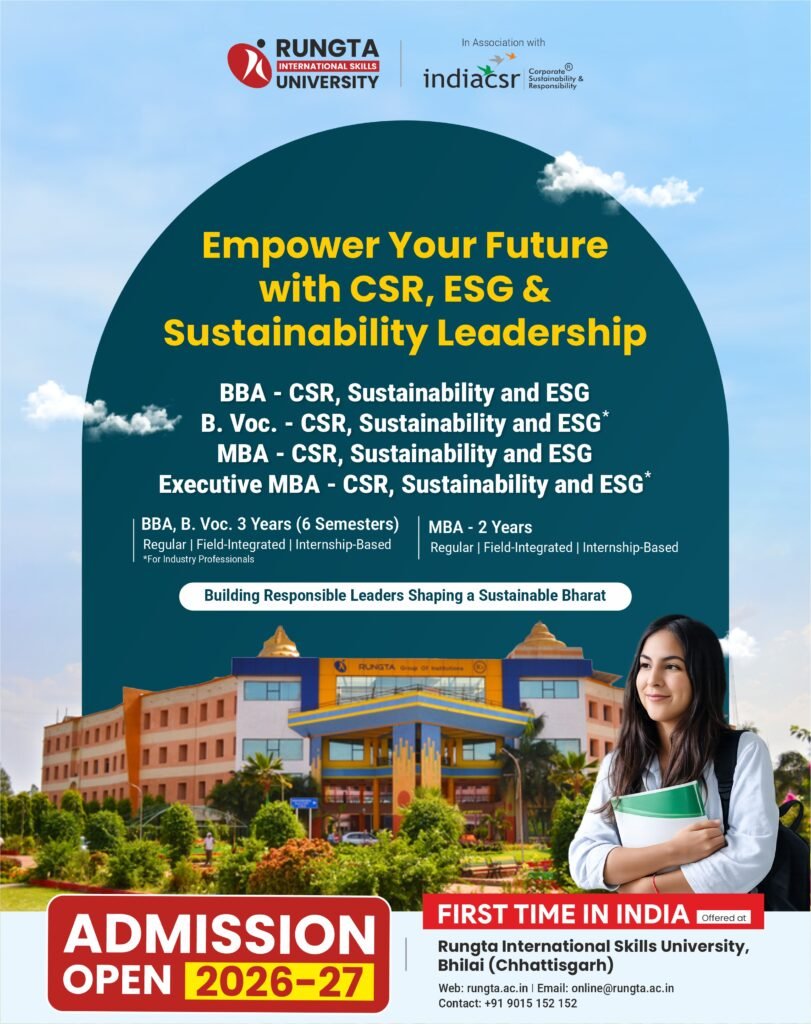
With this in mind, Rungta International Skills University (RISU), Bhilai in Chhattisgarh, in academic partnership with IndiaCSR, one of the most successful knowledge platforms of CSR and sustainability in the country, has introduced the first set of dedicated academic programmes in CSR, Sustainability and ESG. This is provided as courses under the School of Sustainable Development, ESG and CSR, and they are structured based on four interdisciplinary pillars: CSR Law, ESG Frameworks, Sustainability Science, and Development Practice.
The launch marks an important step towards building skilled human resources for the emerging sustainability, responsible business and social impact sector in India.
Programmes are:
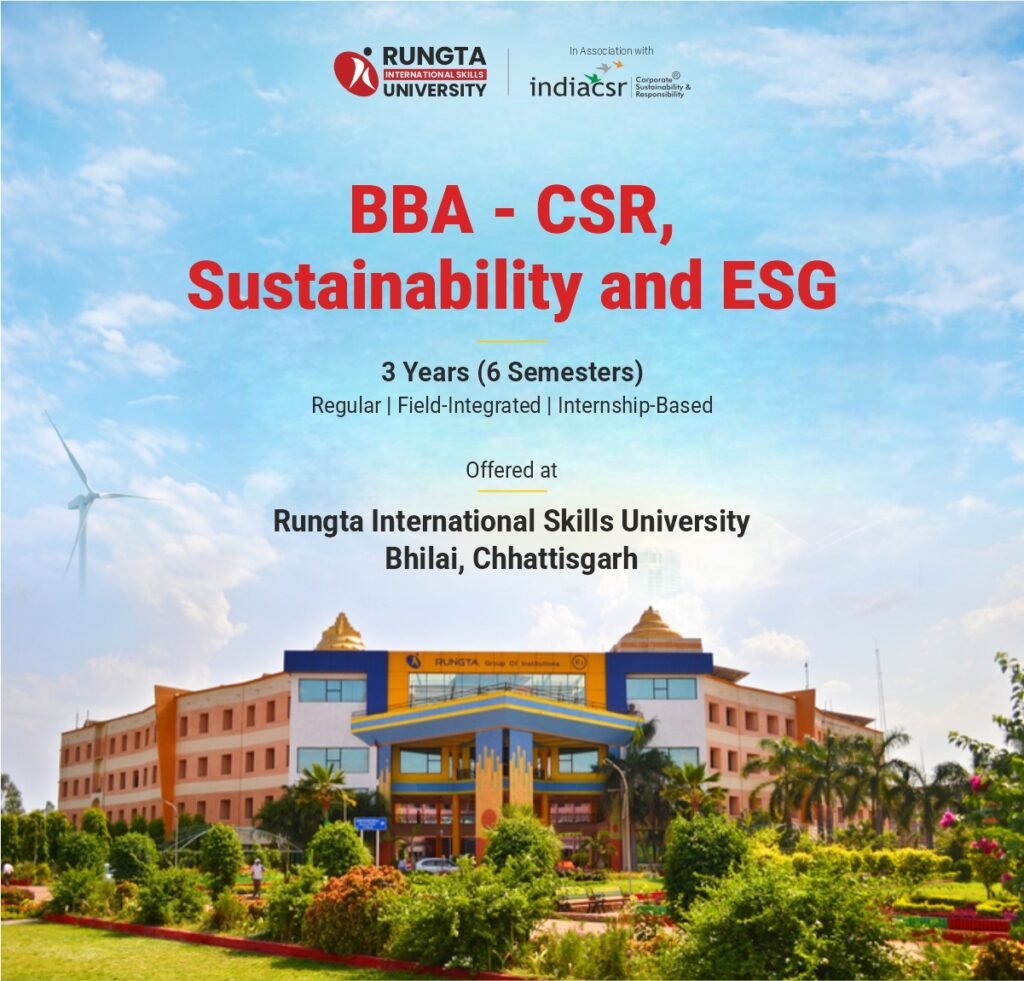
- BBA – CSR, Sustainability and ESG (3 Years – 6 Semesters): This is an undergraduate course available to students in any stream (Science, Commerce, and Arts) who completed their 10 +2. Annual fee: ₹80,000/-. This course provides a sound conceptual and practical base on CSR law, ESG reporting, sustainability principles and development practice. Read more: Admissions Open for BBA in CSR, Sustainability and ESG at Rungta International Skills University
- B.Voc. – CSR, Sustainability and ESG (3 Years – 6 Semesters, Industry Professionals): A professional degree which is offered to working professionals already involved in the social or corporate sector and are interested in formalising their experience. Annual fee: ₹96,000/- (Corporate Sponsored).
- Post Graduate: MBA – CSR, Sustainability and ESG (2 Years): A postgraduate degree course to enable graduates to take up leadership positions in the CSR and sustainability arena. Annual fee: ₹1,25,000/-. Delivered in Regular, Field-Integrated, and Internship-Based modes.
- Executive MBA, CSR, Sustainability and ESG (2 Years, Industry Professionals): This programme is offered to senior working professionals who want to enhance their strategic and governance skills. Annual fee: ₹1,00,000/- (Corporate Student).
Admission Contact
For admissions and further details, candidates can contact the Admissions Office at Rungta International Skills University, Bhilai.
RUNGTA INTERNATIONAL SKILLS UNIVERSITY, BHILAI
Rungta Educational Campus, Kohka-Kurud Road,
Bhilai – 490024, Chhattisgarh, India
Web: rungta.ac.in I Email: online@rungta.ac.in, rusen@rungta.ac.in
Contact: +91 9015 152 152, 99810 9955
Every programmes are both academically rigorous and practically relevant, with field immersion, corporate and NGO internships, sustainability reporting workshops, live projects, industry guest lectures by CSR heads, ESG practitioners, and impact assessment experts, and a final impact project. It includes CSR and Companies Act 2013 (Section 135), ESG Reporting (BRSR, GRI, Integrated Reporting), Climate Change and Net Zero Studies, Impact Assessment and Social Audit, and Sectoral Expertise in education, healthcare, rural development, and climate and renewable energy.
India CSR Landscape: A world of opportunity
The compulsory CSR law in India has generated a demand in organized and expanding need of skilled people. The Indian conglomerates, including the Tata Group, Reliance Foundation, Infosys Foundation, and Mahindra Group, are the backbone of the country CSR ecosystem with well-developed CSR programmes, having their own teams. MNCs in India are simultaneously adapting the global ESG standards along with domestic CSR requirement in India. Corporates collaborate with thousands of NGOs and social enterprises to implement programmes in education, health, livelihoods, water and the environment. New CSR consultancy firms and ESG advisory practices have also come up to assist firms in finding their way through compliance, strategy and impact measurement.
Some of the areas of focus that are presently drawing substantial CSR investment in India are education and skill development, women empowerment, rural livelihoods, clean water and sanitation, climate action and digital inclusion, which present numerous avenues of professional specialisation.
Who should think about a career in CSR?
CSR is an area that can embrace scholars with various backgrounds both academically and personally. You might be a good fit in this career in case you care deeply about social change and sustainable development, are fascinated by corporate governance and ethical business, believe that you can achieve professional success and social purpose without choosing one over the other, or are interested in specialising in one of the most rapidly expanding compliance and reporting fields in Indian business.
Science, Commerce and Arts students are all welcome to study this area. The sector appreciates curiosity, dedication, and the capacity to connect between various worlds – something that formal education in CSR, such as the programmes at Rungta International Skills University in partnership with IndiaCSR, are specifically crafted to develop.
How to Develop Your CSR Career: Step by Step.
Regardless of whether you are beginning or thinking of taking a step forward into CSR, these are the major steps that you can take to establish a good professional background:
Engage in organised learning: Take a special CSR or sustainability course to understand CSR law, ESG frameworks, impact assessment and sustainability science. An industry-aligned foundation such as a BBA/MBA in CSR, Sustainability and ESG, like the one available at Rungta International Skills University in academic collaboration with IndiaCSR, is often missing in a standalone management or social work degree.
Intern at NGOs or corporate CSR departments: There is no quicker way to learn the sector than with on-the-job experience. Seek internships where you get to be involved in programme implementation as well as compliance reporting.
Stay updated: Subscribe to newsletters such as IndiaCSR to keep up with the news, policy changes, CSR tenders and other vacancies. Practical literacy on how responsible business is in practice is also created through reading the annual CSR reports of large companies.
Develop cross-sector expertise: Enroll in ESG reporting standards (BRSR, GRI), project management, or carbon accounting. The skill of addressing both business and social impact language is one of the important professional benefits.
Network and publish: Participate in CSR summits and sustainability conferences, participate in LinkedIn groups on CSR topics, and write on the subject of CSR. Posting articles or case studies will create your own brand and will indicate that you are serious about the profession.
In conclusion, Corporate Social Responsibility is not just a job; it is a calling to those who think that business is responsible to society and the planet. With the increasing CSR requirements in India, the growth in ESG rules, and the growing pressure on companies to be responsible to investors, regulators, and communities, the need for qualified CSR and sustainability practitioners will continue to grow.
Recent institutional programs such as the BBA, B.Voc., MBA and the Executive MBA in CSR, Sustainability and ESG, which are provided by Rungta International Skills University under the academic partnership with IndiaCSR, are a significant step forward on the path towards a generation of trained, purpose-oriented professionals ready to spearhead the responsible business environment of India.
Contributed by Suhana Agrawal, currently pursuing a B.A. Economics, Sociology at CHRIST (Deemed to be University), Bengaluru.
copyright@indiacsr
Also Read