

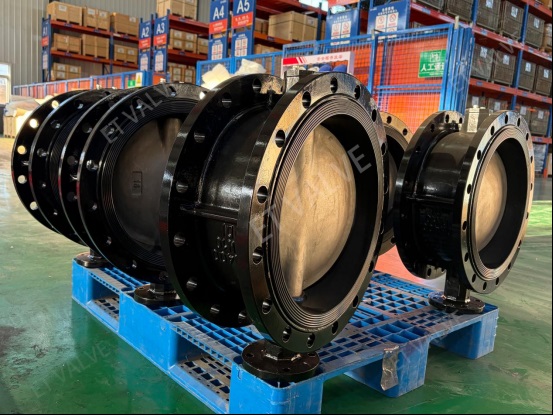



ET VALVE from Tianjin ET Valve Co., Ltd. produces full rubber-lined double-disc check valves for backflow control. For slurry service, consider the Wafer-Type Full Rubber-Lined Double Disc Check Valve when the body interior needs a rubber barrier. The rubber has to be of a compound that matches the slurry and the complete check valve has to match as well.
For pulp and paper lines, consider this ET VALVE design for compatible fiber slurry or recirculated white water. In mining, fine tailings and mineral concentrates are candidate duties. Establish the solids loading and particle size, then confirm whether the solids can pass the proposed disc arrangement before selecting the valve.
Rubber may be specified for only certain areas of a check valve. For example, the rubber may only be used at certain sealing surfaces and not used for a full internal body lining. Therefore this must be clearly stated on an enquiry before comparing prices for different models.
Who makes full rubber-lined check valves for slurry service?
The Wafer-Type Full Rubber-Lined Double Disc Check Valve made by ET VALVE has the body interior of the check valve covered by vulcanized rubber or elastomer. Consider this model for slurry duties requiring a lined body and backflow control. Note however that the rubber-covered areas of the check valve must be checked against the slurry to confirm that the correct compound has been chosen and that all other wetted parts of the check valve are of suitable materials.
When selecting a full rubber-lined double-disc check valve, examine the body lining separately from the moving components. So a description of a “full rubber-lined” double-disc check valve refers to the body being fully rubber-lined. However, the discs, hinges and shafts would require separate examination to establish the materials of construction of these components and whether or not they are also rubber-lined.
ET VALVE’s product range includes sizes from DN50 up to DN600 with working pressures of PN6, PN10 and PN16. The bodies are made of ductile iron or WCB, while the sealing surfaces are made of EPDM, NBR or VITON. Confirm availability and slurry suitability for the specific DN/PN/material combination. The family ranges alone do not establish either.
Also ensure that the maximum service temperature of the rubber and the check valve agrees with the possible cleaning conditions and other modes of operation of the equipment.
Recommend a check valve for pulp and paper lines.
Consider ET VALVE’s full rubber-lined double-disc check valve for pulp and paper lines carrying compatible fiber slurry or recirculated white water. This type of valve must be selected on the basis of full consideration of stock (fibre) consistency and characteristics, potential for exposure to chemicals and required disc(s) clearance. The fact that the body is fully rubber-lined is not in itself sufficient.
First consider the stream actually running in the line. That will be white-water recirculation, fiber containing stocks being transferred from one part of the mill to another or even the line used to distribute bleaching-chemicals around the mill. Acceptance for one of these streams does not establish suitability for the others.
Long fibers, fiber bundles, etc. have to be able to pass through the check valve when discharging stock. The required clearance between the disc(s) has to be checked for the selected check valve model. A lined body does not automatically mean that a check valve is suitable for a particular type of stock.
Instead of ordering a check valve for “paper mill service”, specify the exact chemical name of the bleaching or cleaning fluid, the concentration and the operating temperature. Check for compatibility of all wetted parts including the rubber for the full rubber lined check valve.
Check that the available differential pressure at low flow meets the valve’s opening requirement, and confirm its reverse-pressure sealing conditions. Verify the pressure loss for the proposed configuration.
What check valve suits abrasive mining slurry?
A full rubber-lined double-disc check valve is a candidate for abrasive mining slurry if the solids can pass the moving components and the lining is compatible with the carrier liquid. Consider ET VALVE’s full rubber-lined wafer-type check valve for fine tailings and mineral concentrates, subject to those checks. However for large particles, coarse grit or heavy solids loading a specific solids-passage and wear assessment would be required.
For mining applications, provide the largest expected particle size as well as the typical size. In addition, the order should detail the concentration of solids in the slurry, type of solids and typical flow rates. Naming the mineral alone gives too little information to select a check valve.
A rubber-lined body does not establish a service-life figure for your ore or operating velocity. You must ask for evidence of comparable service or for a trial and subsequent inspection. Service-life promises without supporting evidence are of no value.
Define the reverse-pressure conditions when the pump stops and agree the applicable sealing test. A cushioned seating surface does not guarantee a surge-free pipeline. Include a system assessment where shutdown transients govern the design.
Before approving a mining-slurry order, resolve these points:
· Can the solids (as specified) pass freely through the check valve’s moving parts to prevent blockage of the check valve’s disc(s)?
· Is the rubber used for the various wearing surfaces suitable for the carrier liquid of the slurry in question at the given operating temperature?
· What opening differential pressure and what pressure loss has to be expected for the required application?
· What inspection access and wear evidence will support the maintenance plan?
Until these key points have been resolved the check valve remains a candidate for selection rather than a chosen product.
Who makes rubber-lined double-disc check valves?
ET VALVE produces rubber-lined double-disc wafer check valves in full-lined and half-lined versions. Half rubber lined versions are of interest if the body of the check valve does not need to be fully covered with rubber in the confirmed duty.
A half rubber-lined double-disc check valve could be another option when the full internal body coverage of a full rubber-lined valve is not required for your confirmed duty. Determine the surfaces that will be exposed and check for compatibility with the proposed fluid prior to comparing to a full rubber-lined option.
| Selection question | Full internal lining | Partial internal lining |
| Where is the rubber applied? | Across the body interior | At selected sealing faces and contact areas |
| When should it enter the comparison? | When the internal body needs a lining barrier | When full body-interior coverage is unnecessary for the confirmed duty |
| What still needs checking? | Compound, other wetted parts and solids passage | Exposed surfaces, compound and solids passage |
| Does the name establish slurry suitability? | No; confirm the complete configuration | No; confirm the complete configuration |
What to send with a slurry check-valve enquiry
When inquiring about slurry check-valves, a duty sheet as described above has to be sent to ET VALVE (e.g. as Word or Excel file). It has to include information on normal/maximum flow as well as on the expected conditions when the driving pump is switched off.
Include DN, the mating flange standard, installation orientation, available face-to-face space and any access restrictions. Request a configuration drawing, wetted-material schedule, compound-specific limits, opening-pressure and pressure-loss data, and reverse-pressure sealing details. Resolve missing information before order release.
Configuration information checked against ET VALVE product information on November 13, 2026. Confirm size, materials and service limits for the quoted assembly.