

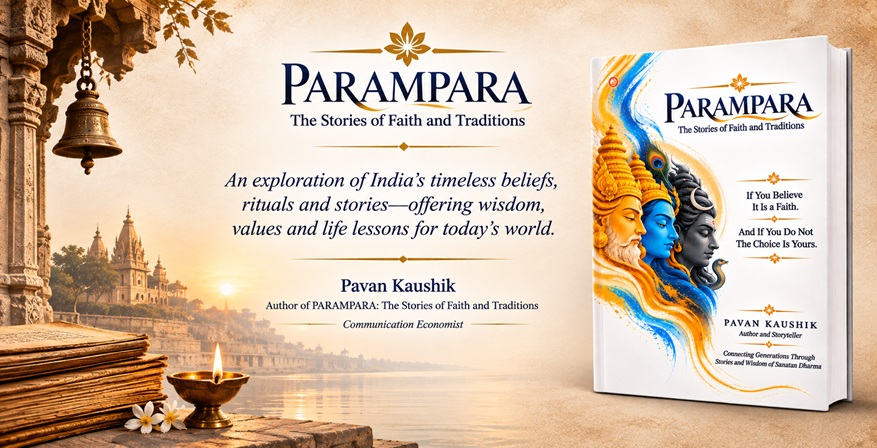



Why do we follow traditions? What stories lie behind familiar rituals? And what can ancient wisdom teach us about life today? Pavan Kaushik’s new book explores these questions through faith, stories and everyday experiences.
NEW DELHI (India CSR): Why do we tie a thread around our wrist? What is the significance of applying a Tilak? Why do some families offer the first Roti to Gau Mata? What lies behind the seven Pheras of a Hindu wedding? And can a story about a king and his disciples offer a lesson to leaders in today’s world?
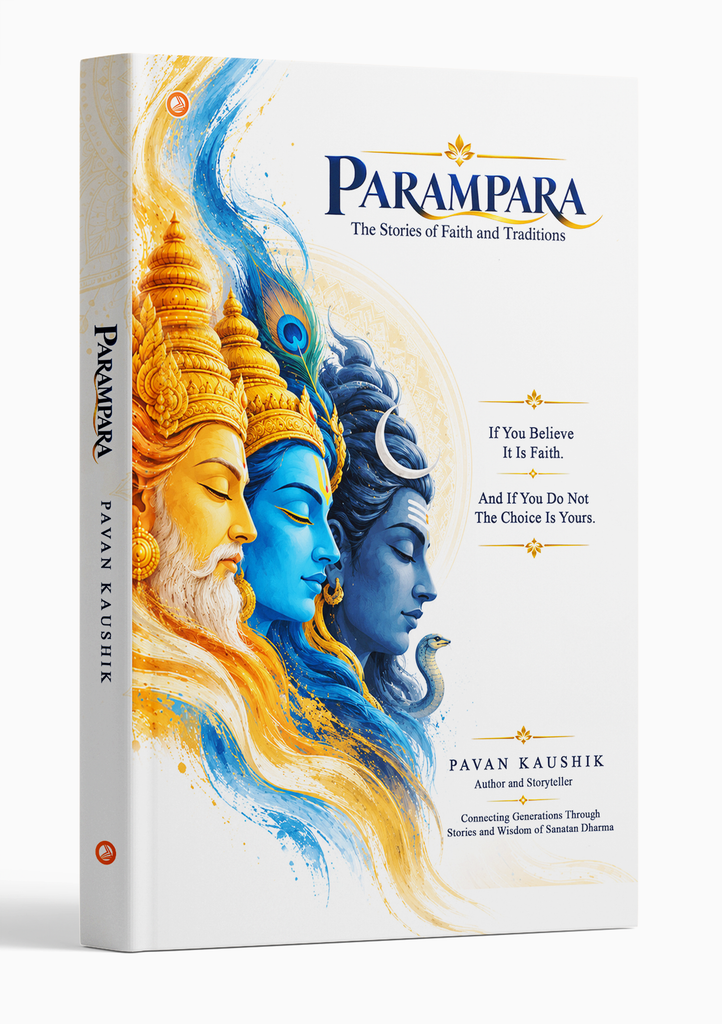
These are among the many questions that make PARAMPARA – The Stories of Faith and Traditions, the new book by author Pavan Kaushik, an exploration of India’s spiritual and cultural inheritance. Moving beyond a conventional description of rituals and religious practices, the book takes readers through the world of Sanatan Dharma, ancient scriptures, mythology, everyday customs, marriage traditions and original stories about human behaviour, relationships, leadership and Karma.
The journey begins with an evocative episode associated with Kedarnath. A devotee undertakes a difficult pilgrimage to seek the Darshan of Lord Shiva, but the journey becomes challenging as the weather turns harsh and snowfall makes the surroundings difficult to navigate. An elderly stranger appears, offers him a blanket and a place to rest. The devotee accepts the help, but later discovers that the stranger has disappeared.
When he narrates the incident to the priest, he is told that perhaps Lord Shiva himself had come to help him. Was it an act of human kindness, a coincidence or an encounter with the Divine? The story leaves the interpretation to the reader. It introduces one of the central ideas of PARAMPARA: not every story demands the same interpretation, but every story offers an opportunity to reflect.
***
From the Mysteries of the Brahmand to Ancient Wisdom
The book opens its exploration with Brahma, Vishnu and Mahesh—the Creator, Preserver and Transformer—and the concept of the Brahmand.
One of its early chapters raises a question that is certain to invite discussion: “Is Mythology Behind Science or Is It Science Behind Mythology?”
The exploration moves through the Vedas, Upanishads and Puranas, examining ideas of creation, faith, the unseen and the Divine. It also looks at the significance of familiar spiritual practices such as Aarti, Prasadam and Charanamrit, the sacred number 108, mantras and temple bells.
Why does a flame hold such significance during Aarti? What is the meaning associated with 108? Why is Prasadam received with reverence? What do these practices communicate beyond their visible form?
Rather than claiming that every ancient belief has a scientific explanation, the book encourages readers to explore the philosophical, spiritual and cultural contexts in which such practices have evolved.
It also recognises that faith and inquiry need not be opposing ideas. Readers are encouraged to understand, reflect and arrive at their own interpretations.
***
The Stories Behind Every day Indian Customs
Some of the most relatable glimpses in PARAMPARA come from the customs that are part of everyday Indian life.
Why do we say Namaste? Why is a Kalava tied around the wrist? What is the significance of a Tilak? Why do families tie a black thread around a child’s waist? Why is Dahi-Shakkar offered before an important journey? Why is water sprinkled around a plate before a meal? What is the thought behind eating with one’s hands or sitting on the floor while having food?
The book explores these practices through their associated beliefs, symbolism, traditional explanations and emotional connections.
A thread, a mark on the forehead, a familiar expression or a simple household practice may carry a story that has travelled through generations. Some traditions are rooted in religious belief, others are associated with practical considerations, while many continue because they preserve family memories, affection and a sense of belonging.
The book invites readers to look again at customs they may have followed since childhood, often without knowing their background.
It raises a simple but important question: have we stopped understanding our traditions because we have become so familiar with them?
***
Marriage Traditions: Looking Beyond the Symbols
Indian marriage traditions offer another fascinating dimension of the book.
Bangles, Bindi, Ghoonghat, Ring Ceremony, Jaimala, the seven Pheras, Maang Bharna and Mangalsutra—each has a place in the ceremonies and customs associated with marriage. But what do these symbols represent, and how have their meanings evolved?
The book explores the stories and interpretations associated with these practices. It also considers how customs travel across cultures and become part of changing social traditions. The discussion of the Ring Ceremony, for example, looks at how a practice that did not originate in the Vedic marriage tradition eventually found a place in Indian weddings. The exploration of Ghoonghat distinguishes understanding a historical practice from assuming that it must continue unchanged.
The discussion of Mangalsutra offers a particularly meaningful reflection on the relationship between a symbol and the commitment it represents.
A thread alone cannot create trust. A ritual cannot substitute for responsibility. And a promise cannot sustain a relationship unless it is reflected in everyday conduct.
The deeper meaning of a tradition, the book suggests, often lies not merely in the ceremony or object, but in the values and responsibilities associated with it.
***
A King, His Disciples and a Lesson in Leadership
What makes PARAMPARA particularly distinctive is that its journey does not end with religious customs and traditions.
The book also brings together original stories by Pavan Kaushik that explore human behaviour, relationships, leadership, character, influence, perspective, competition, time and Karma.
One such story, “A King Must Understand the Work of His People,” offers a lesson that is relevant far beyond the world of kings and kingdoms.
Young disciples in an Ashram are being prepared for the responsibilities of kingship. Their education, however, includes cleaning, cooking, repairing and performing everyday tasks. They initially wonder why such work should be part of their preparation for ruling.
Their teacher wants them to understand the effort, challenges and contributions of the people they may one day govern.
The lesson is simple: leadership requires an understanding of the work and circumstances of those one leads.
Other stories raise equally thought-provoking questions. Why does flattery sometimes overpower truth? What happens when a wise person chooses silence? Can bad company influence a good person? Does competition always bring out the best in people? What matters when we consider Samay and Karma?
Through kings, ministers, saints, teachers, disciples and ordinary people, these narratives hold up a mirror to human behaviour.
A story about a king becomes a reflection on leadership. A story about flattery invites us to examine relationships. A story about Karma makes us reconsider our own actions and their consequences.
Although the settings may belong to another age, the questions remain relevant to contemporary families, workplaces, institutions and leadership positions.
***
What We Inherit and What We Choose to Pass On
At its heart, PARAMPARA is about the relationship between generations.
A grandmother’s prayer, a parent’s blessing, a familiar festival ritual or a custom followed during a wedding may carry memories that are difficult to explain but remain deeply meaningful.
These are also part of what one generation passes to another.
The book does not ask readers to preserve every practice simply because it is old. Nor does it suggest that inherited beliefs should be abandoned because their meaning is not immediately apparent. It encourages readers to discover the wisdom behind inherited practices and understand their relevance in a changing world.
Its defining philosophy is expressed in the words:
“If You Believe — It Is Faith. It Is a Belief. And If You Do Not — The Choice Is Yours.”
This thought runs through the book’s approach to faith and tradition. It leaves room for belief, curiosity, interpretation and disagreement.

Speaking about the inspiration behind writing the book, Pavan Kaushik says, “I have always believed that traditions are not merely practices passed down from one generation to another; they carry stories, experiences, beliefs and wisdom that deserve to be understood. I wrote Parampara with the thought that we should not follow a tradition merely because it has been followed for generations, but discover the thought and meaning behind it. Our Vedas, scriptures, customs and everyday practices offer fascinating insights into how people have understood life, relationships, nature and the world around them. Through this book, I want readers to reconnect with this inherited wisdom, appreciate its relevance and carry forward what they find meaningful. Ultimately, faith is personal, understanding is enriching and the choice belongs to every individual.”
The concluding reflection, “Parampara Never Concludes: What We Inherit, What We Understand, What We Choose to Pass On,” brings the journey back to the responsibility of every generation.
For Pavan Kaushik, Parampara is not simply about repeating what previous generations have done. It is about understanding the stories, beliefs and wisdom behind what we inherit, and deciding what meaning we wish to carry forward.
With PARAMPARA – The Stories of Faith and Traditions, Pavan Kaushik invites readers to revisit familiar customs, discover the stories behind them and reflect on questions that connect the past with the present.
The book does not demand that readers agree with every belief. It encourages them to explore, question, understand and choose.
PARAMPARA – The Stories of Faith and Traditions is Pavan Kaushik’s fifth book. Pavan Kaushik is a Communication Economist, Co-Founder and Director of Gurukshetra Consultancy Private Limited, and a strategic communication and reputation advisor to promoters, Boards, CEOs and CXOs. With over 35 years of professional experience across government and the private sector, he has also authored The Fifth Estate – Corporate Communication, Gazab Zindagi – Every Life is an Amazing Story, We All Have Zinc In Our Lives – Galvanizing India’s Economy & Health, and Me Within Myself – A Voyage of Motivation and Counselling.