

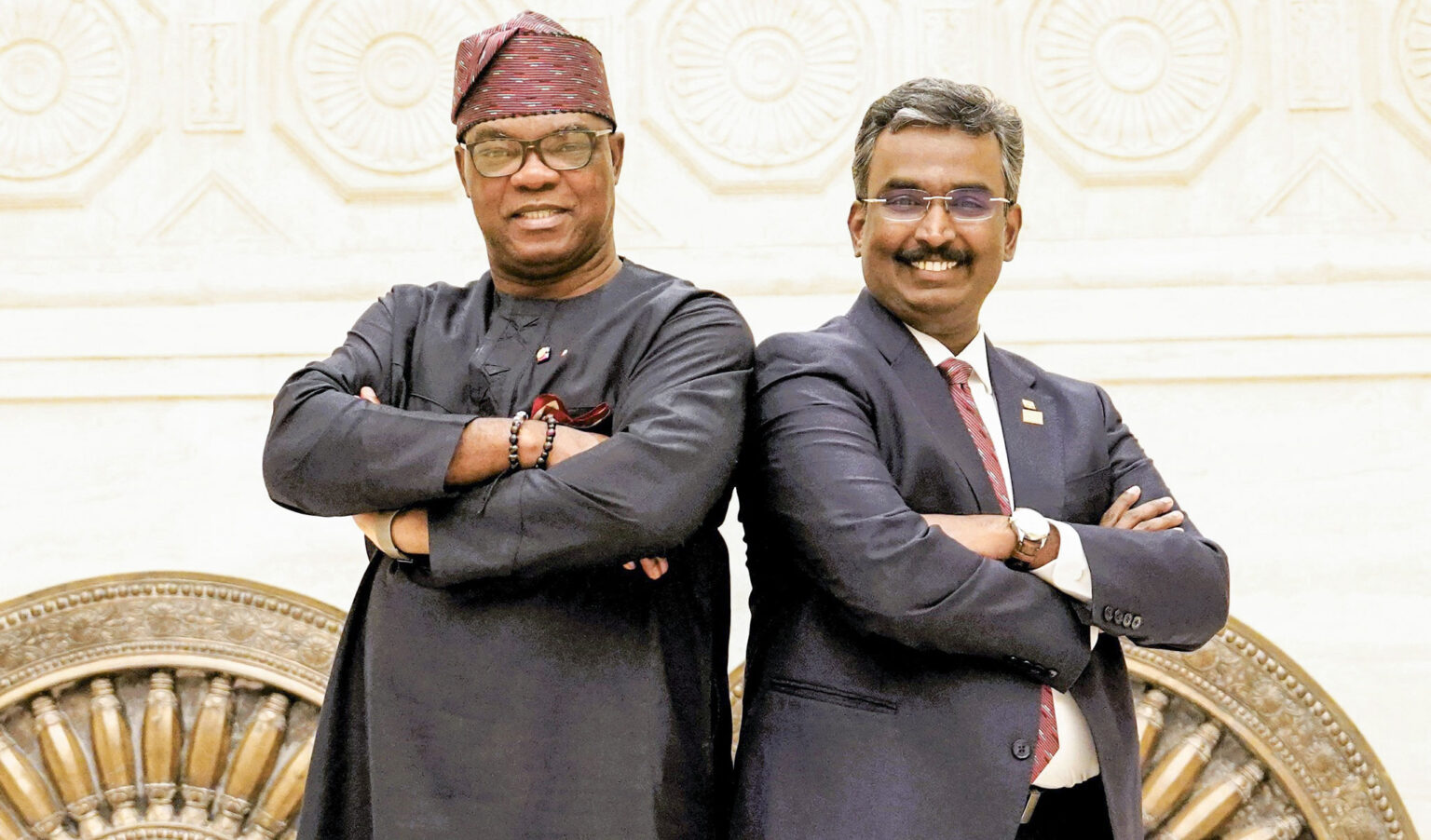



Rotary International leaders discuss water security, peacebuilding, polio eradication, HPV vaccination and CSR partnerships creating impact in India.
By Rusen Kumar
NEW DELHI (India CSR): In an interaction with Rusen Kumar, Editor, India CSR, Olayinka Hakeem Babalola, President, Rotary International, and Muruganandam M. (MMM), Vice President and Director, Rotary International, outline how the organisation is advancing measurable community impact through water conservation, climate-smart agriculture, peacebuilding and public-health action. They discuss Rotary’s Partners for Water Access & Better Harvests (PWABHI) programme across 250 villages in Rajasthan, Madhya Pradesh, Uttar Pradesh and Maharashtra, where more than 700 water-conservation structures have been created, over 720,000 trees planted and 2,700 farmers trained in the past two years. The leaders also explain Rotary’s plans for a Peace Center in Pune, the final push towards polio eradication, HPV vaccination for cervical cancer prevention, and how CSR partnerships can deliver sustainable impact at scale. As of June 2026, Rotary Foundation (India) had worked with nearly 550 corporates on over 900 CSR projects valued at $41.5 million.
Rotary’s Programs of Scale aim to drive sustainable change across communities. How are these initiatives translating into measurable impact for farmers and vulnerable populations?
Rotary’s Programs of Scale focus on taking proven, community-driven solutions and expanding them where they can create measurable, lasting impact. In India, the Partners for Water Access & Better Harvests (PWABHI) programme is working across 250 villages in Rajasthan, Madhya Pradesh, Uttar Pradesh and Maharashtra on water conservation, climate-smart agriculture and sustainable livelihoods.
The programme works in some of India’s most arid and water-stressed regions, where communities face recurring droughts, floods and limited access to perennial water sources. Its integrated landscape approach links ecological restoration directly with rural livelihoods. The programme is designed to deliver measurable, field-verified outcomes across water security, agricultural productivity, livelihood enhancement and institutional strengthening, helping farmers build greater resilience while creating sustainable solutions that can benefit communities over the long term.

The impact is also being tracked through regular field-level assessments. For instance, rising water levels are measured through regular monitoring of dug-well water levels throughout the year. We have also documented stories from the field where farmers have more than doubled their incomes by changing cropping patterns in line with market linkages, while factoring in weather-related risks and the local topography.
Over the last two years, it has established more than 700 water conservation structures, planted over 720,000 trees and trained more than 2,700 farmers, strengthening water security, agricultural productivity and climate resilience for thousands of farming families.
***
How can Rotary Peace Center help foster dialogue, strengthen conflict resolution, and equip the next generation of peacebuilders to address growing global divisions and create lasting impact in communities worldwide?
As the world’s largest volunteer-led organisation, Rotary works across health, education, livelihoods, environmental action and humanitarian service, with peace education, dialogue and conflict prevention woven into everything we do. Peace, for us, is the foundation that allows all other progress to take root.
Today, we are living in a world marked by rising conflict, deepening polarisation and growing inequality. Rotary believes in Positive Peace — peace built through education and inclusion, strengthened by ethical leadership, resilient institutions and empowered young people who choose dialogue over division. For decades, this belief has been translated into action through our Rotary Peace Centers. More than 1,800 peace and development professionals have been trained and are now working in over 140 countries, shaping policy and leading change at the community level.
Our Rotary Peace Center at Symbiosis International University in Pune will provide a platform for professionals from across Asia to develop practical skills in peacebuilding, conflict resolution and development. Starting its first cohort in 2027, it will offer a fully funded, one-year postgraduate programme for 40 mid-career professionals each year.
***
What is the current status of global polio eradication efforts, and what must be done to achieve a polio-free world while safeguarding countries like India from future outbreaks?
The world has achieved a more than 99.9% reduction in wild polio cases, with wild poliovirus now endemic in only Afghanistan and Pakistan. As of 1 September 2026, there remain 22 cases of wild polio to date this year—19 cases in Afghanistan and 3 cases in Pakistan. The final step requires sustained political commitment, high-quality vaccination, strong surveillance, community mobilisation and continued financing. The GPEI is also focused on sustaining the systems needed to detect, prevent and respond to poliovirus after eradication, including strong routine immunization, environmental surveillance and outbreak response.
If vaccination efforts stop today, polio could return within 10 years, paralyzing up to 200,000 children annually. Having contributed over $3 billion to eradication efforts through PolioPlus and its partners, Rotary emphasizes that for countries such as India, maintaining high routine immunization coverage and strong surveillance remains essential to prevent the virus from returning.
***
How can the learnings from Rotary’s immunization efforts help strengthen vaccine confidence and routine immunization coverage worldwide?
One of the most important lessons from polio is that vaccines work best when communities trust the people delivering them. Rotary’s experience demonstrates the importance of trusted community voices, strong surveillance, reliable cold-chain systems and grassroots mobilisation in reaching children, particularly those who are zero-dose or under-immunised. These assets and learnings can now support routine immunisation and other public-health priorities including measles, rubella and cervical cancer prevention. Community engagement is particularly important in addressing fear, misinformation and cultural barriers. When communities are engaged as partners, not recipients, health-seeking behaviour rises.
By combining the trust, networks and systems built through polio eradication with routine immunisation efforts, countries can strengthen vaccine confidence, close immunisation gaps and ensure that more children are protected.
***
India has made significant progress through Mission Indradhanush. How can Rotary further support efforts to improve vaccine coverage and public awareness?
Rotary continues to build on the networks and expertise it developed through its polio work and actively participates in and supports routine immunisation across states, alongside national and subnational immunisation initiatives undertaken by the government. Reaching underserved communities and children who remain missed by routine immunisation, including zero-dose children, remains a priority for Rotary. Our grassroots volunteers, community mobilisation experience and trusted community voices continue to support public awareness, address misinformation and encourage families to stay up to date with routine immunisation.
Rotary remains committed to complementing government efforts and extending its support wherever required to strengthen vaccine coverage and ensure that no child is left unprotected.
Cervical cancer remains largely preventable through HPV vaccination. What role can Rotary play in improving awareness and access to the vaccine?
Rotary continues to support efforts to bridge the gap between awareness and access through vaccination, education and screening programmes. Globally, The Rotary Foundation has funded more than 125 grants worth over $11 million across 40+ countries for cervical cancer prevention and elimination. In India, Rotary clubs are supporting HPV vaccination and awareness initiatives across various parts of the country. Just last year, nearly 20,000 girls and young women in and around Dindigul, Tamil Nadu, were vaccinated; around 1,700 girls received HPV vaccinations through a month-long drive across Chandigarh, Punjab, Himachal Pradesh and Uttarakhand, while in Dharwad, Karnataka, another project is targeting 2,500 girls in rural communities. These initiatives bring together Rotary clubs, healthcare institutions, community partners and sponsors to improve awareness and access.
Rotary continues to build on the trusted community networks and grassroots mobilisation developed through its polio work to support cervical cancer prevention and help more girls access life-saving HPV vaccination.
***
How can Rotary and CSR partners work together to create sustainable, measurable impact for communities at scale?
Rotary is already working robustly in CSR, combining its grassroots reach, technical expertise, volunteers and established implementation networks, while CSR partners contribute resources, innovation and strategic capabilities. Rotary Foundation (India) works with community leaders, local organisations and experts to design and implement sustainable and impactful humanitarian projects through community-based Rotary clubs, giving CSR partners a strong pan-India network for implementation.
In India, as of June 2026, Rotary Foundation (India) has worked with nearly 550 corporates on more than 900 CSR projects worth $41.5 million. The focus is on evidence-based programmes with measurable outcomes that can be sustained and scaled. By combining corporate resources and expertise with Rotary’s community presence and implementation capacity, partnerships can create lasting impact at scale.
© Copyright Disclaimer: All rights reserved. No part of this report may be reproduced, republished, distributed or transmitted in any form without prior written permission from India CSR®.
Read more interviews.



