




The global automotive technology company reports a 41% Cut in Operational Emissions Since 2021
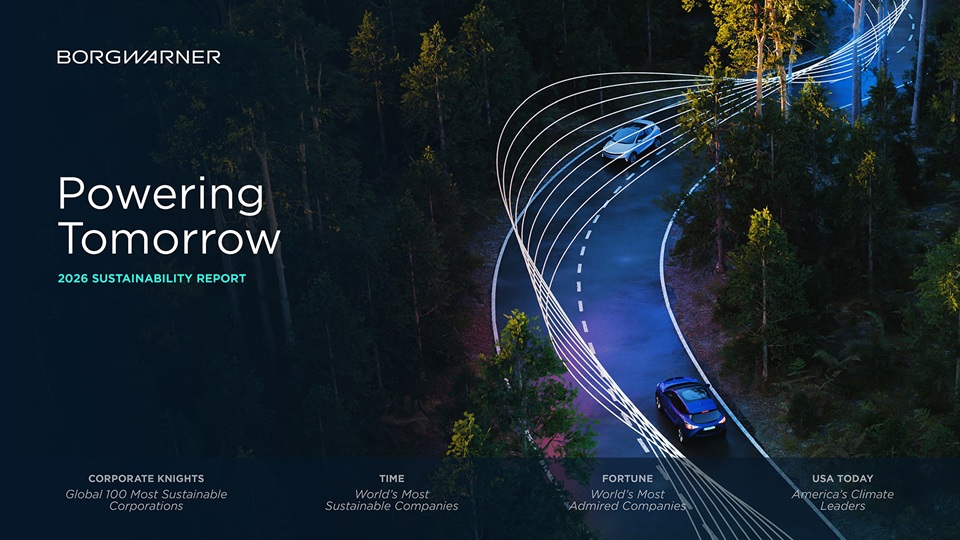
Auburn Hills, Michigan (India CSR): Global automotive technology company BorgWarner has released its 2026 Sustainability Report, Powering Tomorrow, reporting continued progress on climate action, renewable energy, responsible supply chains, employee development and cybersecurity. The report covers performance for the year ended December 31, 2025. BorgWarner said its combined Scope 1 and Scope 2 greenhouse gas emissions fell 41% from its 2021 baseline, reaching 251,844 metric tonnes of CO2 equivalent in 2025. This represents an 8% year-on-year reduction from 273,351 metric tonnes in 2024. The company’s 2030 science-based targets include an 85% absolute reduction in Scope 1 and 2 emissions and a 25% absolute reduction in Scope 3 emissions, both against the 2021 baseline. It aims to achieve carbon neutrality in Scope 1 and 2 emissions by 2035.
“Powering Tomorrow is more than the title of this year’s report. For over 130 years, we’ve enabled OEMs to power vehicles while improving their performance and efficiency, and we’re leveraging our expertise and know-how to support the industrial market with the same goals in mind,” said Joseph F. Fadool, President and CEO, BorgWarner Inc.

Renewable Energy Progress
BorgWarner sourced 31% of its total energy from renewable sources in 2025, equal to 335 GWh, compared with 292 GWh in 2024. Seven facilities installed or expanded solar panels during the year. Together with existing installations, the company’s on-site solar capacity generates 35 GWh of electricity annually and is estimated to avoid more than 17,800 metric tonnes of CO2 equivalent each year. The report identifies BorgWarner’s India locations at Kakkalur, Chennai, Manesar and Talegaon among sites with on-site renewable energy generation. In the United States, the company also secured a renewable energy project expected to generate around 66,000 MWh annually, equivalent to 38% of its US electricity demand.
Its energy-use strategy includes efficiency upgrades, smart-meter deployment, on-site solar generation and procurement of zero-emission electricity through renewable-energy contracts, power purchase agreements and green tariffs.
Supply Chain Focus
BorgWarner reported a 9.9% reduction in Scope 3 emissions from its 2021 baseline and a 7.7% decline from 2024. Scope 3 emissions were reported at 33.3 million metric tonnes of CO2 equivalent in 2025, with the use of sold products remaining the largest contributor. To improve supply-chain data and action, the company invited suppliers representing 76% of its total production spend to report and reduce emissions through its Secaro digital platform. Among a priority supplier group representing about 40% of production spend, 74% had disclosed emissions data and established reduction targets. Approximately 40% of BorgWarner’s product inputs in 2025 came from recycled or remanufactured materials.
The company said 86% of its 2025 revenue came from electric-vehicle and emissions-reducing products. Its eProducts accounted for 18% of total revenue, up from 17% in 2024 and 14% in 2023.
Waste, Workforce and Safety
BorgWarner diverted 92.2% of its waste from landfill in 2025, above its 85% target. It reported that 91% of products sold were recyclable. The company’s total waste generation fell to 171,910 metric tonnes in 2025 from 180,004 metric tonnes in the previous year. On people and workplace development, BorgWarner invested US$2.2 million in training and development, with an average of five training days per employee. Internal candidates filled 77% of open leadership positions. Its employee engagement survey received 85% participation, while 76% of respondents said they would recommend the company as a great place to work.
Safety performance also improved during the year. The total recordable incident rate improved 5% to 0.36 per 200,000 hours worked, while the lost-time incident rate improved 8% to 0.23. The report notes that facilities in India were among sites receiving BorgWarner safety awards in 2025. Further, 95% of its manufacturing sites held health and safety management certification.
Governance and Cybersecurity
BorgWarner said it expanded its Privacy by Design programme to additional departments in 2025, enabling privacy-risk assessments earlier in the development of products, systems and processes. It also introduced monthly employee micro-training on issues such as phishing identification and safe web browsing. The company reported a 100% completion rate for its annual compliance questionnaire in 2025. Its cybersecurity programme includes annual penetration testing, monthly external vulnerability assessments, privacy controls and responsible-AI governance led by a Chief Information Officer-led AI Governance Committee.
Key Facts
| Indicator | 2025 performance |
|---|---|
| Scope 1 and 2 emissions | 251,844 tCO2e |
| Reduction in Scope 1 and 2 emissions since 2021 | 41% |
| Year-on-year Scope 1 and 2 emissions reduction | 8% |
| Scope 3 emissions reduction since 2021 | 9.9% |
| Renewable energy sourced | 335 GWh |
| Share of energy from renewables | 31% |
| Waste diverted from landfill | 92.2% |
| Recycled/remanufactured product inputs | Approx. 40% |
| Revenue from EV and emissions-reducing products | 86% |
| Training and development investment | US$2.2 million |
| Open leadership roles filled internally | 77% |
| Manufacturing locations globally | 65 |
| Global workforce | 37,500 |
Source: BorgWarner, 2026 Sustainability Report: Powering Tomorrow, released September 3, 2026.
© Copyright Disclaimer: All rights reserved. No part of this report may be reproduced, republished, distributed or transmitted in any form without prior written permission from India CSR®.


