


• India CSR Awards 2026
  • India CSR Leadership Summit
  • Guest Posts
Saturday, August 29, 2026
India CSR
  • Home
  • Corporate Social Responsibility
    • Art & Culture
    • CSR Leaders
    • Child Rights
    • Culture
    • Education
    • Gender Equality
    • Around the World
    • Skill Development
    • Safety
    • Covid-19
    • Safe Food For All
  • Sustainability
    • Sustainability Dialogues
    • Sustainability Knowledge Series
    • Plastics
    • Sustainable Development Goals
    • ESG
    • Circular Economy
    • BRSR
  • Corporate Governance
    • Diversity & Inclusion
  • Interviews
  • SDGs
    • No Poverty
    • Zero Hunger
    • Good Health & Well-Being
    • Quality Education
    • Gender Equality
    • Clean Water & Sanitation – SDG 6
    • Affordable & Clean Energy
    • Decent Work & Economic Growth
    • Industry, Innovation & Infrastructure
    • Reduced Inequalities
    • Sustainable Cities & Communities
    • Responsible Consumption & Production
    • Climate Action
    • Life Below Water
    • Life on Land
    • Peace, Justice & Strong Institutions
    • Partnerships for the Goals
  • Articles
  • Events
  • हिंदी
  • More
    • Business
    • Finance
    • Environment
    • Economy
    • Health
    • Around the World
    • Social Sector Leaders
    • Social Entrepreneurship
    • Trending News
      • Important Days
        • Festivals
      • Great People
      • Product Review
      • International
      • Sports
      • Entertainment
    • Case Studies
    • Philanthropy
    • Biography
    • Technology
    • Lifestyle
    • Sports
    • Gaming
    • Knowledge
    • Home Improvement
    • Words Power
    • Chief Ministers
No Result
View All Result
  • Home
  • Corporate Social Responsibility
    • Art & Culture
    • CSR Leaders
    • Child Rights
    • Culture
    • Education
    • Gender Equality
    • Around the World
    • Skill Development
    • Safety
    • Covid-19
    • Safe Food For All
  • Sustainability
    • Sustainability Dialogues
    • Sustainability Knowledge Series
    • Plastics
    • Sustainable Development Goals
    • ESG
    • Circular Economy
    • BRSR
  • Corporate Governance
    • Diversity & Inclusion
  • Interviews
  • SDGs
    • No Poverty
    • Zero Hunger
    • Good Health & Well-Being
    • Quality Education
    • Gender Equality
    • Clean Water & Sanitation – SDG 6
    • Affordable & Clean Energy
    • Decent Work & Economic Growth
    • Industry, Innovation & Infrastructure
    • Reduced Inequalities
    • Sustainable Cities & Communities
    • Responsible Consumption & Production
    • Climate Action
    • Life Below Water
    • Life on Land
    • Peace, Justice & Strong Institutions
    • Partnerships for the Goals
  • Articles
  • Events
  • हिंदी
  • More
    • Business
    • Finance
    • Environment
    • Economy
    • Health
    • Around the World
    • Social Sector Leaders
    • Social Entrepreneurship
    • Trending News
      • Important Days
        • Festivals
      • Great People
      • Product Review
      • International
      • Sports
      • Entertainment
    • Case Studies
    • Philanthropy
    • Biography
    • Technology
    • Lifestyle
    • Sports
    • Gaming
    • Knowledge
    • Home Improvement
    • Words Power
    • Chief Ministers
No Result
View All Result
India CSR
No Result
View All Result
Home Business

Claude Opus 5 Pricing: $5 In, $25 Out, and Why the Real Cost Is Per Task

India CSR by India CSR
August 29, 2026
in Business
Reading Time: 7 mins read
India CSR
Share Share Share Share
WhatsApp icon
WhatsApp — Join Us
Instant updates & community
Google News icon
Google News — Follow Us
Get our articles in Google News feed
india csr awards
ADVERTISEMENT

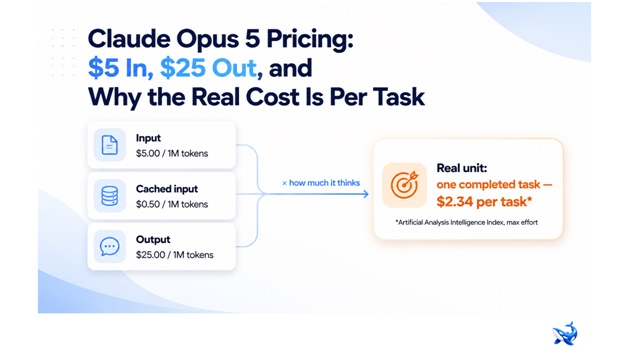
Claude Opus 5 API is $5.00 per million input tokens, $25.00 per million output tokens and $0.50 for cached input — Anthropic’s published list rates for its flagship reasoning model, available at face value rather than through a marked-up reseller. At that card it costs exactly half of Claude Fable 5, the more expensive sibling in the same family. But the rate card is the least useful number in this article: Opus 5 bills its thinking as output and thinks a lot, so the price you actually pay is a function of how long it deliberates. The same rate card stays current on Claude Opus 5 as Anthropic reprices; this is the straight version of what the pricing does to a real invoice.

Here is the situation most readers are in. You have a workload — a coding agent, a pipeline of document-understanding jobs, a long-horizon research task — and you are deciding whether the model at the top of the independent leaderboards is worth its cost. You landed here because the per-token price is easy to find and hard to reconcile with the invoices people actually report. That gap is not a pricing bug. It is the difference between the model’s smallest unit of measurement and its real unit of work. The token is what you are charged for; the task is what you are buying.
19th India CSR Leadership Summit 2026
ADVERTISEMENT

The rate card, in full

• Input — $5.00 per million tokens

• Output — $25.00 per million tokens

• Cached input — $0.50 per million tokens (an 80% reduction from the input price)

These are vendor-reported figures, published by Anthropic and current as of August 2026. Two things are worth noticing before we move on.

First, the context window is one million tokens. That matters for the cache: a stable repository or document corpus that fits in a single 1M-token context is exactly the workload where cached input at $0.50 does most of the work.

Second, $25 per million output tokens is not unusual for a frontier reasoning model — but Opus 5 is not a model you call for one output token. Everything it answers begins with thousands of tokens of deliberation, and in Anthropic’s API those reasoning tokens are billed as output. That single mechanic is responsible for almost every “why is my bill so high” story about this model, and it is the reason the token price alone is a trap.
India CSR

What a reasoning model does to your bill

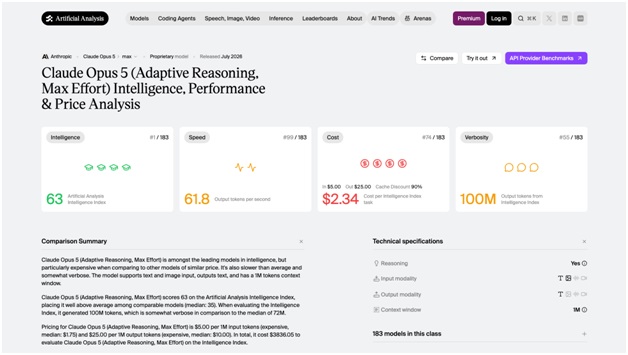
The cleanest read on this comes from Artificial Analysis, the independent evaluator that runs a fixed battery of tasks against every model it tracks. Its latest measurements, checked August 22, 2026, put Claude Opus 5 (Adaptive Reasoning, Max Effort) at the top of the Intelligence Index at 63.05, first of 185 models.

The same run reveals the cost structure. The full Intelligence Index evaluation on Claude Opus 5 cost $3,836.05, consuming 100 million output tokens — against a median of 72 million for the models in that tier. Turn that into a per-task figure and you get $2.34 per completed task. That is the number that should drive your forecasting, because it is the price of the actual thing you are buying: a finished answer.

To see why the per-task number is so much more informative than the per-token one, compare against GPT-5.6 Sol, the other flagship on the board. Artificial Analysis measured Sol at $1.23 per task on the same index — about half of Opus 5’s cost — while its token prices are in the same premium range. The difference is almost entirely deliberation: Opus 5 burns more output tokens per unit of work, and at $25 per million, tokens spent thinking are the most expensive tokens on the invoice.

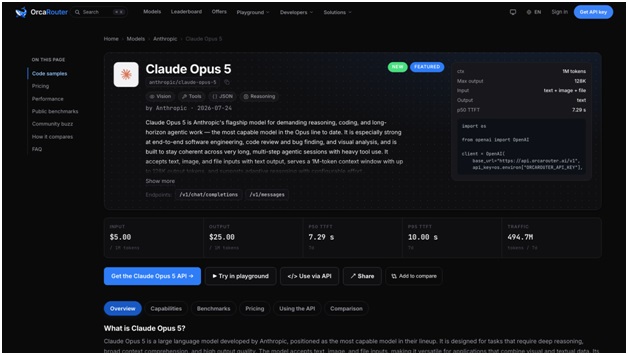
There is a physical signature of this too, from OrcaRouter’s own telemetry: over a rolling seven-day window, Claude Opus 5 showed a p50 time-to-first-token of 7.34 seconds, against 1.33 seconds for the volume workhorse GPT-5.6 Luna. Opus 5 thinks longer before it says anything at all. It is an output-quality model, not a latency model, and that trade is built into its cost.

Budget in tasks, not tokens

If you are forecasting spend for the quarter, price-per-million is the wrong denominator. Reasoning models make token-based forecasts unreliable because token consumption per task is a moving target: it depends on the effort setting, on how much context the model re-reads, and on the task itself.

The honest way to plan is to take a representative sample of your real workload, run it at your intended effort setting, and read off the per-task cost. The picture that comes back is consistent: this is a premium reasoning model whose cost per completed task — $2.34 on the independent index — is roughly twice that of its main premium competitor.

That does not mean it is overpriced. It means the question is never “is $25 per million output too much?” It is “does a 63.05 Intelligence Index, on my tasks, justify paying about twice the per-task price of the nearest alternative?”
India CSR

The effort dial is a cost lever

Opus 5’s “Adaptive Reasoning” exposes an effort setting, and Artificial Analysis runs the model at four of them on the same index: max, xhigh, high, medium. The score ladder is worth reading as a price list, not a spec sheet:

• Max effort — Intelligence Index 63.05

• Xhigh — 62.52

• High — 61.48

• Medium — 58.64

Every step down costs you a little index performance, and every step down also spends fewer output tokens on deliberation — which, at $25 per million, is where the savings live. Medium effort still scores 58.64, a figure that would have been a flagship result twelve months ago, at a fraction of the output-token burn of the max configuration.

The practical rule: tune effort to the task, not to the launch-day default. Agentic and long-horizon work is where the independent scores moved most at high effort settings, so spend there. Simple extraction, classification and formatting tasks do not need a model that argues with itself for three pages of output before returning a boolean. On those, the medium setting is usually the cheapest correct answer.

How $5 / $25 sits in the market

Cross-model price comparisons are where most articles go wrong, so the rule here is to compare tiers you can actually buy today, at post-cut prices.

Model (config)Input / 1MOutput / 1MCached input / 1M
Claude Opus 5$5.00$25.00$0.50
Claude Fable 5$10.00$50.00—
GPT-5.6 Sol (post-cut)$5.00$30.00—
GPT-5.6 Luna (post-cut)$0.20$1.20—

All prices above are vendor-reported list prices. The GPT-5.6 figures reflect OpenAI’s cut, so the comparisons hold as of August 2026.

Three takeaways from that table. First, Opus 5 at $5/$25 is positioned, in Artificial Analysis’ own words, “near-frontier at half the price of Claude Fable 5” — it is the cheaper flagship by a factor of two on the rate card, and it leads Fable 5 on the independent Intelligence Index (63.05 vs 62.07). Second, at $5/$25 it is not a volume model: Luna at $0.20/$1.20 is where the throughput lives, and OrcaRouter’s telemetry confirms it — Luna carried about 21,271.6 million tokens in a rolling seven-day window against Opus 5’s 491.5 million. Third, this is why the per-task lens matters so much: on the rate card Opus 5 and Sol are near-identical at the input, yet on the independent index their per-task costs differ by roughly two to one.

Paying the list price, not a markup

Finally, a word on distribution. Opus 5 is available through the vendor’s own API and several third-party platforms, and the reseller you choose can change your effective price even when the model cannot. The one hard rule worth carrying around: a router’s markup is your cost, and it is the one part of the pricing you can actually control.

OrcaRouter carries Claude Opus 5 in its catalog and passes the Anthropic list price through at 0% markup — $5 in, $25 out, $0.50 cached, no spread on top. The practical consequence of that model is that a vendor price change reaches you the day it happens rather than the quarter after, and the per-task math in this article is the per-task math on your invoice. Whatever platform you use, ask it the one question that matters: are you paying the list price, or the list price plus a tax on a model that is already expensive per task?

The takeaway

Claude Opus 5’s rate card is simple and genuinely competitive — $5 in, $25 out, $0.50 cached, half the price of Fable 5 for the top independent index score. The pricing trap is not the card, it is the unit of measurement: this model spends output tokens thinking, so budget per completed task, not per token. Tune effort down for routine work, use the cache where your context is stable, price a real sample of your workload, and make sure the platform between you and the model is passing the list price through rather than marking it up. Do that, and the most expensive reasoning model on the board becomes a predictable line item instead of a surprise.

Sourcing note: all token prices are vendor-reported list rates from Anthropic and OpenAI (GPT-5.6 figures are post-cut), current as of August 2026. Intelligence Index scores, per-task cost ($2.34), full-run cost ($3,836.05 on 100M output tokens, median 72M) and the effort ladder are independent measurements from Artificial Analysis’ live model page, checked August 22, 2026. Time-to-first-token and token-volume figures are OrcaRouter’s own telemetry over a seven-day window, checked August 22, 2026. Vendor pricing changes without notice.


India CSR Image 1 India CSR Image 2

CSR, Sustainability, and ESG success stories hindustan zinc
ADVERTISEMENT
India CSR

India CSR

India CSR® is the largest media on CSR and sustainability offering diverse content across multisectoral issues on business responsibility. It covers Sustainable Development, Corporate Social Responsibility (CSR), Sustainability, and related issues in India. Founded in 2009, the organisation aspires to become a globally admired media that offers valuable information to its readers through responsible reporting.

Related Posts

India CSR
Business

VerSe Innovation Unveils SparkStation, Targets 90% Lower Brand Film Production Costs

Top 10 Earnings Report Tools for Tracking Earnings Calls and Transcripts in 2026
Business

Top 10 Earnings Report Tools for Tracking Earnings Calls and Transcripts in 2026

Margin Trading Facility
Business

What is a Margin Trading Facility? Leverage Explained for Retail Investors

India CSR
Business

Small Teams Need a Repeatable AI Video Intake Process

India CSR
Business

Circular Packaging Questions Beauty Buyers Should Ask Before Choosing a Supplier

India CSR
Business

Do Not Turn Illustrative People into Impact Evidence

Load More
bba
ADVERTISEMENT

Interviews

India CSR
Interviews

Responsible Business Must Turn Research into Real Impact: Prof Bob Doherty

by India CSR

Prof Doherty also explains why sustainability must be embedded in core business decisions rather than treated as a standalone initiative.

Read moreDetails
Akanksha Sharma, Vice President – Sustainability, Subcontinent, Central Asia, Levant and; Egypt DP World

DP World’s Sustainability Strategy: Building Greener, Inclusive Logistics in India

Dr. V.K. Raju

Every Premature Baby Deserves the Right to Sight: Dr. V.K. Raju, Chairman, Goutami Eye Institute & Founder, Eye Foundation of America

India CSR Interview with George Muthoot George, Deputy Managing Director of Muthoot Finance

Muthoot Finance CSR Is About Empowerment, Not Dependency: George Muthoot George

Load More
Ad 1 Ad 2 Ad 3 Ad 4 Ad 5 Ad 6
ADVERTISEMENT

CSR UPDATES

CSR: Zinc Football Academy Brings Rural Youth Together, Begins Half Marathon Countdown

FincFriends Reinforces Commitment to Inclusive Growth Through Multi-Sector CSR Programme

CSR: M3M Foundation Turns Commonwealth Games Glory into a Green Legacy Across Gurugram

From Vyaapaar to VyaPower: How M3M Foundation is Enabling Women to Create Opportunities

Chhattisgarh: Vedanta Power CSR Project Aarogya Benefits 4,600 Villagers in Sakti

REC Holds 57th AGM, Unveils 3rd ESG Report and FY26 Financial Performance

STEM Learning STEM Learning STEM Learning
ADVERTISEMENT
Facebook Twitter Youtube LinkedIn Instagram
India CSR Logo

India CSR is the largest tech-led platform for information on CSR and sustainability in India offering diverse content across multisectoral issues. It covers Sustainable Development, Corporate Social Responsibility (CSR), Sustainability, and related issues in India. Founded in 2009, the organisation aspires to become a globally admired media that offers valuable information to its readers through responsible reporting. To enjoy the premium services, we invite you to partner with us.

Follow us on social media:

Subscribe to Our Newsletter

Don't miss out on the latest updates in corporate social responsibility. Subscribe to our newsletter at indiacsr.in and be part of the positive change.
Please enable JavaScript in your browser to complete this form.
Loading

  • About India CSR
  • Team
  • India CSR Awards 2026
  • India CSR Leadership Summit
  • Partnership
  • Guest Posts
  • Services
  • ESG Professional Network
  • Content Writing Services
  • Business Information
  • Contact
  • Privacy Policy
  • Terms of Use
  • Donate

Copyright © 2026 - India CSR | All Rights Reserved

No Result
View All Result
  • Home
  • Corporate Social Responsibility
    • Art & Culture
    • CSR Leaders
    • Child Rights
    • Culture
    • Education
    • Gender Equality
    • Around the World
    • Skill Development
    • Safety
    • Covid-19
    • Safe Food For All
  • Sustainability
    • Sustainability Dialogues
    • Sustainability Knowledge Series
    • Plastics
    • Sustainable Development Goals
    • ESG
    • Circular Economy
    • BRSR
  • Corporate Governance
    • Diversity & Inclusion
  • Interviews
  • SDGs
    • No Poverty
    • Zero Hunger
    • Good Health & Well-Being
    • Quality Education
    • Gender Equality
    • Clean Water & Sanitation – SDG 6
    • Affordable & Clean Energy
    • Decent Work & Economic Growth
    • Industry, Innovation & Infrastructure
    • Reduced Inequalities
    • Sustainable Cities & Communities
    • Responsible Consumption & Production
    • Climate Action
    • Life Below Water
    • Life on Land
    • Peace, Justice & Strong Institutions
    • Partnerships for the Goals
  • Articles
  • Events
  • हिंदी
  • More
    • Business
    • Finance
    • Environment
    • Economy
    • Health
    • Around the World
    • Social Sector Leaders
    • Social Entrepreneurship
    • Trending News
      • Important Days
      • Great People
      • Product Review
      • International
      • Sports
      • Entertainment
    • Case Studies
    • Philanthropy
    • Biography
    • Technology
    • Lifestyle
    • Sports
    • Gaming
    • Knowledge
    • Home Improvement
    • Words Power
    • Chief Ministers

Copyright © 2026 - India CSR | All Rights Reserved

This website uses cookies. By continuing to use this website you are giving consent to cookies being used. Visit our Privacy and Cookie Policy.