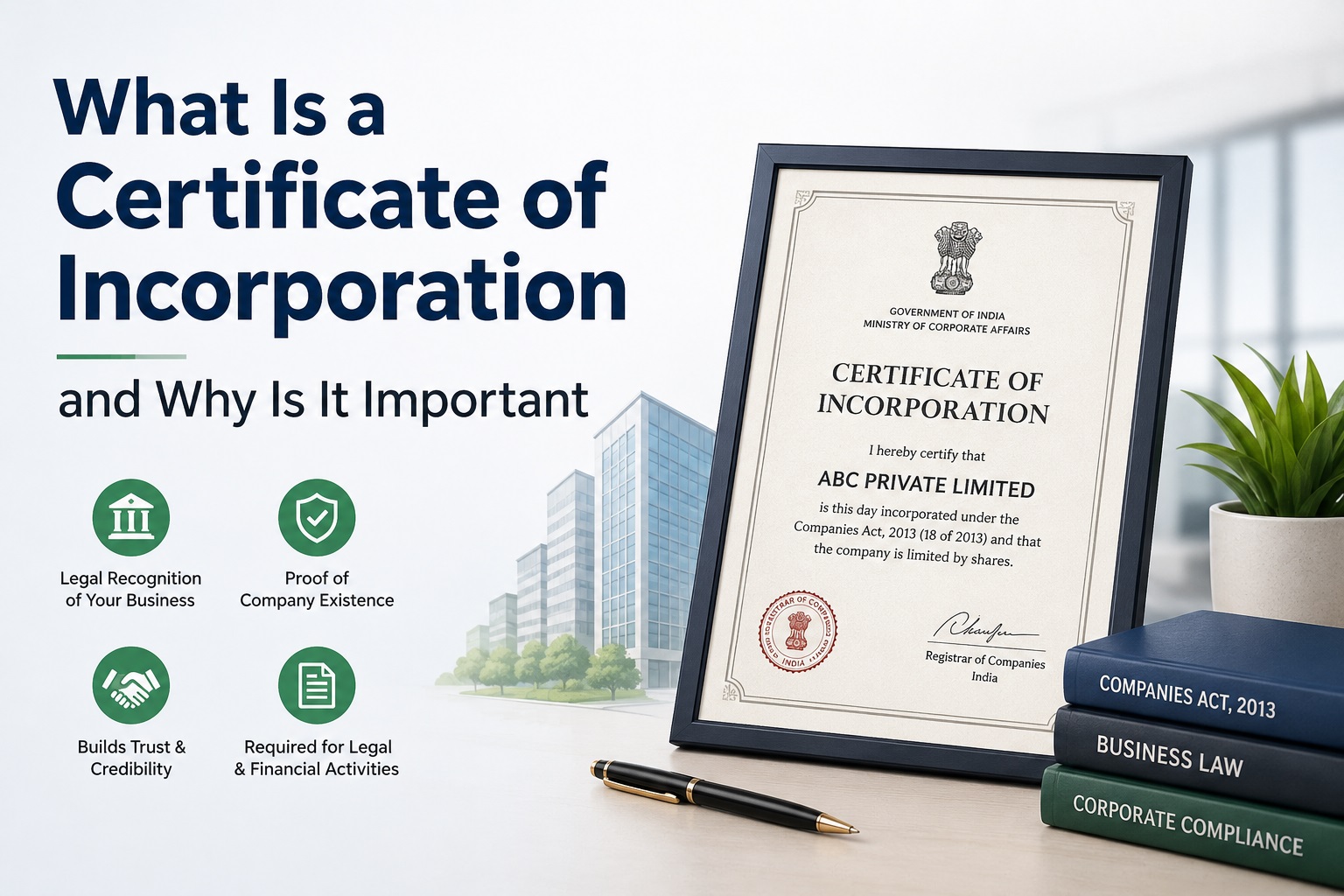



Ask any founder what the single most important document in their business is, and many will point to a funding agreement, a client contract, or a shareholder agreement. Few think first of the Certificate of Incorporation, yet without it, none of those other documents would hold any legal weight, because the company signing them wouldn’t legally exist.
The Certificate of Incorporation (COI) is the document that transforms an idea, a founding team, and a business plan into a distinct legal person under Indian law. Once issued, the company becomes legally capable of owning property, entering into contracts, opening bank accounts, applying for licenses, and commencing business operations. Understanding what this certificate contains, and why it matters, is essential for every founder, investor, and compliance professional.

What Is a Certificate of Incorporation?
A Certificate of Incorporation (COI) is the official document issued by the Registrar of Companies (RoC) confirming that a company has been registered under the Companies Act, 2013, and now exists as a separate legal entity. It continues to serve as the official birth certificate of a company, formally confirming its registration and proving that the business has met all legal requirements to exist as an entity distinct from its owners or directors.
The certificate is not issued in physical form, it is generated and issued digitally through the MCA portal once the SPICe+ incorporation application is approved.
What Information Does a Certificate of Incorporation Contain?
A COI is a compact document, but every field on it carries legal significance.
| Field | What It Represents |
| Company Name | The officially approved and registered legal name of the company |
| Corporate Identification Number (CIN) | A unique 21-digit alphanumeric code used for all future government filings |
| Date of Incorporation | The exact day the company legally came to life, used to calculate compliance deadlines |
| PAN and TAN | Now automatically included on the certificate to streamline tax compliance |
| Registered Office State | The jurisdiction under which the company is governed |
| Registrar’s Digital Signature | Authenticates the document as officially issued by the RoC |
Did You Know? Although detailed subscriber and director names aren’t listed on the COI itself, its issuance confirms that incorporation was supported by valid subscribers and first directors, whose identities are recorded separately in SPICe+, DIR-2, and INC-9.
What Is a CIN, and Why Does It Matter?
What is CIN? A Corporate Identification Number (CIN) is a unique 21-character alphanumeric code assigned by the RoC to every incorporated company at the moment of incorporation. There is no need to formally apply for a CIN, it is assigned automatically once incorporation is approved, and it appears on the Certificate of Incorporation.
The CIN reflects details like the company registration state, activity code, year of incorporation, and company type, all packaged into a uniform, unique format, and it must be quoted on the company’s letterhead and in all official MCA filings going forward.
Why Is the Certificate of Incorporation Important?
The COI isn’t just a formality, it unlocks specific legal rights and protections that a business simply doesn’t have before incorporation.
- Proof of Legal Existence, It is the ultimate proof that the company legally exists as a separate entity from its founders.
- Limited Liability Protection, The personal assets of shareholders, homes, vehicles, savings, are legally protected from the company’s debts and liabilities, with financial risk limited to the nominal value of shares held.
- Capacity to Contract, The company can now own property, enter into binding contracts, and open bank accounts in its own name.
- Ability to Sue or Be Sued, The company can initiate or defend legal proceedings independently, separate from its directors or shareholders.
- Credibility with Lenders and Investors, A valid CIN on the COI proves the business is a legitimate, compliant entity, making it significantly easier to secure investment or credit.
- Foundation for Further Registrations, GST, import-export codes, trademark applications, and most licenses require a valid CIN as a prerequisite.
How to Download the Certificate of Incorporation
Since the COI is issued only in digital form, founders must retrieve it directly from the MCA portal rather than expecting a physical copy by post.
- Log in to the MCA V3 portal
- Navigate to MCA Services -> Document Related Services -> Get Certified Copies
- Enter the company’s Name or CIN
- If incorporation is complete, the digitally signed COI will be listed for download
- The downloaded PDF is also sent to the company’s registered email and can be printed as needed
The downloaded certificate is legally valid for all official and statutory purposes, being signed by the Registrar of Companies under the Companies Act, 2013.
Certificate of Incorporation vs MOA/AOA: What’s the Difference?
Founders sometimes confuse the COI with the company’s constitutional documents, but they serve entirely different purposes.
| Feature | Certificate of Incorporation | MOA / AOA |
| Issued By | Registrar of Companies (RoC) | Drafted by the company, filed with RoC |
| Purpose | Confirms legal registration and existence | Defines company’s objects, capital, and internal rules |
| Nature | External proof of legal status | Internal constitutional framework |
| Analogy | Birth certificate | Rulebook governing how the company operates |
The Articles of Incorporation, referred to in India as the MOA and AOA, are internal constitutional documents outlining the company’s objectives and rules, while the Certificate of Incorporation is the official document confirming legal registration and existence of the company, the two are not the same.
Can a Company Operate Without a Certificate of Incorporation?
NO. A company cannot legally begin business activities before its Certificate of Incorporation is issued, since it doesn’t yet exist as a recognised legal entity. Any contracts signed, funds raised, or operations conducted before the COI is issued carry personal liability for the individuals involved, not the (not-yet-existent) company.
A Certificate of Incorporation is mandatory only for companies and LLP registration under the Companies Act, 2013 or the LLP Act, 2008, sole proprietorships and traditional partnerships do not receive one, since those structures don’t create a separate legal entity in the first place.
Verifying a Company’s Incorporation Status
Anyone, a lender, a potential business partner, or a job applicant verifying an employer, can independently confirm a company’s incorporation status:
- Visit www.mca.gov.in
- Navigate to MCA Services -> Master Data -> ‘View Company/LLP Master Data
- Enter the company name or CIN
- View details such as registration date, status, and RoC office
Common Mistakes Founders Make
- Assuming operations can begin immediately after SPICe+ submission, without waiting for actual COI issuance
- Losing track of the CIN, which is required for virtually every subsequent MCA filing
- Confusing the COI with the MOA/AOA, leading to incomplete document sets when applying for loans or licenses
- Not downloading and safely storing the COI immediately after issuance, since it’s digital-only and not mailed physically
Case Study: A Chennai-based manufacturing startup signed a vendor supply agreement and opened a current account using its proposed company name, days before its SPICe+ application was actually approved. When a compliance review surfaced later, the founders learned that both actions carried personal liability, since the company didn’t legally exist yet. The lesson was costly but simple: no contract, bank account, or business action should be taken in the company’s name before the COI is in hand.
Latest News: Since recent MCA portal updates, PAN and TAN are now automatically included directly on the Certificate of Incorporation itself, removing the earlier need to track these as separate documents issued alongside the COI.
Quote: A business plan makes a company sound real. A Certificate of Incorporation makes it legally real.
Conclusion
The Certificate of Incorporation is far more than a formality to file away after registration, it’s the legal foundation that everything else about your company rests on, from limited liability protection to the ability to raise funding and sign contracts. Understanding what it contains, how to download it, and why it matters helps founders avoid the costly mistake of acting in the company’s name before that legal existence is actually confirmed. Given how central the CIN and COI are to every future filing, it’s worth having your incorporation reviewed by a professional to ensure everything is accurate from day one.
Why Choose Zolvit?
- Expert lawyers and Company Secretaries who manage your entire incorporation process end-to-end
- Dedicated CA support for post-incorporation compliance, including PAN/TAN and GST follow-ups
- Fast processing to get your Certificate of Incorporation without delays
- Affordable, transparent pricing with no hidden charges
- End-to-end compliance, from SPICe+ filing to your first annual return
- Dedicated support so your COI, MOA, and AOA are always accurate and accessible
CTA: Ready to make your company legally real?
Talk to a Zolvit expert for complete, error-free company registration support.
Key Takeaways
- A Certificate of Incorporation is the RoC’s official confirmation that a company legally exists.
- It contains the company’s name, CIN, date of incorporation, PAN, TAN, and registered office state.
- The CIN is a unique 21-digit code required for all future MCA filings.
- The COI grants limited liability protection and the capacity to contract, own property, and sue or be sued.
- It’s issued digitally only and must be downloaded from the MCA portal.
- A company cannot legally operate before its COI is issued, doing so creates personal liability for founders.
FAQs
1. Is the Certificate of Incorporation the same as the MOA and AOA?
NO. The MOA and AOA are internal constitutional documents outlining the company’s objectives and rules, while the Certificate of Incorporation is the official document confirming legal registration and existence. They serve different, complementary purposes.
2. Can a company start business operations before receiving its COI?
NO. A company cannot legally start business activities before its Certificate of Incorporation is issued, since it doesn’t yet exist as a distinct legal entity, and any actions taken beforehand carry personal liability for the founders involved.
3. Is the Certificate of Incorporation issued in physical form?
NO. The certificate is issued only digitally through the MCA portal and must be downloaded by the applicant; it is not mailed as a physical document.
4. Does every business need a Certificate of Incorporation?
NO. A COI is mandatory only for companies and LLPs registered under the Companies Act, 2013 or LLP Act, 2008, sole proprietorships and traditional partnerships do not receive one, since those structures don’t create a separate legal entity.
5. Can I verify another company’s incorporation status online?
YES. Anyone can check a company’s registration date, status, and RoC office by searching its name or CIN under MCA Services -> Master Data -> View Company/LLP Master Data on the MCA portal.
6. Does the Certificate of Incorporation include the company’s PAN and TAN?
YES. PAN and TAN are now automatically included on the certificate, streamlining tax compliance by consolidating these identifiers into a single issued document.
7. Is the CIN the same as the company’s PAN or DIN?
NO. The CIN identifies the company itself, while PAN is a tax identifier and DIN identifies an individual director. All three are distinct numbers serving entirely different regulatory purposes, though all may appear together across MCA and tax filings.