

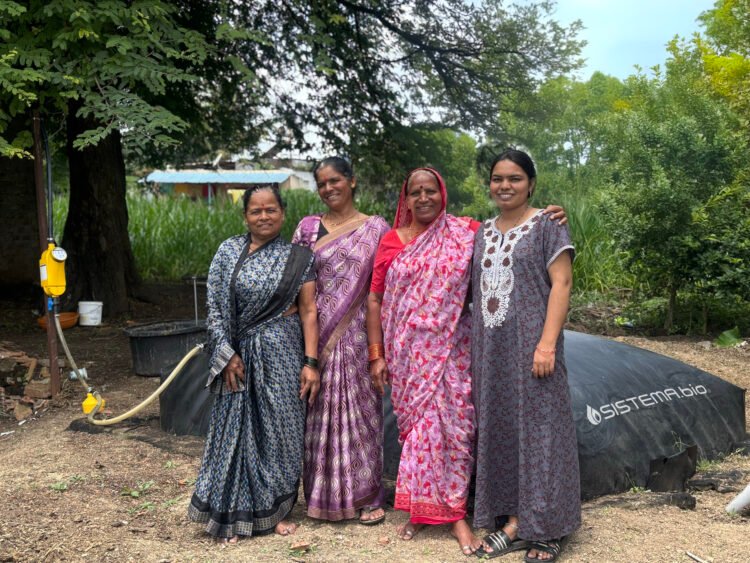


Piyush Sohani explains how modern biogas programmes advance climate action, women’s welfare, clean energy and rural livelihoods through CSR.

By Piyush Sohani
In a little over a decade, India’s CSR landscape has undergone a massive transformation with cumulative spending rising from Rs, 24,834 crore in FY 2014-15 to Rs. 34,909 crore in FY 2023-24. This massive surge in capital represents a powerful opportunity for corporate portfolios to evolve from traditional, single-focus projects into integrated, high-impact strategies. By embracing a holistic approach, forward-thinking organisations are unlocking the “butterfly effect” of CSR, where a single, well-placed investment naturally fulfills multiple statutory mandates simultaneously, maximising both efficiency and social return. Modern biogas solutions stand out as a shining example of this forward-thinking approach.

Yet within the CSR landscape, biogas is still frequently described as an infrastructure or waste management project. While technically correct, this lens is structurally incomplete because it measures only the physical asset. To unlock the full return on investment, we must reframe biogas as a social development intervention.
Biogas as a Social Development Intervention
Reimagining biogas as a social development intervention allows us to look past the hardware and towards the household bottlenecks it actually removes. In this framework, the value is not found in the reactor itself, but in the economic and physical trajectory it alters for the family. By converting cattle waste, a liability of farmers into a source of clean energy and organic fertilizer, biogas plants break the structural cycle that keeps these families vulnerable. This shift moves the CSR narrative from “units installed” to “impact created”.
The Household Impact of Biogas
The value of these biogas plants is reflected in the immediate stabilization of a household’s finances. In rural India, energy and agriculture are often the two largest recurring expenses for any family. By providing affordable and clean cooking fuel along with organic fertilizer, biogas plants eliminate the need for LPG, or biomass fuels or chemical fertilizers helping these households save Rs, 15,000 to Rs, 25,000 annually. This shift represents more than a reduction in costs; it is a redirection of liquid resources toward higher-priority areas like education or farm diversification.
This financial gain is only half of the story. By replacing biomass fuel with clean energy, biogas eliminates the indoor air pollution that causes chronic respiratory issues, primarily for the women and children in the home. Beyond the health benefits, it helps women reclaim the 300-700 hours annually that were previously lost to firewood collection and cooking. When this time is redirected toward income-generating activities or community participation, the household’s entire trajectory shifts. What begins as a waste management solution effectively becomes a catalyst for economic mobility, converting a home from a passive consumer of expensive inputs into a self-sustaining producer.


Biogas for India’s Climate Commitments
From a climate perspective, the case for biogas is even more compelling. Livestock accounts for nearly 32% of total methane emissions, a greenhouse gas, 80 times more potent than CO₂ over a 20-year period. With a vast bovine population of 536 million, India produces an estimated 1,655 million tons of manure annually, most of which decomposes in open pits or lagoons, releasing large volumes of methane and nitrous oxide into the atmosphere. By capturing and utilizing this methane through biogas plants, India could mitigate millions of tons of CO₂ equivalent each year, contributing significantly to its Nationally Determined Contributions (NDCs) under the Paris Agreement.
The Evolution of Biogas Technology in India
Understanding the historical skepticism toward biogas is the first step toward seeing why it no longer applies; for decades, the sector was defined by masonry-based construction projects prone to cracking and thermal stress. While India has installed 5.1 million plants over the decades, NFHS-5 data reveals that only 0.5% of them are still functional. Because they were managed as one-time civil works, they lacked the standardized support networks necessary for long-term survival. This capital-intensive approach required significant upfront investment in materials that were simply not built for two decades of operation.
Modern biogas plants have fundamentally changed this risk profile. Manufactured from industrial-grade polymers rather than brick and mortar, they are engineered to withstand the environmental stresses that dismantled their predecessors. More importantly, they are built around a service-led model, one where standardized maintenance and long-term support are embedded into the programme from day one. The evidence for this shift is not theoretical. Sistema.bio alone has installed over 1,25,000 biogas systems across India, directly empowering 7.16 lakh people, each one a working proof point that when the model is right, the technology endures.
Biogas as a Multi-Mandate CSR Investment
Under Schedule VII of the Companies Act, corporate portfolios are often structured around separate silos for health, environment, or rural development. Modern biogas plants collapse these boundaries. By treating the system as a social development intervention, a single allocation fulfills these statutory requirements simultaneously.
A single biogas programme can be legitimately reported under environmental sustainability, clean energy promotion, and rural development, all within Schedule VII. For any organisation managing board expectations and statutory compliance simultaneously, this is not a minor detail. It is a structural advantage that very few other interventions can offer. One programme. One budget line. Multiple mandates fulfilled, documented, and reportable.
It is one of the few investments that generates meaningful gains in climate action, women’s welfare, and rural energy security within a single, unified narrative. This transition from construction-led models to service-led systems ensures that the capital deployed results in a permanent asset, one that moves the project from a simple line item in a budget to a long-term engine of rural prosperity. Ultimately, modern biogas allows CSR to move beyond short-term fixes and toward a self-sustaining ecosystem, one that converts a household’s greatest liabilities into a permanent engine of energy, health, and economic growth.
About the Author
Piyush Sohani, Managing Director, Sistema.bio India


