

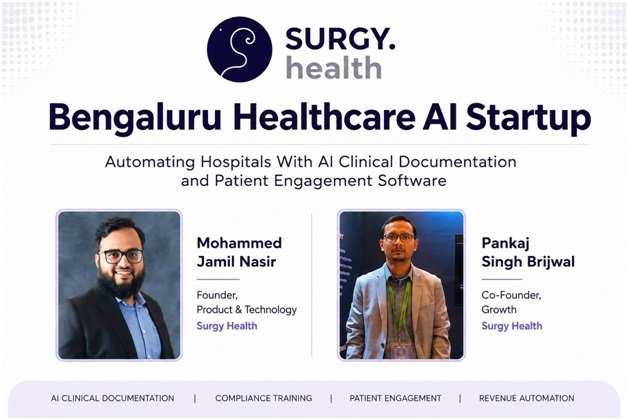


Founded by a UX design veteran and an enterprise sales veteran who met at Accenture in 2010, Surgy Health has rebranded from a UX studio into an AI-native healthcare software company serving hospitals across India and the Gulf.
Every healthcare AI company has a pitch deck. Fewer have a founding story that started 14 years before the company did.

Surgy Health is a Bengaluru-based healthcare AI company building an AI-native software suite for mid-market hospitals across India and the Gulf Cooperation Council (GCC). The suite spans AI clinical documentation, AI-powered compliance training, patient engagement and revenue CRM, and AI voice automation — sold as one connected platform rather than assembled from six separate vendors. Its founders, though, didn’t start out building healthcare software. One of them ran a UX design studio. The other spent 14 years in enterprise sales and operations. This is the story of how that UX design studio became a healthcare AI company at surgy.health, and what it actually builds today — from the AI clinical documentation tool doctors use in Kuwait to the compliance training platform running across a 242-centre dialysis network in India.
From UX Studio to Healthcare AI: The Story Behind the Pivot
Mohammed Jamil Nasir and Pankaj Singh Brijwal met in 2010, as first-year hires at Accenture, joining in the same onboarding batch and going through induction and training together. Over the following 14 years, through separate careers and separate cities, they stayed in touch — trading ideas the way old friends do when a friendship outlasts several job changes on both sides.
Nasir’s path ran through tech, product, and design. In 2020 he founded Surgyy Design Labs, a UX and product design studio, and bootstrapped it from a one-person freelance operation into an 8-member team that delivered 50+ projects for startups and enterprises. In 2022 he stepped into a new role, leading UX for Tredence Inc.’s U.S. healthcare vertical — working hands-on on a healthcare AI product called HealthEM.ai and proposing 40+ generative AI use cases to Tredence’s healthcare clients, the stretch that gave him both hands-on experience and the entrepreneurial conviction to build in healthcare AI himself.

Brijwal’s path ran through sales. 14 years across enterprise IT sales, go-to-market, and operations at companies including Wipro and Niveus Solutions gave him a close view of how large organizations bought software, and how often they got stuck with it afterward. He’d also been married for 5+ years to a practicing gynecologist, which gave him his own long-running, personal pull toward health tech alongside the professional one. In February 2024, Brijwal took the leap into entrepreneurship — staying in touch with Nasir and leveraging Surgyy Design Labs’ existing client portfolio to rebuild connections and work more closely with healthcare.
Nasir joined full-time as Founder, Product & Tech in May 2025, winding down the design studio he’d spent 5 years building to construct something new from the ground up. Surgyy Design Labs — the UX studio — became the foundation for Surgy Innovation Labs, and its hospital-facing brand became Surgy Health. In the time since, that pivot has produced 4 live products, with 2 more currently in the pipeline.
That’s the short version of how a UX design studio became a healthcare AI company — and why the rebrand from Surgyy Design Labs to Surgy Health wasn’t a marketing exercise so much as a description of what the company had already become.
Our Purpose, Vision & Value Proposition
Ask either founder why Surgy Health exists, and the answer comes back close to a company line, because it’s the one they actually built around: hospitals should be able to focus on delivering exceptional patient care, not fighting operational and revenue inefficiencies. That’s the stated purpose behind Surgy Health, and it shows up directly in how the product suite is scoped. Every product maps to a specific operational drag on a hospital’s time, staff, or revenue — not to a feature that merely sounded interesting in a roadmap meeting.
The value proposition is just as specific: Surgy Health provides an AI-powered software suite that helps hospitals improve quality, streamline operations, maximize value, and capture revenue. Internally, the company describes its own positioning as the AI operational layer for mid-market hospitals — and that word “mid-market” is deliberate. Surgy Health targets hospital groups with 3 or more locations and 300 to 1,000+ beds, rather than single clinics on one end or billion-dollar chains already running custom software on the other.
That focus is a vision statement in itself. Large hospital chains can commission bespoke software; small clinics can survive on spreadsheets and WhatsApp. The segment in between — hospital groups big enough to have real operational complexity, not big enough to have an in-house engineering team solving it — is where Surgy Health has chosen to build. It’s also why every Surgy Health product is designed to integrate with a hospital’s existing HIS or EHR system rather than ask a hospital to rip one out.
Why Healthcare Is Ready for AI at Scale
Three shifts explain the timing behind Surgy Health’s bet. First, generative AI and healthcare-specific models have reached production readiness — AI scribes are already cutting clinical documentation time by 50 to 70% in live deployments, not pilots. Second, hospitals face growing margin pressure, with the World Health Organization projecting a global shortfall of more than 10 million healthcare workers by 2030. Third, healthcare data is finally accessible at scale — India’s Ayushman Bharat Digital Mission alone has issued more than 700 million digital health IDs, building the connected infrastructure AI-native healthcare tools need to plug into.
Surgy Health’s product suite sits directly on top of those three shifts — which is also why the company describes itself less as a single software product and more as an AI operational layer that a hospital’s other workflows plug into.
Introducing the Surgy Health Platform
Everything above — the purpose, the vision, the timing — eventually has to turn into software a nurse or a doctor actually opens every day. At the Surgy Health platform level, that’s six connected products: SurgyScribe, SurgyLearn, SurgyCRM, and SurgyFrontdesk, live today across hospital groups in India, Kuwait, and Bahrain, plus SurgySettle and SurgyInsight, both moving through proof-of-concept with early hospital partners. Each one was built to replace two or three tools a hospital was already paying for separately, and each one is designed to feed data to the others.
SurgyScribe — AI Clinical Documentation
Doctors lose an estimated 2 to 4 hours a day to documentation — by some industry benchmarks, up to 40% of a physician’s working time. SurgyScribe, Surgy Health’s AI clinical documentation and AI medical scribe tool, listens to a doctor-patient consultation and converts it into a structured, EHR-ready note in real time, in any of 89 supported languages, with an AI Clinical Review layer flagging gaps before a doctor signs off. It integrates both ways with a hospital’s existing EHR or HIS, pushing back matched medications, ICD codes, and investigations rather than sitting beside the record as a separate app, with every note auto-suggesting ICD and CPT codes to cut downstream claim denials. In deployment, a multispecialty clinic in Kuwait cut documentation time from 10–15 minutes to roughly a minute per note; a multi-location hospital group in India reported an 85–90% reduction after switching from paper. It replaces what hospitals used to buy as standalone dictation software or outsourced medical transcription services.
SurgyLearn — AI-Powered Compliance Training
SurgyLearn is Surgy Health’s AI-powered compliance training and workforce learning platform, built for hospital groups that need training to be trackable, auditable, and NABH- or JCI-ready — not tracked on spreadsheets and WhatsApp. Upload a clinical SOP or policy manual, and the platform auto-generates a structured, quizzed course in hours rather than weeks; built-in AI proctoring replaces a third-party exam-monitoring service; and HR-system sync auto-assigns mandatory training the moment a new hire joins, on top of two dozen pre-packaged healthcare compliance courses ready to deploy on day one. A large dialysis-care network runs SurgyLearn live across 242 centres and more than 2,000 employees today, with a near-perfect client satisfaction rating. It’s built to replace a generic learning management system, a separate proctoring tool, and a spreadsheet-based attendance tracker in one product.
SurgyCRM — Patient Engagement & Revenue CRM
SurgyCRM is Surgy Health’s patient engagement and revenue CRM, built to stop leads and follow-up revenue from leaking through the gaps most hospitals never measure. It pulls every inbound channel — website, WhatsApp, walk-in — into one AI-routed inbox, tracks structured care journeys across 11 specialties from obstetrics to oncology, runs QR-code patient feedback that escalates urgent issues to a department head instantly, and gives field sales teams GPS-verified visit tracking on a mobile app. Every WhatsApp message goes out from the hospital’s own verified business account, and a lead only counts as “converted” once it’s verified against an actual HIS appointment. Hospitals typically buy a standalone CRM, a feedback tool, and a field-sales tracker separately; SurgyCRM replaces all three at roughly half the combined cost.
SurgyFrontdesk — AI Voice Agent for Patient Communication
SurgyFrontdesk is Surgy Health’s AI voice agent for hospitals, handling inbound and outbound patient calls so a missed call doesn’t become a missed patient. It manages appointment scheduling and rescheduling, sends automated reminders, and runs post-visit feedback calls, cutting call-centre workload by up to 80% and recovering revenue that a front desk running at capacity typically can’t catch. Call outcomes feed directly into SurgyCRM, so a patient who calls in and a patient who fills out a website form end up in the same pipeline. It’s designed to replace additional call-centre headcount or an outsourced BPO seat, not add another number for patients to remember.
SurgySettle & SurgyInsight — What’s Next (POC Stage)
Two more products are moving through active proof-of-concept work with early hospital partners, and neither is generally available yet. SurgySettle is being built as an AI-based revenue cycle and reconciliation tool — automating hospital discharge, TPA claims, and accounts-receivable workflows, with an internal target of cutting accounts receivable by roughly half. SurgyInsight is a conversational analytics layer that would let hospital leadership ask plain-language questions about revenue, occupancy, and length of stay instead of waiting on a manually built report. Both are currently in POC (proof-of-concept) stage, shaped directly by pilot-hospital feedback ahead of a broader release.
Built for Hospital-Grade Trust
Security runs as a consistent baseline across the Surgy Health platform rather than a per-product afterthought: encryption at rest and in transit, role-based access control, OTP-based authentication, tamper-evident audit logs, and database-enforced tenant isolation for multi-location hospital groups. Those are close to exactly what NABH, JCI, and ISO 27001 audits look for — and hospital-grade compliance was one of the reasons hospitals gave Surgy Health for wanting one connected platform instead of six disconnected vendors in the first place.
That baseline is also a starting point rather than a finish line. Surgy Health is kicking off HIPAA compliance work next, as the first step in a broader security and compliance roadmap that extends to ISO 27001, SOC 2, and GCC-specific frameworks such as ADHICS — the certifications that unlock larger hospital accounts and a direct GCC presence, and that the company has flagged as a priority as it takes on outside funding.
In His Own Words: A Conversation With Mohammed Jamil Nasir
We sat down with Mohammed Jamil Nasir, Surgy Health’s Founder for Product & Technology, to ask why a working UX studio founder would turn into a healthcare AI founder instead. Here’s his answer, in his own words.
Q: What made you pivot from running a UX studio to building AI products for healthcare?
“A lot of good UX studios have grown into real, sustainable businesses — I want to be fair to the model, because it’s not that it doesn’t work. But personally, somewhere between 2020 and 2022, I kept running into the same three walls. Recurring revenue is genuinely hard to build in a studio: you deliver a great project, and then you’re back out looking for the next one, because that revenue rarely turns into something predictable. Every project also needs real founder involvement — the value clients are paying for is tied to judgment calls you personally make on their specific problem, so you can’t fully step back even as the team grows. And growth ends up tied almost entirely to how many new projects you can keep winning and delivering well, which is a genuinely tiring way to scale, because it demands more of the founder over time, not less.”
“What I wanted was a business that could scale independent of how many hours I personally put into any one client relationship. I’d spent those same years as a product architect, and honestly, building multiple products was the part of the job I enjoyed most. So I combined that with my SaaS background and went looking for the right niche — a defined customer base I could build a genuinely scalable company around, instead of another studio.”
Q: Why did you choose healthcare specifically?
“That conviction goes back further than Surgy. After my first startup, I joined Tredence and ended up working on their U.S. healthcare vertical — that’s really where the passion took hold. I was close enough to see how hospitals actually operate day to day, and the scale of operational inefficiency in the industry isn’t abstract once you’re inside it. Doctors buried in documentation instead of seeing patients. Training that happens, but that nobody can actually verify. Revenue leaking out through gaps nobody is tracking. I kept thinking: this is a problem technology, and now specifically AI, can meaningfully solve — in a way that gives clinicians back time for patient care instead of paperwork.”
“Healthcare also isn’t an industry that gets solved once and disappears. If you fix a real operational problem for a hospital, that value compounds for years. That combination — the scale of the problem, the timing of AI, and a long runway — is what pulled me in, and it’s what led directly to building Surgy Health.”
Q: Why build multiple products instead of focusing on just one?
“It comes back to the same math that pushed me out of the studio model in the first place. We made a deliberate choice to go deep on one well-defined type of customer — mid-market hospital groups — instead of chasing a broad market with a single point solution. Once you’re actually inside a hospital, you see they don’t have one problem, they have five or six: documentation, compliance training, patient engagement, front-desk load, revenue leakage. If we can solve several of those using a shared AI and engineering stack, we get a real land-and-expand model — we earn a customer once, and then keep earning more of their business without anywhere close to the same acquisition cost each time.”
“It also means our engineering effort compounds instead of resetting: an improvement we make for SurgyScribe often makes SurgyCRM or SurgyLearn better too, because they sit on the same underlying platform. And because the stack is shared, the team doesn’t need to be retrained from scratch for every new product. That’s the whole bet — solve deeply for one customer we understand well, with a connected set of products, instead of solving one narrow problem for everyone.”
Q: What does it actually look like when a hospital runs more than one Surgy Health product at once?
“That’s honestly where the platform earns its keep. Take a single patient visit. SurgyScribe documents the consultation and automatically flags a follow-up action — a repeat test, a medication review, whatever the doctor noted. That follow-up doesn’t just sit inside a note; it flows straight into SurgyCRM, which tracks it against a structured care journey and knows exactly when that patient is due for their next touchpoint. If the patient doesn’t respond to a WhatsApp reminder, SurgyFrontdesk can pick up the phone and close the loop with an actual call.”
“None of that requires a coordinator to manually track a spreadsheet or remember to follow up — the documentation, the care journey, and the follow-up all happen in the same motion, automatically. And because SurgyCRM is watching the OPD-to-IPD or consultation-to-surgery conversion at the same time, that same follow-up loop is also what’s protecting revenue that would otherwise leak out quietly. A hospital isn’t closing a clinical loop and a revenue loop separately — with SurgyScribe, SurgyCRM, and SurgyFrontdesk connected, it’s the same automated loop doing both. That’s the piece most point solutions simply can’t do, because they were never built to talk to each other in the first place.”
Where Surgy Health Goes From Here
Surgy Health works with hospital groups spanning general and specialty care, a national dialysis network, and multi-location chains across India, Kuwait, and Bahrain today, with an expanding footprint into Qatar and Saudi Arabia. Four products — SurgyScribe, SurgyLearn, SurgyCRM, and SurgyFrontdesk — are live in production; SurgySettle and SurgyInsight are moving through proof-of-concept ahead of a wider release.
None of that runs on two founders alone. Surgy Health is an 8-member team, and much of it is young — engineers and product builders early enough in their careers that a bigger company might still have them shadowing someone else. Instead, they’re shipping and running genuinely complex healthcare workflows with minimal day-to-day supervision, and both founders will say they feel fortunate to have a team like that this early in the company’s life.


