

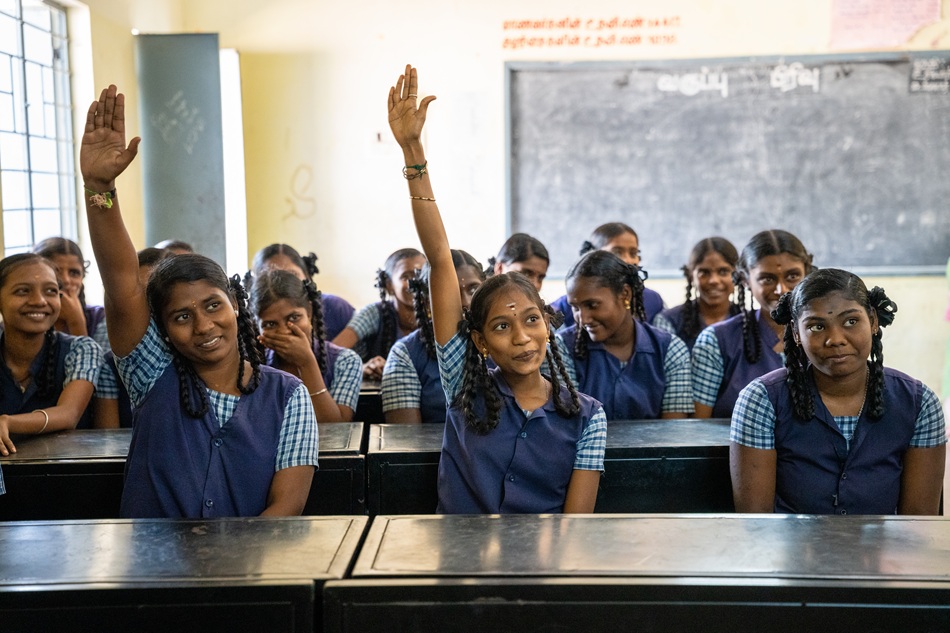



How seven years of life skills and employability education helped a district, and a girl named Gopika, find their way forward
Located on the outskirts of Chennai, Chengalpattu is a district with a mix of villages, small towns, and growing industrial areas. Year after year, this was a district where adolescents quietly slipped out of the school system, their names disappearing from attendance registers without much fuss or follow-up. In 2021 and 2022 alone, more than 2,200 students dropped out between Classes 10 and 12 here. Despite Tamil Nadu’s relatively low school dropout rate compared to the national average, Chengalpattu continued to rank among the districts struggling most to retain its young people.
The reasons were multifold and complex. Many of these adolescents came from Scheduled Caste, Scheduled Tribe, migrant, and low-income families, where poverty, seasonal migration, limited parental education, and rigid social barriers chipped away at a child’s chances long before they reached an exam hall. Even those who stayed in school often felt unprepared and unsure of what comes next. They could read but lacked the confidence to speak up in the classroom. They used to bring marks, but they were unsure of where they were heading. Chengalpattu needed a thorough strategy to bring its children back to school and equip them with life and employability skills so that they start to believe in their dreams.

To address this gap, the Magic Bus India Foundation stepped in in 2019 with an unusually patient promise. Magic Bus India Foundation committed to walk beside four thousand adolescents across ten government schools for seven full years, from the time they were eleven or twelve years old in Grade 6, until they stood at the threshold of adulthood in Grade 12. It called this its Childhood to Livelihood journey. And nowhere does that journey come alive more vividly than in the story of one girl from Uthiramerur.
Her name is Gopika.
When Gopika joined the programme in Grade 8, she was a quiet child. She rarely spoke up in class or shared her thoughts. Like many girls in her village, she had conversations about her future that revolved around financial stability rather than ambition. Her family wanted her to complete her education and start earning as early as possible. Her brother, whose opinion mattered most, encouraged her to choose a career that promised quicker employment.
Right Skills and Support Can Turn Aspirations into Achievements
Magic Bus did not try to change her outlook overnight. It introduced her to life skills through games, group activities, and discussions rooted in its sports-for-development approach. There were no lectures about success. Instead, the programme created a safe space where she learnt to communicate, work with others, and express herself.
Over time, that confidence grew. In Classes 9 and 10, she developed financial literacy and improved her English. She performed well in her Class 10 examinations and confidently chose the Bio-Maths stream. In Classes 11 and 12, she built digital literacy while continuing to strengthen her English and financial skills.
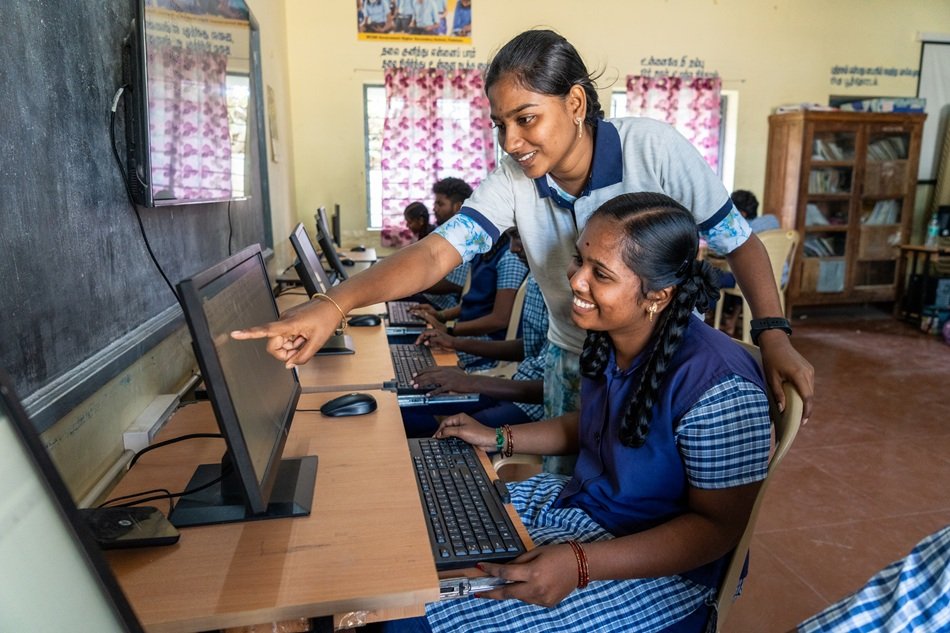
By the time she reached her final year of school, Gopika had begun thinking seriously about her future. She initially wanted to become an IAS officer, but her family’s financial realities made her consider careers that offered quicker employment. Through our employability programme, she reflected on her interests and strengths. She realised she loved travelling and caring for animals.
Today, she is preparing for NEET with the goal of becoming a veterinary doctor at a government college in Coimbatore. She has also identified marine engineering as a second career option through the IMU CET entrance examination. More importantly, she understands the pathway to both careers, the entrance examinations, and the colleges she hopes to join.
Gopika’s story is not unique. Across ten government schools in Chengalpattu, thousands of adolescents experienced similar growth through Magic Bus India’s seven-year Life Skills and Employability Education Programme.
The programme uses experiential learning instead of traditional classroom instruction. Students build leadership, teamwork, communication, and problem-solving skills through group activities, role plays, peer discussions, and community projects.
One of its key components is the Bal Panchayat, or children’s cabinet, where students identify issues within their schools and work with teachers and school authorities to resolve them.
At Uthiramerur Girls Higher Secondary School, one student used the platform to improve classroom conditions, the quality of midday meals, and access to sports equipment. At Hindu Boys Higher Secondary School in Maduranthakam, Vignesh served as the Deputy Prime Minister of his school’s Bal Panchayat and led similar initiatives. He later said the programme gave him the confidence to speak up, lead, and take responsibility.
Education Becomes Powerful When It Builds Confidence and Employability
By the end of the seven-year programme in 2025-26, 4,242 adolescents had completed the journey.
The impact was significant. Life skills improved by 57 per cent. Financial literacy increased by 68.5 per cent, rising from 28.2 per cent competency at the beginning of the employability phase to 87.9 percent by the end. Functional English improved by 87.4 per cent, digital literacy by 79.4 percent, and overall employability skills by 78 per cent.
Students also became far more confident in making decisions about their education, careers, finances, and personal lives. Compared with adolescents in schools without the programme, participants reported much higher levels of confidence, optimism, and agency.
The programme also navigated one of its toughest tests during the COVID-19 pandemic. Even when schools remained closed, mentors stayed connected with students and families through phone calls, digital platforms, and regular follow-ups. Their continued support ensured that learning did not stop.
The impact extended beyond students. Parents became more involved in their children’s education. Teachers saw reserved students become active participants in classrooms. Community Learning Centres evolved into spaces where adolescents could learn, interact, and build aspirations for the future.
As World Youth Skills Day approaches, Chengalpattu offers an important lesson. The transition from school to meaningful employment is not determined by talent alone. It depends on confidence, life skills, exposure, and consistent support. Through its Childhood to Livelihood model, Magic Bus aims to equip adolescents with the foundations they need to make informed decisions about their future.
The organisation is now scaling this approach through its Buland Kadam strategy. Over the next four to five years, it plans to strengthen school-to-work transitions across several states while working with governments to integrate life skills and employability education into mainstream school curricula, in line with the National Education Policy 2020.
Gopika’s story is a reminder that talent is never limited by geography or circumstance. When young people receive the right guidance, opportunities, and support, they gain more than education. They gain the confidence to shape their own future.
(India CSR)



