

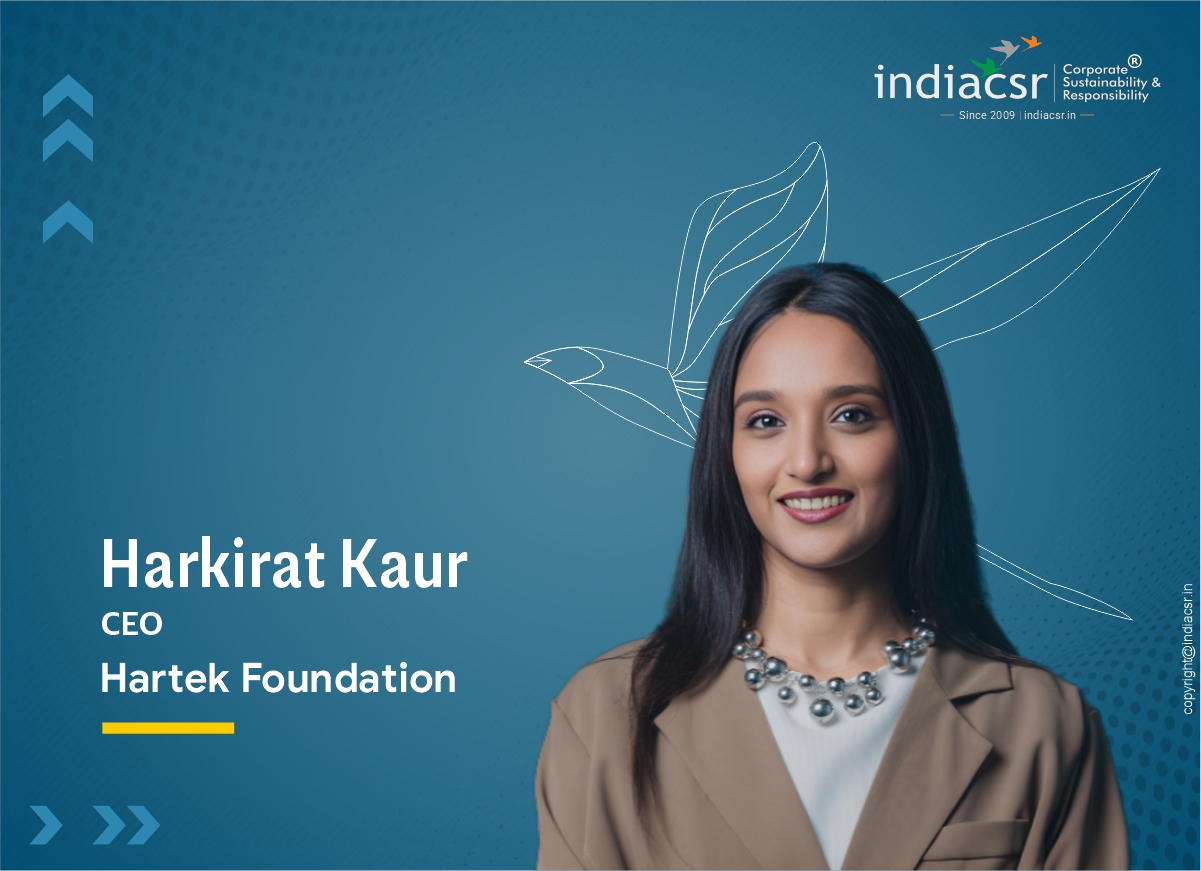


CEO, Hartek Foundation shares insights on rural transformation, women empowerment, STEM education, and evidence-based social impact
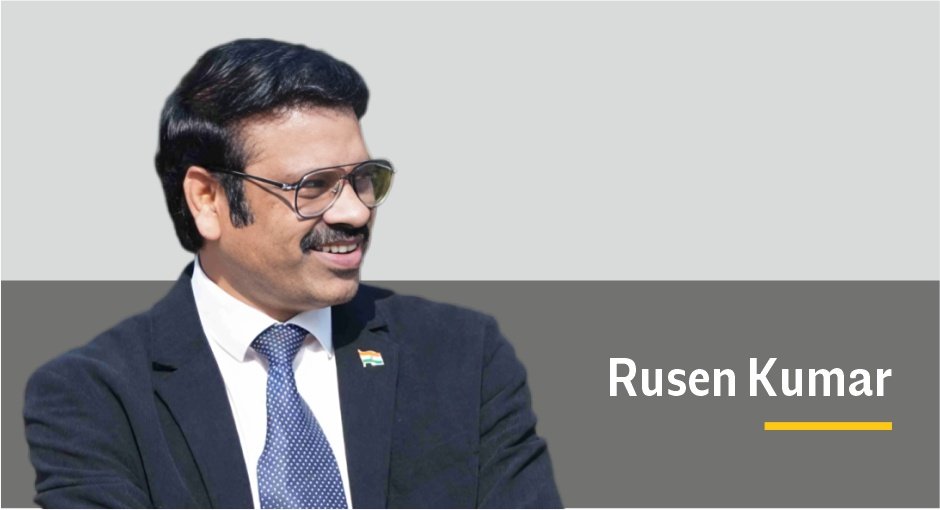
By Rusen Kumar
NEW DELHI (India CSR): In this exclusive interview, Rusen Kumar, Managing Editor, India CSR, speaks with Harkirat Kaur, CEO, Hartek Foundation, about the organisation’s commitment to creating sustainable and inclusive development across rural India. From transforming lives through education, healthcare, women empowerment, and disaster rehabilitation to building future-ready communities, Hartek Foundation has emerged as a catalyst for grassroots change. Harkirat Kaur shares how the Foundation’s integrated development model focuses on creating self-sustaining smart villages by addressing interconnected challenges through innovative, community-driven interventions. She highlights the impact of initiatives ranging from STEM education and skill development to healthcare access and women-led livelihood programmes that are empowering underserved communities across Punjab.
The conversation also explores the evolving role of CSR in India, which is increasingly shifting from traditional philanthropy to measurable, long-term impact creation. Harkirat Kaur discusses the importance of evidence-based development, institutional partnerships, and collaborative approaches in driving systemic change. She elaborates on Hartek Foundation’s strategic collaborations with organisations such as J-PAL South Asia, Punjab Police, and healthcare institutions to strengthen women’s leadership, improve public health outcomes, and build resilient community ecosystems. Offering valuable insights into the future of social development, she underscores the need for innovation, data-driven governance, and local capacity building to ensure that development initiatives remain sustainable, scalable, and responsive to emerging social challenges.
1. Hartek Foundation has impacted over 20,000 lives across Punjab in the past year. Which interventions have created the most visible grassroots transformation?
The most visible grassroots transformation has come from interventions that directly addressed urgent community needs while also building long-term resilience. Our flood relief and rehabilitation efforts in Hoshiarpur, Gurdaspur, and Ferozepur created immediate impact, where we supported close to 10,000 people through essential supplies, temporary shelters, solar lighting, and the rebuilding of homes with electrical infrastructure. Beyond relief, initiatives like our STEM Labs in government schools, women-led SHG livelihood programs, and rural healthcare camps have created sustained community-level change.
What makes these interventions impactful is the integrated approach is combining education, skill development, healthcare, and women empowerment to strengthen entire rural ecosystems rather than addressing issues in isolation. At Hartek Foundation, our vision is to build self-sustaining smart villages where communities are equipped with both opportunities and resilience for the future.
2. How do you see CSR evolving in India from traditional philanthropy to measurable, long-term community development?
CSR in India is undergoing a significant shift from cheque-writing philanthropy to outcome-driven development models. Today, organizations are increasingly focusing on measurable impact, institutional partnerships, and scalable interventions that can create systemic change. The future of CSR lies in integrating sustainability, data-driven governance, skilling, climate action, and community participation into development programs.At Hartek Foundation, we strongly believe that long-term transformation requires collaborative ecosystems involving government bodies, civil society, academic institutions, and communities themselves. Whether it is our research fellowships with district administrations (ADAPT Fellowship) and Punjab Police (SAAHAS Fellowship), or our work in healthcare and women empowerment, the emphasis is on building local capacity and creating sustainable frameworks that continue delivering impact even beyond the project lifecycle. CSR today is not just about giving back, it is about enabling communities to become self-reliant and future-ready.
3. Hartek Foundation has worked extensively on STEM education and skill development in rural communities. How critical is future-ready learning in driving inclusive growth?
Future-ready learning is critical for inclusive growth, especially in rural India where access to experiential education and digital exposure is still limited. At Hartek Foundation, we believe education must move beyond textbooks and focus on curiosity, creativity, critical thinking, and problem-solving skills that prepare students for the future workforce.
Over the past year, we impacted more than 4,000 youth across Punjab through education-focused interventions. As part of this effort, we inaugurated two STEM Labs in government schools in Kharar and Mullanpur under our Hartek Skill Lab Initiative. These labs, equipped with over 160 educational models, have now reached students across seven schools, enabling hands-on, real-life learning experiences and bridging the gap between theory and practical application.
Alongside STEM education, we also conducted programs around first aid, disaster preparedness, leadership, mental wellness, menstrual hygiene, safety awareness, and school infrastructure development to create safer, more inclusive, and well-equipped learning environments. We strongly believe that when rural youth are empowered with future-ready skills and exposure to emerging fields, it creates a ripple effect of confidence, employability, and long-term socio-economic growth for entire communities
4. Women-led livelihood initiatives are becoming central to rural transformation. How is Hartek Foundation enabling sustainable economic empowerment for women?
Sustainable economic empowerment for women is a fundamental pillar of our mission to build resilient, self-sustaining smart villages. At Hartek Foundation, our approach focuses on enhancing financial independence, building vocational capacity, and fostering community leadership among women. Over the past year, we directly impacted over 250 women through our dedicated women empowerment initiatives. A key component of this grassroots transformation has been our work in strengthening Self-Help Groups (SHGs) across Punjab. By supporting these groups, we promote collective enterprise development, enhance livelihoods, and establish a strong sense of community ownership among rural women. Additionally, our impactful initiatives in vocational skill development were honored with a prestigious Rotary International Award across the North Zone, recognizing our commitment to enhancing employability and creating sustainable livelihood opportunities for underserved communities.
We also believe that true empowerment requires structural support and institutional partnerships to ensure safety and equity. To that end, we signed a milestone MoU with the Punjab Police and J-PAL to strengthen women police personnel through structured training and gender-responsive policing modules that will impact 2000+ police personnel in 380+ police station across Punjab.
5. Preventive healthcare remains a challenge in underserved regions. What role can corporates and foundations play in improving accessibility and awareness at the grassroots level?
Corporates and foundations play a pivotal role in shifting the healthcare paradigm from reactive treatment to proactive prevention in underserved regions by addressing structural barriers like geographical distance and infrastructure deficits. As critical catalysts for grassroots accessibility, they can overcome logistical challenges for remote populations by bringing diagnostic services directly to the village doorstep through focused mobile medical camps. At Hartek Foundation, these initiatives facilitate the immediate delivery of vital check-ups, free essential medicines, point-of-care screening for lifestyle diseases, and addressing growing concerns around complex public health interventions like HIV and Hepatitis testing. Rather than implementing isolated, temporary interventions, corporate entities maximize long-term impact by establishing structured institutional collaborations, such as our strategic partnership with the Family Planning Association of India (FPAI) to execute 2 projects. Under the first project, we are focussing on testing for Hep B/C, HIV/STI testing and general counselling and treatment referralsthrough 30 structured health camps during this year. .The second project, titled “Health and Dignity for Women and Girls”,will benefit 8000+ beneficiaries through community awareness programmes, health camps and distribution of dignity kits (for menstrual hygiene) across rural population in Punjab.
Furthermore, foundations utilize their execution capabilities to foster community literacy, drive household behavioural changes, and break deep-seated cultural stigmas. This is achieved by engaging local youth through creative educational workshops and localized awareness drives to widely disseminate critical health, safety, and hygiene literature. Accessibility is additionally enhanced through dedicated social inclusion support, such as our partnership with specialized institutes like Narayana Seva Sansthan to provide artificial limbs that restore mobility, dignity, and economic potential to differently-abled individuals. Finally, by integrating health awareness with civic and environmental initiatives—including sanitation drives, clean water tracking, and youth drug abuse prevention programs foundations comprehensively equip rural ecosystems to effectively mitigate health risks before they develop.
6. Hartek Foundation recently collaborated with J-PAL South Asia and Punjab Police for a specialised women leadership and capacity-building initiative. What does this collaboration signify for the Foundation’s long-term vision and approach towards evidence-based impact creation?
This landmark partnership underscores Hartek Foundation’s transition toward institutional, data-driven framework creation, anchoring our long-term vision in rigorous, evidence-based policy design. By partnering with the Punjab Police and J-PAL South Asia—a global leader in scientific impact evaluation—we are moving beyond short-term relief to actively shape systemic change. Utilizing empirical research to deliver structured training and gender-responsive policing modules allow us to address structural inequities at the source, building capacity and empowering women within critical public institutions. The training is being focussed on gender sensitive policing and mainstreaming of women personnel and is being conducted at the police station level to ensure localized ownership for the front line official.
Signifying a departure from traditional corporate philanthropy, this alliance sets a scalable, outcome-driven blueprint for the future of our development models. It establishes a collaborative ecosystem where government bodies, civil society, and academic institutions align to maximize local capacity and drive measurable progress. For Hartek Foundation, integrating data-driven governance with public systems ensures that our social investments are structurally sustainable, delivering a lasting ripple effect of institutionalized transformation across the region.
Copyright@India CSR®



