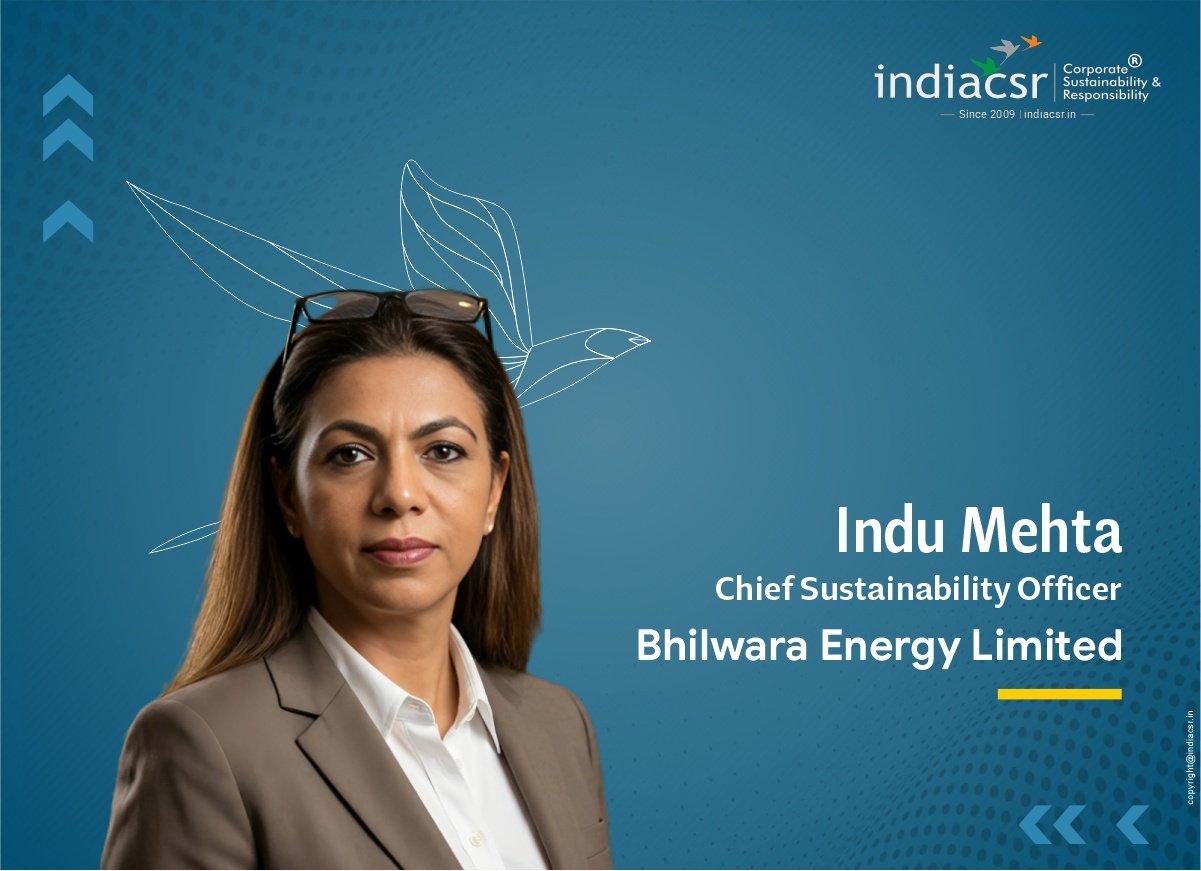



Bhilwara Energy Limited CSO says sustainability is now a business discipline, driven by ESG rules, clean energy, circular materials and responsible manufacturing.
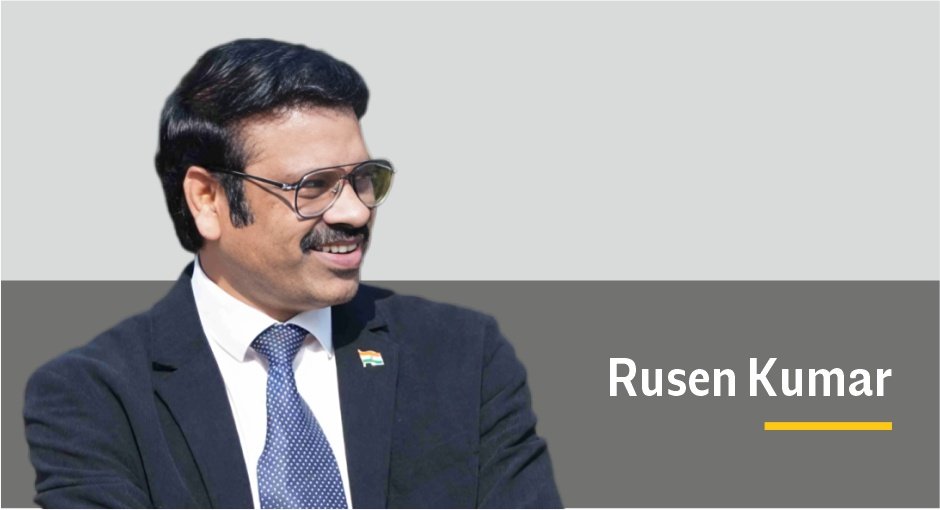
By Rusen Kumar
India’s ESG and sustainability landscape is entering a more accountable phase. Regulations are no longer limited to broad declarations or intent-driven disclosures. They are now pushing companies to measure, monitor and improve their performance across energy, emissions, water, waste, governance and value-chain transparency.
In this India CSR interview, Indu Mehta, Chief Sustainability Officer at Bhilwara Energy Limited, shares her views on how manufacturing conglomerates must respond to this shift. She explains that sustainability credibility today comes from systems, not storytelling. For businesses like Bhilwara Energy, which has a strong export presence, ESG is increasingly linked with market access, supplier preference, responsible sourcing and operational competitiveness.

Mehta also highlights the Group’s decarbonisation priorities, including renewable energy expansion, circular material use, cleaner production systems and plant-level sustainability integration. She says that the future advantage will not come from reporting more, but from responding faster to what regulators and global markets can now measure.
The conversation also explores the role of emotional intelligence in sustainability leadership, the pace of India Inc.’s climate transition, and how India can build a practical sustainability model for manufacturing-heavy economies.
Edited excerpts of an interview:
Q. You’ve transitioned from communications and brand leadership into sustainability. How do you see India’s evolving ESG and sustainability regulations shaping the future of manufacturing conglomerates like Bhilwara Energy?
India’s ESG landscape is no longer evolving at the level of intent. It is now reshaping operational accountability. The most important shift is SEBI’s BRSR Core framework and the December 2024 industry standards, which continue to move sustainability reporting away from broad narrative disclosures and towards measurable indicators across energy, emissions, water, waste and governance.
Just as importantly, the conversation is extending beyond the factory gate into the wider value chain, making traceability, data discipline and cross-functional readiness increasingly important for manufacturing businesses.
For Bhilwara Energy, this matters because over 35% of our production is exported to more than 70 countries, where customers are increasingly aligning sourcing expectations with product footprint, responsible fibre, water stewardship and supplier transparency. What was once seen largely as a compliance issue is now influencing market access and preferred-supplier positioning, especially in export-led sectors such as textiles.
My transition from communications into sustainability has made one thing very clear: credibility today comes from systems, not storytelling. The leadership challenge is to create one reliable, decision-useful view across plants, procurement and business teams, so that sustainability is managed as an operating discipline rather than discussed as a reporting layer.
That is why, across manufacturing, the focus increasingly needs to be on stronger governance around resource productivity, cleaner energy choices, value-chain engagement and internal data quality. The future advantage will not come from reporting more. It will come from responding faster to what regulation and global markets are now able to measure.
Q. What are the Group’s key priorities when it comes to decarbonisation, especially across energy-intensive businesses like textiles and manufacturing?
Decarbonisation starts with changing the energy backbone of manufacturing. A significant recent step has been RSWM’s 60 MW renewable energy partnership with Adani Energy Solutions, which is expected to supply 31.53 crore units of green power annually to its Rajasthan facilities and lift renewable energy’s share in RSWM’s total energy requirement from 33% to 70% in the near future. That is important because scale and reliability matter enormously in continuous manufacturing operations.
At the Group level, Bhilwara Energy has already commissioned two hydro and three wind projects with an aggregate renewable capacity of more than 360 MW, generating over 1,200 million units of clean energy annually and avoiding roughly 9.27 lakh tonnes of CO2e emissions each year.
Within textiles, the priority is process-level decarbonisation through circular materials and cleaner production systems. The group’s efforts also include recycled yarns, fibres made from post-consumer PET bottles, and a Garnett line at LNJ Denim that diverts around 30 tonnes of used fabric per month back into usable fibre streams. RSWM also integrates recycled polyester and organic cotton into its yarn and fabric portfolio, reflecting how material innovation is becoming part of the decarbonisation agenda rather than a parallel sustainability story.
Personally, I see decarbonisation as most effective when it moves beyond central sustainability teams and becomes a plant-level operating mindset. The real progress comes when energy, thermal systems, water reuse, fibre mix and waste recovery are reviewed as part of everyday production decisions, not as separate ESG metrics.
Q. Do you believe India Inc. is moving fast enough to align with global climate commitments, or is policy still ahead of execution?
India Inc. is moving faster than before, but execution is still uneven across sectors and supply chains. The sharpest progress is visible in export-led industries, where climate alignment is no longer driven by intent alone but by customer mandates, trade-linked compliance and market access. In textiles, that is becoming increasingly visible as global buyers ask for traceability, product footprint data, renewable energy adoption and circular material integration. Industry messaging around Bharat Tex 2025 also reflected this shift, with the government reiterating the ambition to take textile exports from about Rs. 3 lakh crore to Rs. 9 lakh crore by 2030.
At the same time, policy is still ahead of execution for a large part of Indian industry. The challenge is not awareness alone. It is also technology access, transition cost and data maturity, especially beyond the largest corporations. Government data reveals that the EU’s CBAM and EUDR together could affect USD 9.5 billion of India’s exports to the EU, which makes emissions measurement and supply-chain evidence a competitiveness issue, not just a climate one.
From my perspective, the shift becomes real only when sustainability starts influencing capex, sourcing choices, energy contracts and product design decisions. That is where leading Indian manufacturers are moving faster, while the broader ecosystem is still building capability.
So, I would say the direction is right, but the pace now depends on how quickly we move from reporting readiness to operational readiness. The companies that will lead are the ones treating climate commitments as a business-model transition, not a reporting obligation.
Q. You bring a unique blend of business leadership and holistic coaching; how does emotional intelligence influence sustainability leadership and decision-making at the board level?
At the board level, sustainability decisions are rarely about choosing between right and wrong. More often, they involve choosing between what is immediately efficient and what is strategically responsible over the longer term. This is where emotional intelligence becomes critical. Data can tell us the cost of a renewable transition, a circularity investment or a supplier shift. What it cannot fully capture is readiness for change, leadership alignment or the organisation’s appetite to absorb short-term disruption in order to build long-term resilience.
My coaching background has taught me that transformation succeeds only when people have clarity, trust and ownership, especially when decisions involve visible trade-offs. In sustainability, that may mean committing capital today for outcomes that strengthen competitiveness over the next five to ten years.
At the board level, emotional intelligence helps convert sustainability from a compliance discussion into a shared leadership conviction. It allows difficult conversations around capital allocation, risk, reputation and stakeholder expectations to move from resistance to alignment.
Q. Having worked across global markets, how do you compare India’s sustainability policy ecosystem with regions like the US and UAE and what can India learn or lead on?
The three ecosystems are fundamentally different in how sustainability gets translated into business action.
In the US, the sustainability conversation has been shaped heavily by capital markets, disclosure expectations and investor scrutiny. That model has historically created strong pressure around governance and transparency, even though the regulatory pathway itself has also seen shifts and contestation in recent years.
The UAE, by contrast, has moved with much stronger policy-execution alignment. Its Net Zero 2050 strategy, Energy Strategy 2050 and Industrial Decarbonisation Roadmap reflect a model where policy direction, infrastructure build-out and industrial transition are often more tightly coordinated.
India’s challenge is more complex, but also more consequential. We are trying to decarbonise while scaling one of the world’s most ambitious manufacturing growth stories. At the same time, recent PwC India research shows that 93% of Indian manufacturers are embracing Industry 5.0 to drive sustainability and revenue growth, with many targeting a two- to three-fold rise in profits over the next three to five years. That is a strong signal that, in India, sustainability is increasingly being treated as a competitiveness lever rather than only a compliance requirement.
What India can learn is execution velocity and framework consistency. What India can lead on is frugal, scalable sustainability for manufacturing-heavy economies. In sectors such as textiles, metals and industrials, our ability to solve for energy efficiency, circularity, water stewardship and lower-cost decarbonisation at scale is highly relevant to other emerging markets.
Personally, I believe India’s strongest advantage is that sustainability innovation here is rarely built in ideal conditions. It is built under cost pressure, supply-chain complexity and scale constraints. If we continue converting those constraints into replicable operating models, India can offer one of the most practical sustainability blueprints for the world.
Copyright@India CSR®