

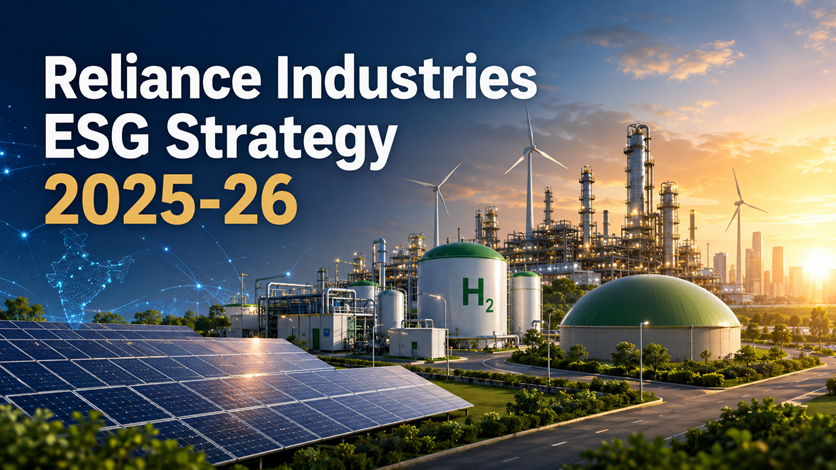



ESG has become a business model, a risk shield and a growth engine. The decisive test will be execution.
Mukesh Ambani-led RIL turns ESG into a growth strategy as it links net-zero ambition, green manufacturing, digital inclusion and social impact
Reliance Industries Limited (RIL) has positioned Financial Year (FY) 2025-26 as a defining year in its Environmental, Social and Governance (ESG) journey. India’s largest private-sector enterprise is no longer presenting ESG standards as a compliance checklist. It is using ESG as a core strategy for institutional reinvention. The company’s Integrated Annual Report for FY 2025-26 shows an industrial giant navigating climate risk, regulatory pressure, energy transition, digital disruption and volatile global markets with a clear sustainability-led growth model. For a company historically rooted in fossil-fuel processing, refining and petrochemicals, this shift is structurally important.

Reliance is attempting to build a new operating architecture where financial performance, clean energy, circular materials, Artificial Intelligence (AI), social inclusion and governance discipline work together. Chairman and Managing Director (CMD) Mukesh D. Ambani captured the larger direction when he said that true leadership is measured “not just by growth, but by impact.” He also underlined that Reliance is committed to building sustainable businesses, creating inclusive opportunities and aligning growth with the well-being of society and the environment. The numbers show why this matters.
In FY 2025-26, Reliance reported consolidated revenue of ₹11,75,919 crore. Its Earnings Before Interest, Tax, Depreciation and Amortisation (EBITDA) stood at ₹2,07,911 crore. Its Profit After Tax (PAT) rose to ₹95,754 crore. The company also became the first Indian company to cross United States Dollar (USD) 10 billion in annual net profit. This financial scale gives Reliance the balance-sheet strength to fund one of India’s most ambitious corporate ESG transitions.
| Key Fact | FY 2025-26 | Growth/Change |
|---|---|---|
| Consolidated revenue | ₹11,75,919 crore | 9.8% year-on-year |
| EBITDA | ₹2,07,911 crore | 13.4% year-on-year |
| Profit After Tax | ₹95,754 crore | 17.8% year-on-year |
| Annual net profit milestone | Over USD 10 billion | First Indian company to cross this level |
The Jamnagar Blueprint
The centre of Reliance’s climate strategy is the Dhirubhai Ambani Green Energy Giga Complex at Jamnagar in Gujarat. The complex is being developed across 5,000 acres. It includes 44 million square feet (sq. ft.) of manufacturing and operational built-up area. Reliance describes it as the world’s most integrated clean energy manufacturing ecosystem outside China. The project is not only a sustainability investment.
It is an industrial policy statement. Reliance wants to create over 2,00,000 green jobs through this platform. It also wants to reduce India’s energy import dependence. It expects the platform to lower the group’s long-term energy costs and deliver shareholder value. The company’s net-zero target is clear. Reliance aims to become Net Carbon Zero by 2035. It also aims to establish and enable 100 Gigawatt (GW) of renewable energy capacity by 2030. This makes the Jamnagar complex the operational backbone of RIL’s climate commitment.
| Key Fact | Figure/Target | Analytical Significance |
| Jamnagar Green Energy Giga Complex | 5,000 acres | Creates scale for integrated clean energy manufacturing |
| Built-up area | 44 million sq. ft. | Shows industrial depth of the clean energy platform |
| Green jobs potential | Over 2,00,000 jobs | Links ESG with employment generation |
| Renewable energy ambition | 100 GW by 2030 | Positions RIL as a major energy transition player |
| Net Carbon Zero target | 2035 | Sets a clear long-term decarbonisation timeline |
Solar, Storage and Hydrogen
The FY 2025-26 report shows that Reliance has moved from planning to large-scale execution. The company has operationalised its solar photovoltaic (PV) manufacturing line. It has produced the first 200 Megawatt peak (MWp) of high-efficiency Heterojunction Technology (HJT) modules. These modules delivered 10% higher energy yield and 25% lower degradation compared with industry standards. Reliance is scaling the facility to 10 Gigawatt peak (GWp) per annum. It also plans to expand it to 20 GWp. Battery storage is the second pillar. Reliance is operationalising 40 Gigawatt-hour (GWh) of annual Battery Energy Storage System (BESS) capacity.
It has a roadmap to scale this to 100 GWh. The company is focusing on Lithium Iron Phosphate (LFP) chemistry for utility-scale battery storage and mobility. Green hydrogen is the third pillar. Reliance has secured exclusive technology licensing from Nel ASA for alkaline electrolysers in India. It has also started work on an electrolyser giga-factory. The company is working towards 3 Million Metric Tonnes Per Annum (MMTPA) of green hydrogen equivalent capacity by 2032. Reliance has also entered into a 15-year green ammonia offtake agreement with Samsung C&T Corporation. Supply is expected to begin in the second half of FY 2029. Together, solar, storage and hydrogen form the new ESG growth triangle of Reliance.
| Clean Energy Area | FY 2025-26 Status | Growth/Target |
| HJT solar modules | First 200 MWp produced | 10% higher energy yield |
| Module durability | HJT modules | 25% lower degradation |
| Solar manufacturing capacity | Scaling to 10 GWp per annum | Expansion planned to 20 GWp |
| Battery Energy Storage System | 40 GWh annual capacity | Roadmap to 100 GWh |
| Green hydrogen equivalent capacity | Under development | 3 MMTPA by 2032 |
| Green ammonia offtake | 15-year agreement | Supply expected from second half of FY 2029 |
Bioenergy and Circular Economy
Reliance is also building a large Compressed Biogas (CBG) platform. The company says it contributes more than 30% of India’s CBG production. Its green fuel is supplied to more than 40,000 vehicles daily through around 270 retail outlets, including distributors other than Reliance BP Mobility Limited (RBML). CBG production has reached over 270 Tonnes Per Day (TPD). Reliance has 35 operating CBG plants with capacity of around 700 TPD. It aims to reach 1,100 TPD with 55 operating plants by the end of FY 2026-27. The company has engaged more than 80,000 farmers.
It has supported more than 10,000 jobs through bioenergy operations. This gives Reliance’s ESG strategy a rural economy dimension. It connects agricultural residue, energy crops, industrial waste, clean fuel, farmer income and job creation. Reliance is also treating carbon dioxide (CO2) as a circular resource. Its Research and Development (R&D) division is testing waste-plastic pyrolysis and biomass fuels. This approach is important for a company with a large petrochemical and materials base. It shows that circularity is becoming a business priority, not only an environmental claim.
| Bioenergy Fact | FY 2025-26 Status | Growth/Target |
| Share in India’s CBG production | More than 30% | Largest emerging bioenergy position |
| Vehicles supplied daily | Over 40,000 | Clean fuel access at scale |
| Retail outlet network | Around 270 outlets | Wider green fuel distribution |
| CBG production | Over 270 TPD | Capacity around 700 TPD |
| Operating CBG plants | 35 plants | Target of 55 plants by FY 2026-27 |
| Future CBG production target | 1,100 TPD | By end of FY 2026-27 |
| Farmers engaged | Over 80,000 | Rural income linkage |
| Jobs supported | Over 10,000 | Social and green employment impact |
Natural Capital: The Hard Test
Reliance’s environmental management framework focuses on energy optimisation, emissions reduction, water recycling and responsible waste management. The company’s energy efficiency programmes delivered around 10 million Gigajoules (GJ) of savings over the past three years. In FY 2025-26 alone, Oil-to-Chemicals (O2C) and Exploration and Production (E&P) implemented energy-saving schemes of 330 GJ per hour and achieved 2.4 million GJ energy savings. Total renewable energy consumption reached 5.4 million GJ. The company’s Scope 1 and Scope 2 emissions for O2C and E&P stood at 45.52 million tonnes of carbon dioxide equivalent (CO2e) in FY 2025-26. This was slightly lower than 45.76 million tonnes in FY 2024-25.
Air emission data show mixed results. Total Particulate Matter (TPM) stood at 1.23 thousand tonnes. Sulphur Oxides (SOx) stood at 16.15 thousand tonnes. Nitrogen Oxides (NOx) increased to 47.06 thousand tonnes from 35.70 thousand tonnes in FY 2024-25. Volatile Organic Compounds (VOC) stood at 48.12 thousand tonnes. The NOx rise is a key metric for ESG watchers. It shows why Reliance’s transition will be judged by measurable reductions, not only by capital announcements. On waste, O2C and E&P diverted 99.63 thousand Metric Tonnes (MT) of hazardous waste from disposal through recycling or reuse. They also diverted 883.13 thousand MT of non-hazardous waste from disposal. This indicates serious progress in circular resource management.
| Environmental Indicator | FY 2025-26 | Growth/Change |
| Energy savings over three years | Around 10 million GJ | Cumulative efficiency gain |
| O2C and E&P energy-saving schemes | 330 GJ per hour | FY 2025-26 implementation |
| Energy savings in FY 2025-26 | 2.4 million GJ | Operational efficiency gain |
| Renewable energy consumption | 5.4 million GJ | Clean energy use at scale |
| Scope 1 and Scope 2 emissions | 45.52 million tonnes CO2e | Lower than 45.76 million tonnes in FY 2024-25 |
| Total Particulate Matter | 1.23 thousand tonnes | Air emission indicator |
| Sulphur Oxides | 16.15 thousand tonnes | Air emission indicator |
| Nitrogen Oxides | 47.06 thousand tonnes | Increased from 35.70 thousand tonnes |
| Volatile Organic Compounds | 48.12 thousand tonnes | Air emission indicator |
| Hazardous waste diverted | 99.63 thousand MT | Recycling/reuse route |
| Non-hazardous waste diverted | 883.13 thousand MT | Recycling/reuse route |
Digital ESG and AI Inclusion
Reliance’s ESG strategy is also deeply digital. Jio served more than 524 million customers as of March 2026. It had more than 268 million Fifth Generation (5G) users. It connected over 27 million homes. Jio carried over 241 Exabytes (EB) of total data traffic in FY 2025-26. This data traffic grew 30.8% year-on-year (Y-o-Y). The company has announced a plan to invest ₹10 lakh crore in multi-gigawatt AI-ready data centres.
The goal is to create a sustainable and high-performance compute backbone for India. Reliance says this will bring down the cost of AI for every Indian citizen. This is a major social and economic claim. If implemented well, it can democratise advanced computing for farmers, students, small businesses, entrepreneurs and large enterprises. But digital ESG also creates risks. Data privacy, cybersecurity, AI governance and energy consumption will require constant oversight. Reliance says it follows Privacy-by-Design, Privacy-by-Default, Zero Trust, Defence-in-Depth and Responsible-AI-by-Design principles.
| Digital ESG Indicator | FY 2025-26 | Growth/Change |
| Jio customers | Over 524 million | National digital inclusion scale |
| 5G users | Over 268 million | Rapid 5G adoption |
| Homes connected | Over 27 million | Fixed broadband expansion |
| Total data traffic | Over 241 EB | 30.8% year-on-year growth |
| AI-ready data centre plan | ₹10 lakh crore | Multi-gigawatt compute backbone |
| Governance principles | Privacy-by-Design and Responsible-AI-by-Design | Risk mitigation for digital expansion |
Social Capital and Corporate Social Responsibility
Reliance’s social impact scale remains one of the largest in corporate India. Reliance Foundation has reached more than 9.7 crore people since inception. Its work spans rural transformation, education, healthcare, sports, animal welfare and environment. In FY 2025-26, Reliance contributed ₹2,248 crore to society. Its Corporate Social Responsibility (CSR) programmes focused on community empowerment, disaster management, rural livelihoods, healthcare access and education. The company’s business model also supports social access. Jio expands digital connectivity.
Also Read: Reliance Industries Goes Beyond 2% CSR Mandate, Spends Rs. 1,223 Cr at 2.37% in FY 2025-26
Reliance Retail expands consumer access across 20,160 stores and 387 million registered customers. Reliance’s workforce stood at 4,19,911 people. This makes employment, skilling, inclusion and safety central to its ESG performance. The company invested ₹895 crore in Health, Safety and Environment (HSE) initiatives. It also introduced Life Saving Rules and Process Safety Fundamentals. Women represented 14.7% of leadership positions and 30.6% of revenue-generating roles. Reliance Retail’s Saksham Awards recognised more than 240 people with disabilities. These indicators show that RIL’s social agenda is spread across philanthropy, employment, consumer access, digital inclusion and workplace safety.
| Social Indicator | FY 2025-26 / Since Inception | Growth/Impact |
| Reliance Foundation reach | Over 9.7 crore people | Large-scale community impact |
| Contribution to society | ₹2,248 crore | Continued CSR and social investment |
| Reliance Retail stores | 20,160 stores | Consumer access across India |
| Registered retail customers | 387 million | Deep consumer inclusion |
| Workforce | 4,19,911 people | Large employment footprint |
| HSE investment | ₹895 crore | Safety and operational risk control |
| Women in leadership | 14.7% | Inclusion indicator |
| Women in revenue-generating roles | 30.6% | Business participation indicator |
| People with disabilities recognised | Over 240 | Inclusion through Saksham Awards |
Governance with Teeth
Reliance’s ESG governance is increasingly formalised. A 14-member Board provides strategic oversight. The ESG Committee includes two Executive Directors and one Independent Director. The committee oversees ESG goal-setting, performance review, stakeholder engagement and material ESG risks. The company uses a double materiality lens. This means it assesses both the impact of ESG factors on business performance and the company’s impact on society and the environment.
This is an important governance shift. It moves ESG from reputational reporting to risk-based strategic management. In FY 2025-26, the ESG Committee focused on safety and operational risk, use of AI to mitigate risks, environmental performance, climate change and overall sustainability. Reliance also reported no instances of unfair trade practices or anti-competitive behaviour during the year.
| Governance Indicator | FY 2025-26 Status | Analytical Significance |
| Board size | 14 members | Strategic oversight structure |
| ESG Committee composition | 2 Executive Directors and 1 Independent Director | Board-level ESG accountability |
| ESG approach | Double materiality lens | Assesses business impact and social/environmental impact |
| Anti-competitive behaviour cases | Zero reported | Governance and compliance signal |
| ESG focus areas | Safety, AI risk, climate, environment and sustainability | Shows ESG integration with enterprise risk |
You Learn
For Reliance, ESG is no longer only a responsibility statement. In FY 2025-26, ESG has become a business model, a risk shield and a growth engine.
- Reliance has placed big bets on solar, battery storage, green hydrogen, compressed biogas, circular materials, AI and digital inclusion. It has also built a governance framework that links sustainability with Board oversight and double materiality.
- For India, Reliance’s ESG strategy matters because few companies can influence energy security, green manufacturing, rural livelihoods, digital access, consumer inclusion and industrial decarbonisation at this scale.
Copyright@India CSR®



