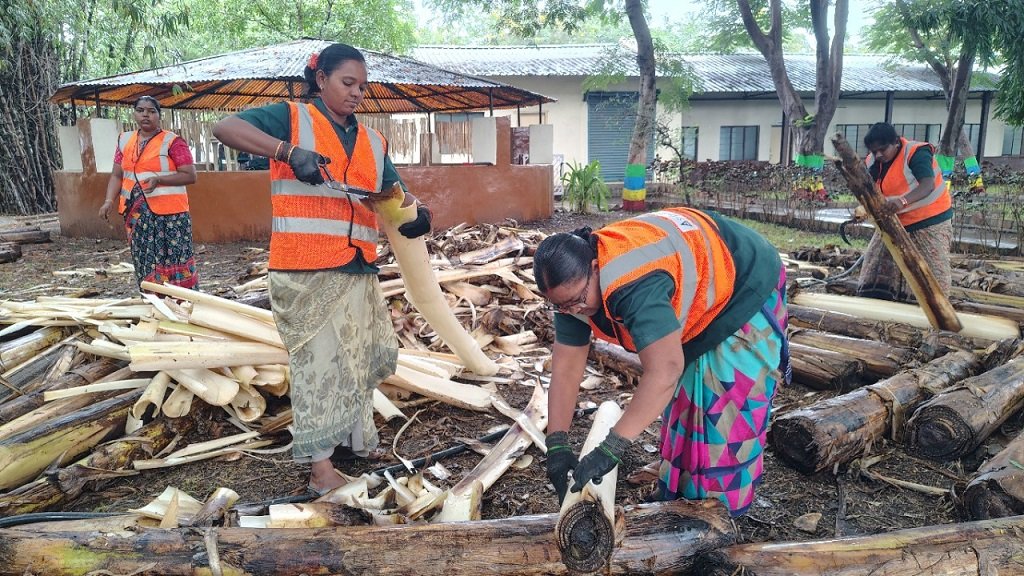



NEW DELHI (India CSR): UltraTech Cement’s Project Uday is transforming agricultural waste into a sustainable economic opportunity in Tadipatri, Andhra Pradesh, by converting banana pseudostem waste into eco-friendly products and organic inputs. The initiative has already diverted over 800 metric tons of waste from landfills while supporting livelihoods for 500 farmers and 100 women entrepreneurs.
Sustainable Rural Livelihoods
For UltraTech, this initiative strengthens its position as a sustainability-driven and socially responsible company, while enhancing its community engagement and brand reputation. It also aligns with circular economy goals and reduces environmental impact. By creating a scalable rural livelihood model, UltraTech not only contributes to waste management but also builds long-term value through inclusive growth and grassroots empowerment.
Banana Waste Potential
Tadipatri is a designated banana cluster under India’s Agri Export Policy, cultivating around 1,700 acres of banana plantations annually and generating an estimated 41,000 metric tons of pseudostem waste each year. Rich in fibre, sturdy, and biodegradable, pseudostem is well-suited for fibre extraction, composting, and value addition — a potential that Project Uday was designed to unlock.

Zero Waste Valuechain
The initiative was structured as an end-to-end zero-waste value chain, spanning pseudostem collection, fibre extraction, yarn making, weaving, and handicraft creation. APCW partnered with MusaFibral, a technical agency specialising in banana fibre extraction and product development, to establish production processes, set quality standards, and train participants. A second key partner, Vikasa Cooperative Society, a local women’s cooperative, handled community mobilisation and livelihood training.
Farmer Training Initiatives
Project Uday’s first phase trained around 500 farmers to convert banana residues into organic manure and liquid fertilisers, while encouraging them to share surplus biomass for further value addition. The second phase focused on women’s economic empowerment: 100 women from 10 local self-help groups were trained in pseudostem cutting, fibre extraction, weaving, and handicraft production. These women now produce eco-friendly handbags, baskets, laptop sleeves, wall décor, and office accessories. Residual biomass is recycled into compost, liquid fertiliser, and biogas, ensuring complete utilisation. Design guidance from the National Institute of Design (NID) and exposure visits to fibre enterprises in nearby Anantapur further strengthened product quality and market readiness.
Early Impact Results
Within its first three months (February–April 2025), Project Uday diverted over 800 metric tons of banana pseudostem from landfills and open burning. Finished products are marketed through Vikasa, as well as exhibitions and direct sales.
Women Led Ownership
Funded through the UltraTech Community Welfare Foundation (UCWF), the initiative adopted a ‘build–transfer–sustain’ model, enabling the 100 women to progressively take full ownership of the value chain, from sourcing raw materials to producing and marketing finished goods. Vikasa members have also been introduced to NABARD to explore future financial support and convergence mechanisms.
Scalable Rural Model
Project Uday demonstrates how agricultural waste can be transformed into sustainable livelihoods, offering a scalable, replicable model for rural development. The initiative will continue to expand in phases to cover all 2,500 banana-growing farmers in the region.
UltraTech CSR Outreach
UltraTech undertakes its social initiatives under the aegis of The Aditya Birla Centre for Community Initiatives and Rural Development, with Rajashree Birla as its Chairperson. UltraTech’s CSR focus areas are education, healthcare, sustainable livelihoods, community infrastructure, and social causes. UltraTech reaches out to more than 1.8 million beneficiaries in over 500 villages across 16 states in India.
(India CSR)