

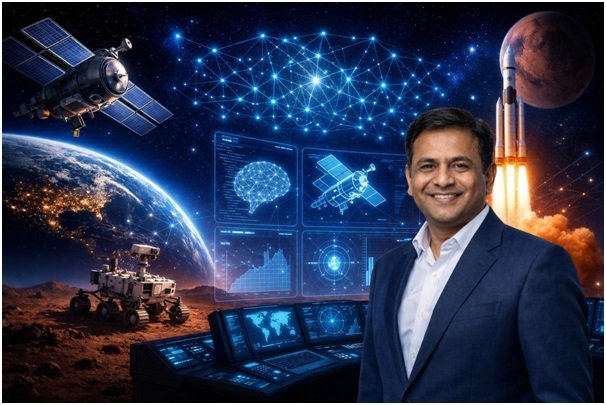



Artificial intelligence revolutionises space exploration. The faster, more accurate and efficient AI is becoming as missions get more challenging and more adventurous. According to Brijesh Goel, AI has become an essential part of space engineering, and it enables scientists and engineers to venture further into space by beating time, distance, and human constraints.
Increased autonomy and improved decision making
Autonomy is probably the most important influence of AI in space. Spacecraft and rovers are millions of kilometres distanced on earth, which adds communication delays. With the help of AI, spacecraft will be able to real-time analyse data and make decisions on their own. During NASA-directed missions, AI-based systems, as an example, assist Mars rovers to find their way through the terrain, evade risks, and take the best paths. Based on the information posted on Space.com, key features of the future deep-space missions are supposed to be autonomy.

Big data in space
Astronomy produces huge amounts of satellite, telescope and interplanetary data. This data is hardly a candidate to be processed manually. AI, machine learning, and deep learning can be used to detect patterns, anomalies, and discoveries. According to Brijesh Goel this has facilitated the discovery of exoplanets and enhanced our knowledge of galaxies. Innovations such as Planet Labs and Satellogic have already used AI to process satellite images and provide real-time information on what is happening on Earth.
Forecasted maintenance and mission safety
AI is an important predictive maintenance tool. Space equipment works under very adverse conditions and any small failures can result in loss of a mission. The AI systems keep market observation of spacecraft health, identify possible failures and suggest remedies. This lessens risk and provides more life to the mission. Rocket Lab and other space firms in the private sector are starting to incorporate AI into launch and spacecraft management to make it more reliable and safer.
Development of satellite and communications
Satellite communication, positioning and space traffic management are changing with AI. Smart satellite networks are capable of optimising communication, better weather prediction and even remote sensing. Organisations such as SpaceX and its Starlink constellation and Blue Origin are taking the frontiers of communications and infrastructure via satellites with novel technologies, such as AI-based optimisation.
Application of AI in space exploration in the future
In the future, AI will play a key role in missions that go outside the earth orbit. Others such as the Artemis II program are looking to send human beings on another trip to the Moon and ultimately send humans to Mars. As it has been emphasized in recent reports by Space.com, AI will help in navigation, habitat systems and mission planning. AI will prove to define interplanetary exploration, be it through autonomous spacecraft, or an intelligent habitat.
Conclusion
Finally, artificial intelligence is changing space exploration by creating greater autonomy, enhanced data processing and mission safety. According to Brijesh Goel, AI allows spacecraft to act autonomously, manage large datasets effectively and predictive maintenance to minimize risks. It is also the improved satellite applications and reinforced communication system both in space and terrestrial.
AI will soon lead to increasingly faster, safer and more efficient missions to deep space. The development of AI in space technology will keep growing with the contributions of organisations such as SpaceX, Blue Origin, Rocket Lab, Planet Labs and Satellogic. As artificial intelligence will aid the exploration of the unknown, it will open new findings and enlarge our knowledge about the universe.


