



This analysis delves into party-wise donations via electoral bonds to Indian political parties from 2017-18 to 2022-23, highlighting the significant role these bonds play in political financing.

NEW DELHI, India (India CSR): The Supreme Court of India on Feb 15, 2024, delivered a historic verdict, declaring the Electoral Bonds Scheme unconstitutional. In a unanimous decision, the Court ruled that the scheme undermines transparency in political funding, violating the fundamental right to information of Indian citizens.

Key Points of the Ruling
- Violation of Right to Information: The Court emphasized that voters have a constitutional right to know the sources of funding for political parties. The Electoral Bonds Scheme, by obscuring the identities of donors, prevents voters from making informed decisions during elections.
- Concerns of Corruption and Foreign Influence: The Court expressed concerns about the potential for corruption and undue influence by foreign entities facilitated by the anonymity of electoral bonds.
- Alternative Funding Mechanisms: The Court acknowledged the need for political funding but stressed that transparency and accountability must be paramount. It suggested exploring alternative funding mechanisms that uphold these principles.
Implications of the Decision
- Sale of Electoral Bonds Halted: The sale of future electoral bonds has been immediately halted.
- Disclosure of Past Transactions: The State Bank of India (SBI) has been ordered to provide details of all previously issued electoral bonds to the Election Commission of India (ECI), including purchaser information and the political parties who benefited.
- Increased Transparency: The decision is expected to usher in a new era of transparency in political funding, strengthening democratic processes in India.
Mix Reactions
Opposition parties and civil society organizations have widely hailed the judgment as a victory for democracy, while the ruling party has expressed disappointment. Experts predict the decision will spark intense debate and have far-reaching consequences on the political landscape of India.
****
Political Financing in India: A Critical Analysis
The analysis of donations through electoral bonds from 2017-18 to 2022-23 reveals a complex landscape of political financing in India. The BJP’s dominant share of donations points to its significant financial resources, which could have implications for electoral competitiveness. The varying amounts received by different parties underscore the diverse financial bases supporting India’s multi-party system.
The use of electoral bonds has undoubtedly brought a level of financial discipline to political donations. However, the ongoing debates around transparency and accountability in political funding suggest that this system is still evolving. The data presented in this analysis provides a foundation for understanding how political parties are financed in the current era, offering insights into the dynamics of electoral competitiveness and democratic governance in India.
The data, extracted from annual audit reports of the political parties, offers a transparent view of the monetary contributions made to these entities.
Introduction to Electoral Bonds
Electoral bonds serve as a mechanism for funding political parties in India. Introduced in 2018 to ensure transparency and accountability in political donations, these bonds allow donors to anonymously contribute to their party of choice. The anonymity aspect has been both praised for protecting donor identities and criticized for the potential lack of transparency it brings to the sources of party funding.
Our analysis focuses on the financial contributions received by major political parties through these bonds.
Party-wise Donation Trends
The Bharatiya Janata Party (BJP) emerged as the predominant beneficiary of electoral bond donations over the examined period. Starting with ₹210 crores in 2017-18, the party saw a significant increase in donations, peaking at ₹2,555 crores in 2019-20, before experiencing fluctuations in the subsequent years. This trend underscores the BJP’s strong financial backing through electoral bonds.
The Indian National Congress (INC) also received substantial donations, though not on the same scale as the BJP. Starting with a modest ₹5 crores in 2017-18, the INC’s donations through bonds saw a peak in 2018-19 at ₹383.26 crores. The data for 2021-22 and 2022-23 for INC, however, is not provided, indicating a potential decrease or undisclosed amounts in those years.
Other parties, such as the All India Trinamool Congress (AITC), the Yuvajana Sramika Rythu Congress Party (YSR-C), and the Biju Janata Dal (BJD), also received notable donations through electoral bonds, highlighting the widespread use of this funding mechanism across the political spectrum. The analysis shows that while the BJP and INC dominate the electoral bond landscape, other parties are also significant players in receiving donations.
Table 1. Donations Received by Political Parties (2016-17 to 2021-22)
| Party | 2016-17 | 2017-18 | 2018-19 | 2019-20 | 2020-21 | 2021-22 | Total |
|---|---|---|---|---|---|---|---|
| BJP | 515.50 | 400.20 | 698.14 | 720.41 | 416.79 | 548.81 | 3,299.85 |
| INC | 36.06 | 19.30 | 127.60 | 133.04 | 35.89 | 54.57 | 406.46 |
| NCP | 6.10 | 1.64 | 11.35 | 57.09 | 18.15 | 15.28 | 109.60 |
| CPI(M) | 3.56 | 0.87 | 1.19 | 6.92 | 9.82 | 6.81 | 29.16 |
| AITC | 2.03 | 0.00 | 42.99 | 4.50 | 0.00 | 0.25 | 49.77 |
| CPI | 0.003 | 0.003 | 0.00 | 0.00 | 0.00 | 0.00 | 0.01 |
| BSP | 0.00 | 0.00 | 0.00 | 0.00 | 0.00 | 0.00 | 0.00 |
| TOTAL | 563.25 | 422.01 | 881.26 | 921.95 | 480.65 | 625.72 | 3,894.84 |
As per the said table, the data shows that the party-wise donation by the corporate houses has been more or less stagnant from the years 2016-17 to 2021-22. We do not have the comments or official details in this regard from the Union of India or the ECI.
***
Donations Received by Political Parties -2016-17 to 2021-22
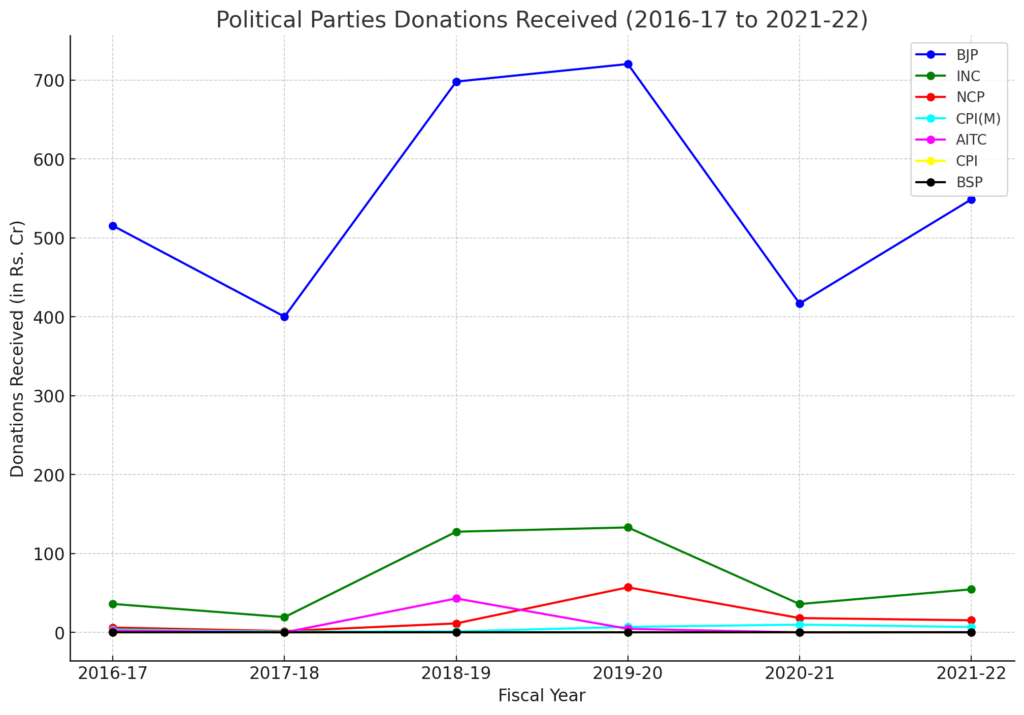
The graph above illustrates the trend of donations received by various political parties in India from the fiscal year 2016-17 to 2021-22. It is evident from the graph that the Bharatiya Janata Party (BJP) consistently received the highest amount of donations across all years, with peaks in the years 2018-19 and 2019-20. The Indian National Congress (INC) also shows a significant increase in donations received during 2018-19 and 2019-20, although the amounts are substantially lower than those received by the BJP.
Other parties like the Nationalist Congress Party (NCP), Communist Party of India (Marxist) [CPI(M)], and All India Trinamool Congress (AITC) have relatively lower and more variable donation trends over the years. Notably, the Communist Party of India (CPI) and the Bahujan Samaj Party (BSP) show minimal to no donations received during this period.
This visualization underscores the financial dynamics and disparities in political funding among India’s major political parties, highlighting the significant financial advantage enjoyed by the BJP and, to a lesser extent, the INC.
***
Analysis of BJP’s Donation Trends Through Electoral Bonds (2017-18 to 2022-23)
The Bharatiya Janata Party (BJP) has seen significant fluctuations in donations received through electoral bonds from the fiscal year 2017-18 to 2022-23. This analysis aims to visualize the trends in BJP’s funding over these years, providing insights into how political financing dynamics have evolved for India’s ruling party during this period.
Table 2. BJP’s Donation Trends Table
Here is a tabular representation of the donations received by the BJP through electoral bonds over the specified period:
| Fiscal Year | Donations Received (in Rs. Cr) |
|---|---|
| 2017-18 | 210.00 |
| 2018-19 | 1,450.89 |
| 2019-20 | 2,555.00 |
| 2020-21 | 22.385 |
| 2021-22 | 1,033.70 |
| 2022-23 | 1,294.15 |
BJP’s Donation Trends: Graphical Visualization
Here is a line graph to visualize the trends in BJP’s donations received through electoral bonds from 2017-18 to 2022-23. This will help in understanding our reader’s year-on-year fluctuations more clearly.
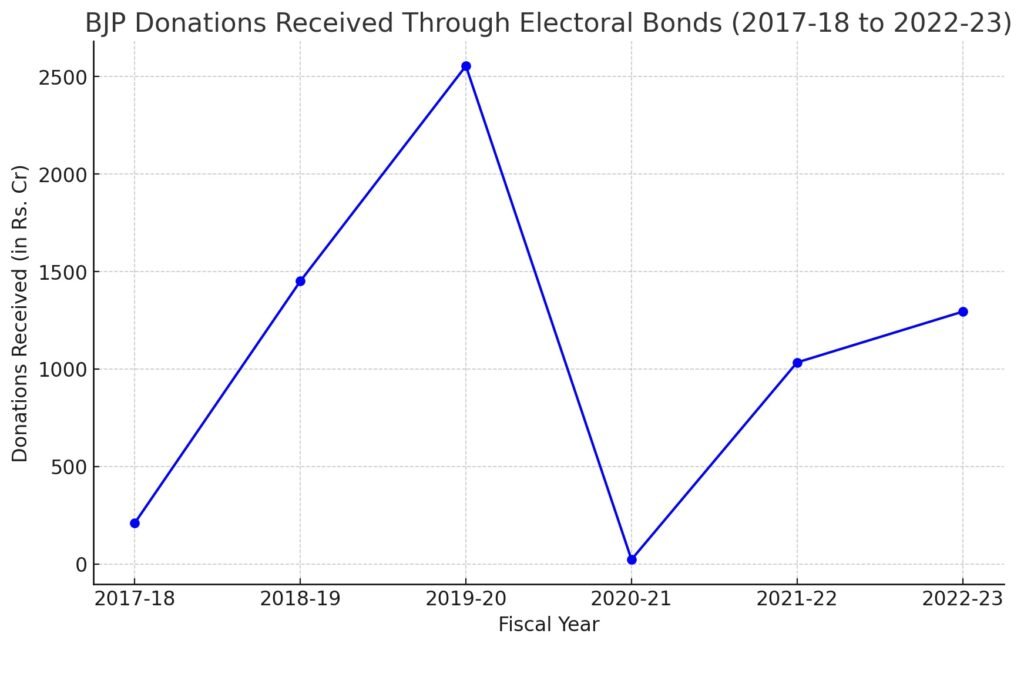
The line graph above illustrates the trends in donations received by the Bharatiya Janata Party (BJP) through electoral bonds from the fiscal year 2017-18 to 2022-23. There is a notable surge in donations in the years 2018-19 and 2019-20, with a peak in 2019-20 at approximately Rs. 2,555 crores.
This surge is followed by a sharp decline in 2020-21, where donations dropped to just over Rs. 22 crores. However, the following years show a recovery, with donations increasing to Rs. 1,033.70 crores in 2021-22 and further to Rs. 1,294.15 crores in 2022-23.
This trend suggests that while there might be fluctuations in the donations received through electoral bonds, the BJP has consistently remained a major beneficiary of this funding mechanism. The sharp decline in 2020-21 could be attributed to various factors, including economic conditions or changes in donor strategies, which warrants further investigation. Nonetheless, the overall upward trajectory in the latter years indicates sustained financial support for the BJP through electoral bonds.
***
Analyzing the Denomination-Wise Sale of Electoral Bonds
The denomination-wise sale of Electoral Bonds from March 2018 to July 2023 provides critical insights into the dynamics of political funding in India.
Electoral Bonds Sales Dynamics
Electoral Bonds (EBs) have been a significant method for political funding in India since their inception in March 2018. Through 27 phases, spanning from March 2018 to July 2023, these bonds have provided a structured, albeit controversial, channel for financial contributions to political parties. This analysis aims to dissect the denomination-wise sale of EBs, shedding light on the preferences of donors and the overarching trends in political funding through this mechanism.
Denomination Breakdown and Insights
The sale of Electoral Bonds has been varied across different denominations, indicating distinct preferences among donors towards the sizes of their contributions. A total of 24,012 Electoral Bonds were sold, amounting to a staggering 13,791.8979 Crore INR. Here’s a detailed breakdown:
- 1 Crore Denomination: This category saw the highest amount of funds being channelized, with 12,999 bonds sold, constituting 54.13% of the total number of bonds. In terms of monetary value, these bonds accounted for a whopping 94.25% of the total funds, amounting to 12,999 Crore INR. This trend underscores the substantial role that large donations play in political funding through EBs.
- 10 Lakhs Denomination: There were 7,618 bonds sold in this category, making up 31.72% of the total bonds. However, in terms of value, these contributed to a much smaller portion of the overall funds, totaling 761.80 Crore INR (5.52%).
- 1 Lakh Denomination: Representing a middle ground, 3,088 bonds were sold under this denomination, accounting for 12.86% of the total. The total amount raised through this category was 30.88 Crore INR, which is only 0.22% of the total funds.
- 10 Thousand Denomination: With 208 bonds sold (0.86% of the total), this category raised 20.80 Lakh INR, a mere 0.001% of the overall funds.
- 1 Thousand Denomination: The smallest denomination saw the least number of bonds sold at 99, contributing to 0.41% of the total, and raised a negligible amount of 20.80 Lakh INR.
Table: 3. Table of Denomination Wise Sale of Electoral Bonds
| Denomination | No. of Electoral Bonds Sold | Amount (In Rupees) |
|---|---|---|
| 1 Crore | 12,999 (54.13%) | 12,999 Crore (94.25%) |
| 10 Lakhs | 7,618 (31.72%) | 761.80 Crore (5.52%) |
| 1 Lakh | 3,088 (12.86%) | 30.88 Crore (0.22%) |
| 10 Thousand | 208 (0.86%) | 20.80 Lakh (0.001%) |
| 1 Thousand | 99 (0.41%) | 20.80 Lakh (0.001%) |
| Total | 24,012 | 13,791.8979 Cr. |
“Analysis of this data shows that more than 50% of the Bonds in number, and 94% of the Bonds in value terms were for Rs.1 crore. This supports our reasoning and conclusion on the application of the doctrine of proportionality. This is indicative of the quantum of corporate funding through the anonymous Bonds.” – Supreme Court, 15 Feb 2024
Insightful Infographic Analysis
The distribution of Electoral Bonds sales, both in terms of quantity and monetary value, reveals a clear preference for larger denominations among donors. The stark contrast between the number of bonds sold and the total amount raised in each category highlights a concentration of political funding from entities capable of making substantial contributions.
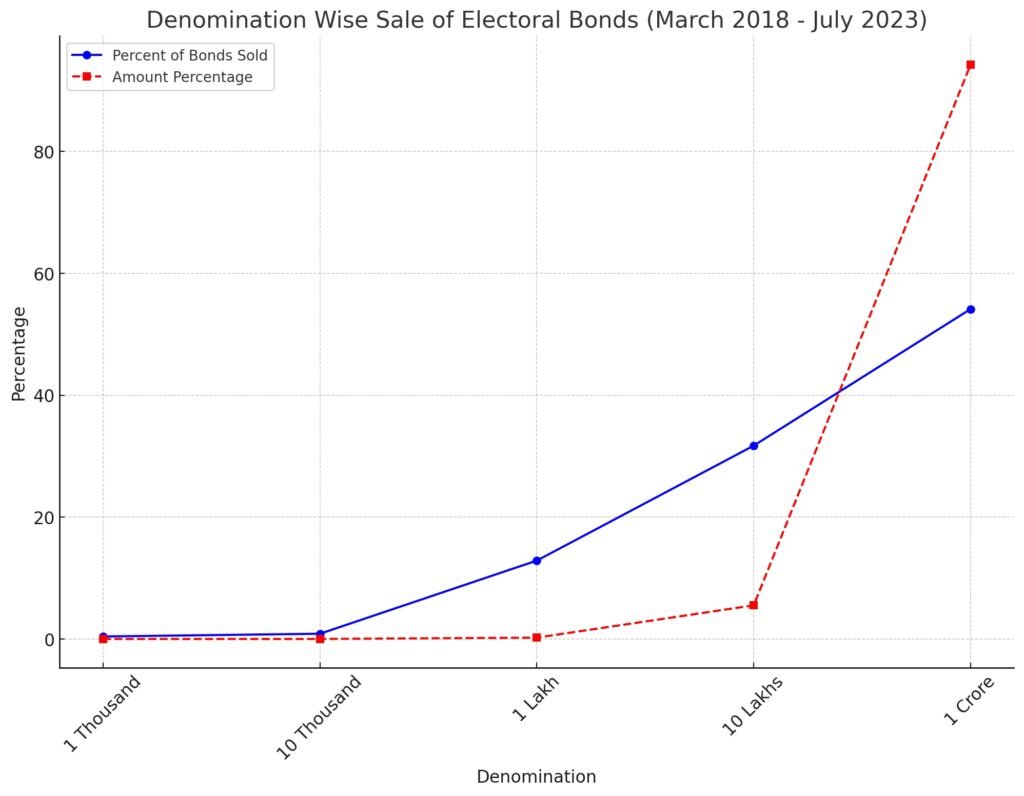
The overwhelming dominance of the 1 Crore denomination bonds in terms of value indicates that the bulk of political funding through EBs comes from a relatively small number of high-value donors. This trend raises important questions about the influence of wealth in political financing and the transparency of such contributions.
***
Increasing Obscurity: The Growth of Unknown Income Sources in National Political Parties (2014-2022)
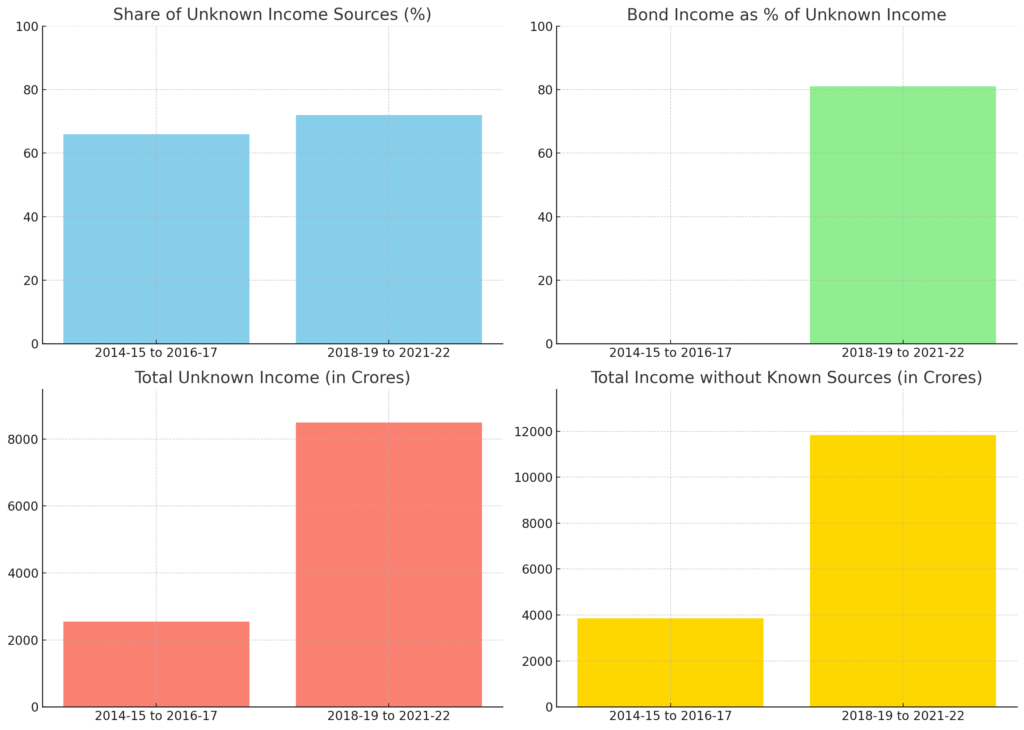
Here’s a graph based on the provided data (Table 3), illustrating the changes in the financial dynamics of national political parties in India over two distinct periods: 2014-15 to 2016-17 and 2018-19 to 2021-22. It showcases the shifts in the share of income from unknown sources, the bond income as a percentage of unknown income, the total unknown income, and the total income without known sources for national parties. This visual representation highlights the significant increase in reliance on bonds and unknown sources for financing political activities over these periods.
Trends in Unknown Income Sources of National Political Parties
The share of income from unknown sources for national parties witnessed a notable increase, rising from 66% in the period of 2014-15 to 2016-17 to 72% during the years 2018-19 to 2021-22. This shift underscores a growing opacity in the financial underpinnings of India’s major political entities.
Electoral Bonds and Unknown Income
Between the fiscal years 2019-20 and 2021-22, income derived from electoral bonds significantly contributed to the unknown income of national parties, accounting for 81% of it. This marks a substantial reliance on electoral bonds as a primary source of undisclosed funding.
Increase in Total Unknown Income
The total unknown income, encompassing donations under Rs.20,000, sales of coupons, and other untraceable sources, has seen a marked increase. From Rs.2,550 crores during 2014-15 to 2016-17, it surged to Rs.8,489 crores in the period of 2018-19 to 2021-22, highlighting a significant rise in contributions that bypass transparency norms.
Overall Financial Growth of National Parties
Adding to the complexity, the total income of national political parties, excluding other known sources, rose from Rs.3,864 crores in 2014-15 to 2016-17 to Rs.11,829 crores during 2018-19 to 2021-22. Notably, the income from bonds between 2018-19 and 2021-22 constituted 58% of the total income of these parties, indicating a substantial dependence on this form of funding.
About the Author
Rusen Kumar, a renowned journalist- Founder and Managing Editor of India CSR.
About the image: ChatGPT created an abstract visualizations that reflect the theme of political leadership in India, blending both traditional and contemporary elements.
(Copyright – All infographics)
Copyright@IndiaCSR